Fossil footprints give land vertebrates a much longer history
January 6, 2010
Fossilised footprints, found in a Polish quarry, of an enigmatic, long-extinct creature have prompted palaeontologists to reopen the file of how life in the sea moved to the land.
The discovery of fossil footprints from early backboned land animals in Poland leads to the sensational conclusion that our ancestors left the water at least 18 million years earlier than previously thought. The results of the Polish-Swedish collaboration are published online this week in Nature.
"These results force us to reconsider our whole picture of the transition from fish to land animals," says Per Ahlberg of Uppsala University, one of the two leaders of the study.
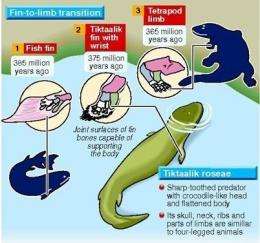
For nearly eighty years, palaeontologists have been scouring the planet for fossil bones and skeletons of the earliest land vertebrates or "tetrapods" - the ultimate progenitors of all later amphibians, reptiles, birds and mammals including ourselves. Their discoveries have suggested that the first tetrapods evolved relatively rapidly from lobe-finned fishes, through a short-lived intermediate stage represented by "elpistostegids" such as Tiktaalik, about 380 million years ago.
But there is another potential source of information about the earliest tetrapods: the fossilized footprints they left behind. In the new study a Polish-Swedish team describe a rich and securely dated footprint locality from Zachelmie Quarry in Poland that pushes back the origin of tetrapods a full 18 million years beyond the earliest skeletal evidence and forces a dramatic reassessment of the transition from water to land.
The trackways show that large tetrapods, up to three metres in length, inhabited the marine intertidal zone during the early Middle Devonian some 395 million years ago.
"This means not that not only tetrapods but also elpistostegids originated much earlier than we thought, because the position of elpistostegids as evolutionary precursors of tetrapods is not in doubt, and so they must have existed at least as long," says Per Ahlberg.
The elpistostegids, it seems, were not at all a short-lived transitional stage but must have existed alongside their descendants the tetrapods for at least 10 million years. The environment is also a major surprise: almost all previous scenarios for the origin of tetrapods have placed this event in a freshwater setting and have associated it with the development of land vegetation and a terrestrial ecosystem.
"Instead, our distant ancestors may first have left the water in order to feed on stranded marine life left behind by the receding tide," says Per Ahlberg.
Provided by Uppsala University
-
Ancient fossils shed light on anatomical changes accompanying evolution of first land vertebrates
Jul 06, 2009 |
not rated yet |
0
-
Fossils suggest earlier land-water transition of tetrapod
Apr 17, 2009 |
not rated yet |
0
-
Earliest evidence for reptiles
Oct 17, 2007 |
not rated yet |
0
-
Chinese report important fish fossil find
May 05, 2006 |
not rated yet |
0
-
Dinosaur prints found on NZealand's South Island
Nov 07, 2009 |
not rated yet |
0
-
Engineers build first sub-10-nm carbon nanotube transistor
Feb 01, 2012 |
4.9 / 5 (31) |
30
-
Something old, something new: Evolution and the structural divergence of duplicate genes
Jan 31, 2012 |
4.6 / 5 (7) |
1
-
The hidden nanoworld of ice crystals: Revealing the dynamic behavior of quasi-liquid layers
Jan 30, 2012 |
5 / 5 (3) |
1
-
Stock market network reveals investor clustering
Jan 27, 2012 |
3.9 / 5 (23) |
8
-
Of microchemistry and molecules: Electronic microfluidic device synthesizes biocompatible probes
Jan 26, 2012 |
5 / 5 (1) |
0
-
Mitosis
4 hours ago
-
Stem cell question.
5 hours ago
-
Protease cleavage
12 hours ago
-
Pertubance in a model
18 hours ago
-
Cancer drugs and Alzheimer's, Oh my!
Feb 09, 2012
-
Squishing cells
Feb 09, 2012
- More from Physics Forums - Biology
More news stories
A frank discussion of the power law and linking correlation to causation
(PhysOrg.com) -- Michael Stumpf a mathematics professor at Imperial College in London, and Mason Porter a lecturer at Oxford have teamed together to write and publish a perspective piece in Science regarding the in ...
Employers feel no love for unscrupulous practice of 'service sweethearting'
A new study led by two Florida State University marketing professors finds that some frontline service employees who are rewarded for hikes in customer loyalty and satisfaction also may engage in "service ...
Other Sciences / Economics & Business
12 hours ago |
4 / 5 (1) |
5
The question of life in the ancient world
Theres a general feeling that we dont get the Greeks ancient or modern. Many, including heads of state like Angela Merkel, visibly shake their head in exasperation, rightly or wrongly, at ...
Other Sciences / Archaeology & Fossils
18 hours ago |
1.3 / 5 (3) |
4
Sonic Cradle lands spot in TED exhibition
A Simon Fraser University graduate student project that melds music, meditation and modern technology has landed a rare spot as an exhibit at TEDActive 2012 in Palm Springs, California this month.
14 hours ago |
not rated yet |
0
Do we no longer care about the collective good?
The Transformation of Solidarity, a book co-edited by University of Queensland sociologist Dr Mara Yerkes, tackles the subject of globalisation of national economies and societies where we put a high value ...
Other Sciences / Social Sciences
Feb 06, 2012 |
3.9 / 5 (8) |
39
Anonymous knocks CIA website offline (Update)
The website of the Central Intelligence Agency was inaccessible on Friday after the hacker group Anonymous claimed to have knocked it offline.
Google users warned of threat to smartphone wallets
Users of Google smartphone wallets were being warned on Friday that there is a way to crack pass codes intended to thwart thieves from going on illicit shopping sprees.
New error-correcting codes guarantee the fastest possible rate of data transmission
Error-correcting codes are one of the triumphs of the digital age. Theyre a way of encoding information so that it can be transmitted across a communication channel such as an optical fiber o ...
Humans may have helped the decline of African rainforests 3000 years ago
(PhysOrg.com) -- Large areas of rainforests in Central Africa mysteriously disappeared over three thousand years ago, to be replaced by savannas. The prevailing theory has been that the cause was a change ...
New power source discovered
(PhysOrg.com) -- Researchers at the Massachusetts Institute of Technology (MIT) and RMIT University have made a breakthrough in energy storage and power generation.
Small modular reactor design could be a 'SUPERSTAR'
(PhysOrg.com) -- Though most of today's nuclear reactors are cooled by water, we've long known that there are alternatives; in fact, the world's first nuclear-powered electricity in 1951 came from a reactor ...