Iowa State physicists beginning to see data from the Large Hadron Collider
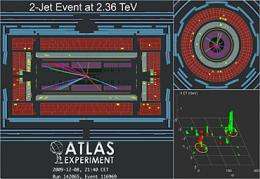
(PhysOrg.com) -- Three Iowa State University physicists who took winter trips to the Large Hadron Collider for meetings and experimental work are starting to see real data from the planet's biggest science experiment. Finally.
The multibillion-dollar collider made international news on Sept. 10, 2008, when it sent its first beam of protons around 17 miles of underground tunnel near Geneva, Switzerland. But breakdowns in the machine's high-current electrical connections forced a complete shutdown for more than a year of repairs and tests.
Physicists from around the world cheered on Nov. 20, 2009, when the collider once again sent protons racing through its tunnel. Three days later the machine recorded its first proton-proton collisions. And on Nov. 30 it set a new world record when it accelerated two beams of protons to a total energy of 2.36 trillion electron volts.
Physicists at CERN, the European Organization for Nuclear Research, shut down the collider on Dec. 16 to prepare for even higher energy collisions later this year.
"The data look just beautiful," said Soeren Prell, an Iowa State associate professor of physics and astronomy.
Prell has been looking at the first data recorded with the ATLAS experiment's silicon pixel detector. The pixel detector is the innermost part of ATLAS, one of two giant, general purpose detectors at the collider. ATLAS will measure the paths, energies and identities of the particles created when protons or lead ions collide at unprecedented energies. The pixel detector uses 80 million pixels to make precise measurements as close to the particle collisions as possible.
Prell said the pixel detector is already sending physicists fairly clean data with very little background noise. But, he said, physicists still have to work to make sure the pixel detector is properly aligned and calibrated. It has a resolution down to 10 millionths of a meter and so it has to be just as precisely aligned.
The detector's data also has to be distributed to physicists around the world for study and analysis. Jim Cochran, an associate professor of physics and astronomy, is the ATLAS experiment's analysis support manager for the United States. It's his job to make sure researchers have the data they need for their analyses.
And, so far, the experiment's analysis system has been able to keep up with the data. But that's going to be a bigger challenge when the collider is turned back on in February and begins running at higher energies and much higher collision rates.
"One of the concerns I've had is whether we'll be able to handle the data loads we're expecting," Cochran said. "We have to have our computing systems optimized so we can do it. We've already had 700,000 collision events, and that's nothing compared to what's coming."
That's just one of the reasons Chunhui Chen, an assistant professor of physics and astronomy, is telling people that big, new, Nobel-winning physics from the Large Hadron Collider won't happen right away. There's just too much data to collect, distribute and analyze.
But, "This is a very big moment," said Chen, who's working on the ATLAS experiment's pixel detector and the ATLAS trigger system that recognizes and records interesting collision events. "Potentially, we'll be able to see some new physics."
That could include the Higgs boson, a particle predicted by the Standard Model of particle physics. The model theorizes that space is filled with a Higgs field and particles acquire their masses by interacting with the field. Detection and study of the Higgs could answer basic questions about why matter has mass and how particles acquire mass.
Physicists also hope the higher energies made possible by the Large Hadron Collider could answer big physics questions about matter and antimatter, dark matter, supersymmetry, extra dimensions, a grand unified theory or perhaps something entirely unexpected.
"One hundred years ago physicists discovered special relativity and quantum mechanics," Chen said. "We know our understanding of physics is incomplete. We don't know what's beyond our understanding. And so this is going to be a long research program. It will take years of dedicated study to really unearth the secrets of the universe."
More information: public.web.cern.ch/public/en/LHC/LHC-en.html
Provided by Iowa State University


