Massive Stars: Good Targets for Planet Hunts, Bad Targets for SETI
January 6, 2010
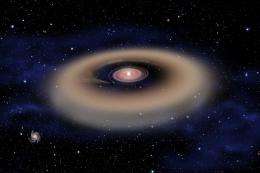
This artist's conception shows a Jupiter-sized planet forming from a disk of dust and gas surrounding a young, massive star. The planet's gravity has cleared a gap in the disk. Of more than 500 stars examined in the W5 star-forming region, 15 show evidence of central clearing that may be due to forming planets. Credit: David A. Aguilar, CfA
(PhysOrg.com) -- Most searches for planets around other stars, also known as exoplanets, focus on Sun-like stars. Those searches have proven successful, turning up more than 400 alien worlds. However, Sun-like stars aren't the only potential homes for planets. New research by astronomers at the Harvard-Smithsonian Center for Astrophysics (CfA) and the National Optical Astronomy Observatory (NOAO) confirms that planet formation is a natural by-product of star formation, even around stars much heftier than the Sun.
"We see evidence of planet formation on fast forward," said Xavier Koenig of the CfA, who presented the research in a press conference today at the 215th meeting of the American Astronomical Society.
Koenig and his colleagues examined the star-forming region named W5, which lies about 6,500 light-years away in the constellation Cassiopeia. They employed NASA's Spitzer Space Telescope and the ground-based Two Micron All-Sky Survey (2MASS) to look for infrared evidence of dusty planet-forming disks. They targeted over 500 type A and B stars, which are about two to 15 times as massive as the Sun. Sirius and Vega, not included in this study, are two type A stars easily visible to backyard skygazers.
The team found that about one-tenth of the stars examined appear to possess dusty disks. Of those, 15 showed signs of central clearing, which suggests that newborn Jupiter-sized planets are sucking up material.
"The gravity of a Jupiter-sized object could easily clear the inner disk out to a radius of 10 to 20 astronomical units, which is what we see," said Lori Allen of NOAO. (An astronomical unit is the average Earth-Sun distance of 93 million miles.)
Planet formation around A and B stars is a battle between opposing forces. On one hand, the stars' disks tend to be more massive and contain more of the raw materials to build planets. On the other hand, fierce stellar radiation and winds try to destroy the disks rapidly.
The stars in W5 are only about two to five million years old, yet most have already lost the raw materials needed to form planets. This indicates that, at least for type A and B stars, planets must form quickly or not at all.
The prospects for hypothetical alien life are disappointing. The habitable zone, or region where liquid water could exist on a rocky surface, is at a greater distance from the star for A and B stars than for sun-like stars due to their greater luminosity. However, that luminosity comes at the price of a short lifetime. A and B stars live for only about 10 - 500 million years before running out of fuel.
Life existed on Earth for 3.5 billion years in very simple forms, before the Cambrian explosion led to the diversity of life forms we see today. Planets in W5 around these more massive stars wouldn't have that opportunity.
"These stars aren't good targets in the hunt for extraterrestrials," said Koenig, "but they give us a great new way to get a better understanding of planet formation."
Provided by Harvard-Smithsonian Center for Astrophysics (news : web)
-
Planets Living on the Edge
Dec 17, 2008 |
not rated yet |
0
-
Baby Jupiters must gain weight fast
Jan 05, 2009 |
not rated yet |
0
-
Making Jupiters
Aug 21, 2009 |
not rated yet |
0
-
Planetary systems can form around binary stars
Jan 10, 2006 |
not rated yet |
0
-
Jupiter-like planets could form around twin suns
Jan 05, 2009 |
not rated yet |
0
-
Engineers build first sub-10-nm carbon nanotube transistor
Feb 01, 2012 |
4.9 / 5 (31) |
30
-
Something old, something new: Evolution and the structural divergence of duplicate genes
Jan 31, 2012 |
4.6 / 5 (7) |
1
-
The hidden nanoworld of ice crystals: Revealing the dynamic behavior of quasi-liquid layers
Jan 30, 2012 |
5 / 5 (3) |
1
-
Stock market network reveals investor clustering
Jan 27, 2012 |
3.9 / 5 (23) |
8
-
Of microchemistry and molecules: Electronic microfluidic device synthesizes biocompatible probes
Jan 26, 2012 |
5 / 5 (1) |
0
-
Scale of the Universe
7 hours ago
-
Titan's lack of impact craters
Feb 09, 2012
-
Real pictures of black hole eating a star?
Feb 08, 2012
-
Hypothetical way to travel faster than light, but not technically exceed lightspeed
Feb 06, 2012
-
How do scientists monitor the Sun's activity?
Feb 05, 2012
-
Search patterns in observational studies
Feb 05, 2012
- More from Physics Forums - General Astronomy
More news stories
Humans may have helped the decline of African rainforests 3000 years ago
(PhysOrg.com) -- Large areas of rainforests in Central Africa mysteriously disappeared over three thousand years ago, to be replaced by savannas. The prevailing theory has been that the cause was a change ...
Could Venus be shifting gear?
(PhysOrg.com) -- ESAs Venus Express spacecraft has discovered that our cloud-covered neighbour spins a little slower than previously measured. Peering through the dense atmosphere in the infrared, the ...
Space & Earth / Space Exploration
14 hours ago |
5 / 5 (7) |
7
|
NASA budget will axe Mars deal with Europe: scientists
US President Barack Obama's budget proposal to be submitted next week for 2013 will cut NASA's budget by 20 percent and eliminate a major partnership with Europe on Mars exploration, scientists said Thursday.
Space & Earth / Space Exploration
17 hours ago |
5 / 5 (2) |
18
Mars Science Laboratory computer issue resolved
(PhysOrg.com) -- Engineers have found the root cause of a computer reset that occurred two months ago on NASA's Mars Science Laboratory and have determined how to correct it.
Space & Earth / Space Exploration
15 hours ago |
4.7 / 5 (6) |
3
|
NASA sees wide-eyed cyclone Jasmine
Cyclone Jasmine's eye has opened wider on NASA satellite imagery, as it moves through the Southern Pacific Ocean.
Space & Earth / Earth Sciences
6 hours ago |
3.5 / 5 (2) |
1
Google users warned of threat to smartphone wallets
Users of Google smartphone wallets were being warned on Friday that there is a way to crack pass codes intended to thwart thieves from going on illicit shopping sprees.
Anonymous knocks CIA website offline (Update)
The website of the Central Intelligence Agency was inaccessible on Friday after the hacker group Anonymous claimed to have knocked it offline.
New error-correcting codes guarantee the fastest possible rate of data transmission
Error-correcting codes are one of the triumphs of the digital age. Theyre a way of encoding information so that it can be transmitted across a communication channel such as an optical fiber o ...
Complex wiring of the nervous system may rely on a just a handful of genes and proteins
Researchers at the Salk Institute have discovered a startling feature of early brain development that helps to explain how complex neuron wiring patterns are programmed using just a handful of critical genes. ...
New power source discovered
(PhysOrg.com) -- Researchers at the Massachusetts Institute of Technology (MIT) and RMIT University have made a breakthrough in energy storage and power generation.
The power of estrogen -- male snakes attract other males
A new study has shown that boosting the estrogen levels of male garter snakes causes them to secrete the same pheromones that females use to attract suitors, and turned the males into just about the sexiest ...