WISE Eye Spies First Glimpse of the Starry Sky
January 6, 2010
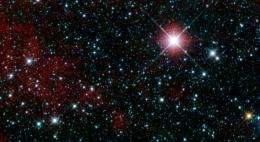
This infrared snapshot of a region in the constellation Carina near the Milky Way was taken shortly after NASA's Wide-field Infrared Survey Explorer (WISE) ejected its cover. Image credit: NASA/JPL-Caltech/UCLA
(PhysOrg.com) -- NASA's Wide-field Infrared Survey Explorer, or WISE, has captured its first look at the starry sky that it will soon begin surveying in infrared light.
Launched on Dec. 14, WISE will scan the entire sky for millions of hidden objects, including asteroids, "failed" stars and powerful galaxies. WISE data will serve as navigation charts for other missions, such as NASA's Hubble and Spitzer Space Telescopes, pointing them to the most interesting targets the mission finds.
A new WISE infrared image was taken shortly after the space telescope's cover was removed, exposing the instrument's detectors to starlight for the first time. The picture shows about 3,000 stars in the Carina constellation and can be viewed online at http://www.nasa.go … 0100106.html .
The image covers a patch of sky about three times larger than the full moon, and was presented today at the 215th meeting of the American Astronomical Society in Washington. The patch was selected because it does not contain any unusually bright objects, which could damage instrument detectors if observed for too long. The picture was taken while the spacecraft was staring at a fixed patch of sky and is being used to calibrate the spacecraft's pointing system.
When the WISE survey begins, the spacecraft will scan the sky continuously as it circles the globe, while an internal scan mirror counteracts its motion. This allows WISE to take "freeze-frame" snapshots every 11 seconds, resulting in millions of images of the entire sky.
"Right now, we are busy matching the rate of the scan mirror to the rate of the spacecraft, so we will capture sharp pictures as our telescope sweeps across the sky," said William Irace, the mission's project manager at NASA's Jet Propulsion Laboratory in Pasadena, Calif.
To sense the infrared glow of stars and galaxies, the WISE spacecraft cannot give off any detectable infrared light of its own. This is accomplished by chilling the telescope and detectors to ultra-cold temperatures. The coldest of WISE's detectors will operate at less than 8 Kelvin, or minus 445 degrees Fahrenheit.
The first sky survey will be complete in six months, followed by a second scan of one-half of the sky lasting three months. The mission ends when the frozen hydrogen that keeps the instrument cold evaporates away, an event expected to occur in October 2010.
Preliminary survey images are expected to be released six months later, in April 2011, with the final atlas and catalog coming 11 months later, in March 2012. Selected images will be released to the public beginning in February 2010.
-
NASA's WISE Space Telescope Jettisons Its Cover
Dec 30, 2009 |
not rated yet |
0
-
WISE satellite blasts off on space-map mission
Dec 14, 2009 |
not rated yet |
0
-
NASA's Wise Gets Ready to Survey the Whole Sky (w/ Video)
Nov 17, 2009 |
not rated yet |
0
-
NASA to launch sky-mapping spacecraft
Dec 06, 2009 |
not rated yet |
0
-
NASA's WISE Mission Arrives at Launch Site
Aug 17, 2009 |
not rated yet |
0
-
Engineers build first sub-10-nm carbon nanotube transistor
Feb 01, 2012 |
4.9 / 5 (31) |
30
-
Something old, something new: Evolution and the structural divergence of duplicate genes
Jan 31, 2012 |
4.6 / 5 (7) |
1
-
The hidden nanoworld of ice crystals: Revealing the dynamic behavior of quasi-liquid layers
Jan 30, 2012 |
5 / 5 (3) |
1
-
Stock market network reveals investor clustering
Jan 27, 2012 |
3.9 / 5 (23) |
8
-
Of microchemistry and molecules: Electronic microfluidic device synthesizes biocompatible probes
Jan 26, 2012 |
5 / 5 (1) |
0
-
Scale of the Universe
7 hours ago
-
Titan's lack of impact craters
Feb 09, 2012
-
Real pictures of black hole eating a star?
Feb 08, 2012
-
Hypothetical way to travel faster than light, but not technically exceed lightspeed
Feb 06, 2012
-
How do scientists monitor the Sun's activity?
Feb 05, 2012
-
Search patterns in observational studies
Feb 05, 2012
- More from Physics Forums - General Astronomy
More news stories
Humans may have helped the decline of African rainforests 3000 years ago
(PhysOrg.com) -- Large areas of rainforests in Central Africa mysteriously disappeared over three thousand years ago, to be replaced by savannas. The prevailing theory has been that the cause was a change ...
Could Venus be shifting gear?
(PhysOrg.com) -- ESAs Venus Express spacecraft has discovered that our cloud-covered neighbour spins a little slower than previously measured. Peering through the dense atmosphere in the infrared, the ...
Space & Earth / Space Exploration
14 hours ago |
5 / 5 (7) |
7
|
NASA budget will axe Mars deal with Europe: scientists
US President Barack Obama's budget proposal to be submitted next week for 2013 will cut NASA's budget by 20 percent and eliminate a major partnership with Europe on Mars exploration, scientists said Thursday.
Space & Earth / Space Exploration
17 hours ago |
5 / 5 (2) |
18
Mars Science Laboratory computer issue resolved
(PhysOrg.com) -- Engineers have found the root cause of a computer reset that occurred two months ago on NASA's Mars Science Laboratory and have determined how to correct it.
Space & Earth / Space Exploration
15 hours ago |
4.7 / 5 (6) |
3
|
NASA sees wide-eyed cyclone Jasmine
Cyclone Jasmine's eye has opened wider on NASA satellite imagery, as it moves through the Southern Pacific Ocean.
Space & Earth / Earth Sciences
6 hours ago |
3.5 / 5 (2) |
1
Google users warned of threat to smartphone wallets
Users of Google smartphone wallets were being warned on Friday that there is a way to crack pass codes intended to thwart thieves from going on illicit shopping sprees.
Anonymous knocks CIA website offline (Update)
The website of the Central Intelligence Agency was inaccessible on Friday after the hacker group Anonymous claimed to have knocked it offline.
New error-correcting codes guarantee the fastest possible rate of data transmission
Error-correcting codes are one of the triumphs of the digital age. Theyre a way of encoding information so that it can be transmitted across a communication channel such as an optical fiber o ...
Complex wiring of the nervous system may rely on a just a handful of genes and proteins
Researchers at the Salk Institute have discovered a startling feature of early brain development that helps to explain how complex neuron wiring patterns are programmed using just a handful of critical genes. ...
New power source discovered
(PhysOrg.com) -- Researchers at the Massachusetts Institute of Technology (MIT) and RMIT University have made a breakthrough in energy storage and power generation.
The power of estrogen -- male snakes attract other males
A new study has shown that boosting the estrogen levels of male garter snakes causes them to secrete the same pheromones that females use to attract suitors, and turned the males into just about the sexiest ...