Massive white dwarf in our galaxy may go supernova
January 7, 2010 by Lin Edwards
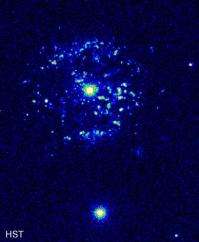
Hubble telescope picture of T Pyxidis, from a compilation of data taken on Feb. 26, 1994, and June 16, Oct. 7, and Nov. 10, 1995, by the Wide Field and Planetary Camera 2. Credit: NASA
(PhysOrg.com) -- A massive white dwarf star in our galaxy may become a supernova several million years from now, and could damage the Earth and possibly destroy life on Earth.
Scientists at the American Astronomical Society's 215th meeting, in Washington DC, said earlier this week that new observations of T Pyxidis in the constellation Pyxis (the compass) using the International Ultraviolet Explorer satellite, indicate the white dwarf is part of a close binary system with a sun, and the pair are 3,260 light-years from Earth and much closer than the previous estimate of 6,000 light-years.
The white dwarf in the T Pyxidis system is a recurrent nova, which means it undergoes nova (thermonuclear) eruptions around every 20 years. The most recent known events were in 1967, 1944, 1920, 1902, and 1890. These explosions are nova rather than supernova events, and do not destroy the star, and have no effect on Earth. The astronomers do not know why the there has been a longer than usual interval since the last nova eruption.
Astronomers believe the nova explosions are the result of an increase of mass as the dwarf siphons off hydrogen-rich gases from its stellar companion. When the mass reaches a certain limit a nova is triggered. It is unknown whether there is a net gain or loss of mass during the siphoning/explosion cycle, but if the mass does build up the so-called Chandrasekhar Limit could be reached, and the dwarf would then become a Type 1a supernova. In this event the dwarf would collapse and detonate a massive explosion resulting in its total destruction. This type of supernova releases 10 million times the energy of a nova.
Observations of the white dwarf during the nova eruptions suggest its mass is increasing, and pictures from the Hubble telescope of shells of material expelled during the previous explosions support the view. Models estimate the white dwarf's mass could reach the Chandrasekhar Limit in around 10 million years or less.
According to the scientists the supernova would result in gamma radiation with an energy equivalent to 1,000 solar flares simultaneously - enough to threaten Earth by production of nitrous oxides that would damage and perhaps destroy the ozone layer. The supernova would be as bright as all the other stars in the Milky Way put together. One of the astronomers, Dr Edward Sion, from Villanova University in Pennsylvania, said the supernova could occur "soon" on the timescales familiar to astronomers and geologists, but this is a long time in the future in human terms.
Astronomers think supernova explosions closer than 100 light years from Earth would be catastrophic, but the effects of events further away are unclear and would depend on how powerful the supernova is. The research team postulate it could be close enough and powerful enough to damage Earth, possibly severely, although other researchers, such as Professor Fillipenko of the Berkeley Astronomy Department, disagree with the calculations and believe the supernova, if it occurred, would be unlikely to damage the planet.
© 2010 PhysOrg.com
-
Star exploding inside another star sheds light on super stellar explosions
Apr 06, 2006 |
not rated yet |
0
-
Peculiar, junior-sized supernova discovered by New York teen
Jun 11, 2009 |
not rated yet |
0
-
Ticking stellar time bomb identified (w/ Video)
Nov 17, 2009 |
not rated yet |
0
-
Action replay of powerful stellar explosion
Mar 20, 2008 |
not rated yet |
0
-
The purple rose of Virgo
Mar 27, 2007 |
not rated yet |
0
-
Engineers build first sub-10-nm carbon nanotube transistor
Feb 01, 2012 |
4.9 / 5 (31) |
30
-
Something old, something new: Evolution and the structural divergence of duplicate genes
Jan 31, 2012 |
4.6 / 5 (7) |
1
-
The hidden nanoworld of ice crystals: Revealing the dynamic behavior of quasi-liquid layers
Jan 30, 2012 |
5 / 5 (3) |
1
-
Stock market network reveals investor clustering
Jan 27, 2012 |
3.9 / 5 (23) |
8
-
Of microchemistry and molecules: Electronic microfluidic device synthesizes biocompatible probes
Jan 26, 2012 |
5 / 5 (1) |
0
-
Scale of the Universe
6 hours ago
-
Titan's lack of impact craters
Feb 09, 2012
-
Real pictures of black hole eating a star?
Feb 08, 2012
-
Hypothetical way to travel faster than light, but not technically exceed lightspeed
Feb 06, 2012
-
How do scientists monitor the Sun's activity?
Feb 05, 2012
-
Search patterns in observational studies
Feb 05, 2012
- More from Physics Forums - General Astronomy
More news stories
Humans may have helped the decline of African rainforests 3000 years ago
(PhysOrg.com) -- Large areas of rainforests in Central Africa mysteriously disappeared over three thousand years ago, to be replaced by savannas. The prevailing theory has been that the cause was a change ...
Could Venus be shifting gear?
(PhysOrg.com) -- ESAs Venus Express spacecraft has discovered that our cloud-covered neighbour spins a little slower than previously measured. Peering through the dense atmosphere in the infrared, the ...
Space & Earth / Space Exploration
13 hours ago |
5 / 5 (7) |
7
|
NASA sees wide-eyed cyclone Jasmine
Cyclone Jasmine's eye has opened wider on NASA satellite imagery, as it moves through the Southern Pacific Ocean.
Space & Earth / Earth Sciences
5 hours ago |
3.5 / 5 (2) |
1
NASA budget will axe Mars deal with Europe: scientists
US President Barack Obama's budget proposal to be submitted next week for 2013 will cut NASA's budget by 20 percent and eliminate a major partnership with Europe on Mars exploration, scientists said Thursday.
Space & Earth / Space Exploration
16 hours ago |
5 / 5 (2) |
18
Mars Science Laboratory computer issue resolved
(PhysOrg.com) -- Engineers have found the root cause of a computer reset that occurred two months ago on NASA's Mars Science Laboratory and have determined how to correct it.
Space & Earth / Space Exploration
14 hours ago |
4.7 / 5 (6) |
3
|
Google users warned of threat to smartphone wallets
Users of Google smartphone wallets were being warned on Friday that there is a way to crack pass codes intended to thwart thieves from going on illicit shopping sprees.
Anonymous knocks CIA website offline (Update)
The website of the Central Intelligence Agency was inaccessible on Friday after the hacker group Anonymous claimed to have knocked it offline.
Complex wiring of the nervous system may rely on a just a handful of genes and proteins
Researchers at the Salk Institute have discovered a startling feature of early brain development that helps to explain how complex neuron wiring patterns are programmed using just a handful of critical genes. ...
New error-correcting codes guarantee the fastest possible rate of data transmission
Error-correcting codes are one of the triumphs of the digital age. Theyre a way of encoding information so that it can be transmitted across a communication channel such as an optical fiber o ...
The power of estrogen -- male snakes attract other males
A new study has shown that boosting the estrogen levels of male garter snakes causes them to secrete the same pheromones that females use to attract suitors, and turned the males into just about the sexiest ...
New power source discovered
(PhysOrg.com) -- Researchers at the Massachusetts Institute of Technology (MIT) and RMIT University have made a breakthrough in energy storage and power generation.
Jan 07, 2010
Rank: 5 / 5 (1)
Jan 07, 2010
Rank: 2.3 / 5 (3)
Jan 07, 2010
Rank: 5 / 5 (2)
Jan 07, 2010
Rank: 4.8 / 5 (4)
Jan 07, 2010
Rank: 5 / 5 (2)
Jan 07, 2010
Rank: 1 / 5 (8)
Jan 07, 2010
Rank: 4.2 / 5 (6)
More likely they would send Ambassador Spock with a canister of red matter to create a black hole to take care of it. Too bad about Romulus though.
Jan 07, 2010
Rank: not rated yet
...what?
This is the biggest crock of $hit I have ever heard. You don't actually believe it's very likely that anything at all unusual will happen in 2012 do you?
Lol, good job!
Jan 07, 2010
Rank: 5 / 5 (3)
Jan 07, 2010
Rank: not rated yet
Jan 07, 2010
Rank: not rated yet
Jan 07, 2010
Rank: 2 / 5 (4)
Jan 07, 2010
Rank: 5 / 5 (2)
Jan 07, 2010
Rank: 5 / 5 (2)
Jan 07, 2010
Rank: 4 / 5 (4)
Or we'll be dead.
Jan 08, 2010
Rank: 1.3 / 5 (3)
Jan 08, 2010
Rank: 5 / 5 (6)
On the other hand there is REALLY strong evidence of climate induced extinction events occurring much more frequently. I wouldn't count on climate stability in the long run. Its not a good bet.
Jan 08, 2010
Rank: 2.3 / 5 (3)
Jan 08, 2010
Rank: 5 / 5 (2)
Stability is for static systems. The atmosphere ain't one. The earth evolves and so do we. 100% of all species that ever lived shall die. We shall die. I promise. Have a drink and enjoy the show.
Jan 09, 2010
Rank: 1 / 5 (1)
Jan 09, 2010
Rank: 1 / 5 (1)
Jan 09, 2010
Rank: 5 / 5 (1)
The theory of relativity is just a century old, it's near impossible to predict what technology will be available a century from now. What will the Earth and humanity look like one hundred thousand centuries from now?
Too bad we will never know the answer.
Jan 10, 2010
Rank: not rated yet
How about just 1M?
Jan 10, 2010
Rank: 1 / 5 (1)
Jan 10, 2010
Rank: not rated yet