EU Galileo satnav system to begin operations in 2014
January 7, 2010
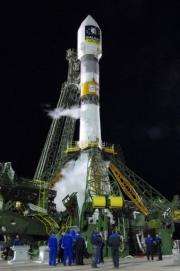
A rocket carrying a Galileo satellite is seen on a launch pad in Kazakhstan in 2008

Enlarge

A rocket carrying a Galileo (GIOVE-B) satellite of the European Space Agency is installed on a launch pad at Kazakhstan's Baikonur cosmodrome in 2008. The EU's much-delayed satellite navigation network Galileo will begin operations in 2014, the European Commission has said as it awarded key contracts to Germany's OHB System and France's Arianespace.

The EU's much-delayed Galileo sat-nav network will begin operation in 2014, the European Commission said Thursday as it awarded key contracts to Germany's OHB System and France's Arianespace.

The European system is aimed to challenge the dominance of the US-built Global Positioning System (GPS), set up by the Pentagon in the 1980s, which is widely used in a huge variety of navigation devices like those in cars and boats.

OHB System beat out larger rival EADS-Astrium for the contract to build the first 14 satellites for the 30-satellite navigation system, EU Transport Commissioner Antonio Tajani said, with Arianespace providing the launch services.

The first satellites will be launched from French Guiana by Russian Soyuz rockets.

Franco-Italian group Thales Alenia Space was handed the contract to provide system support services.

"This will allow the initial deployment and service provision of Europe's satellite navigation system as of early 2014," Tajani said.

"With this and the upcoming awards for the remaining procurement packages, we are concluding a critical phase of the Galileo programme.

"We can now focus on the actual roll-out and demonstrate to European citizens that Europe's own satellite navigation system is firmly underway," he added.

The EU has struggled to secure financing for the project, originally put at 3.4 billion euros (5.4 billion dollars), and has had to tap unused funds from the bloc's massive agricultural budget.

Tajani said there was bound to be an increase in the budget, especially as regards the costs of the launchers, but could not provide a figure.

Last year, the European Court of Auditors criticised the Galileo project as ill-prepared and badly managed.

The commission said some services would be available by early 2014, including the "open service," which will be freely available to the public in Europe, just as the US GPS system is.

Also available early will be the search and rescue service.

Galileo is intended to offer a superior accuracy of one metre (yard), compared to up to 10 metres for GPS, making it very useful for car drivers, farmers and even the blind.

The European version will have global coverage and an encrypted, pay service for commercial clients, with extra information such as weather detail.

The OHB contract for 14 satellites is worth 566 million euros.

The commission offered hope to EADS-Astrium by stressing that subsequent satellites will be procured "each time" from OHB or EADS-Astrium "depending on which company provides the most advantageous offer."

EADS-Astrium had already secured the contract for a preliminary four satellites, which will be among the first launched.

Since the launch of the bidding process, EADS has also taken over Surrey Satellite Technology, a partner with OHB in its successful bid.

The contract with Arianespace covers the launch of five Soyuz launchers with the first lift-off scheduled for October 2012. The contract is worth 397 million euros.

The contract awarded to Thales Alenia Space, worth 85 million euros, for the system support services covers the industrial services needed to support the European Space Agency for the integration of Galileo.

Remaining procurement contracts, for the ground mission infrastructure, the ground control infrastructure and operations should be awarded by mid-2010.

(c) 2010 AFP


Rank 5 /5 (7 votes)
Related Stories
Relevant PhysicsForums posts
  • Force free body diagram problem on gym equipment
    created1 hour ago
  • Empirical data regarding shower heads and water
    created9 hours ago
  • feed hold button on CNC lathe
    createdFeb 09, 2012
  • RFAC in Fortran
    createdFeb 09, 2012
  • dynamics 2/32
    createdFeb 08, 2012
  • dynamics
    createdFeb 08, 2012
  • More from Physics Forums - General Engineering

More news stories

Netflix light on flicks as viewers soak up TV shows

Like most fresh faces that arrive in Hollywood, Netflix wanted to be a movie star. But now it's learning what many in Tinseltown have known for decades: Movies are sexy, but the real money is in television.

Technology / Business

created 6 minutes ago | popularity not rated yet | comments 0

Sony's Hirai refuses to abandon dire TV business

Struggling Japanese entertainment giant Sony will not abandon its cash-bleeding television business, its incoming CEO says, but he acknowledges tough decisions lie ahead including over redundancies.

Technology / Business

created 36 minutes ago | popularity not rated yet | comments 0

New error-correcting codes guarantee the fastest possible rate of data transmission

Error-correcting codes are one of the triumphs of the digital age. They’re a way of encoding information so that it can be transmitted across a communication channel — such as an optical fiber o ...

Technology / Computer Sciences

created 3 hours ago | popularity 5 / 5 (3) | comments 2 | with audio podcast

Small modular reactor design could be a 'SUPERSTAR'

(PhysOrg.com) -- Though most of today's nuclear reactors are cooled by water, we've long known that there are alternatives; in fact, the world's first nuclear-powered electricity in 1951 came from a reactor ...

Technology / Energy & Green Tech

created 2 hours ago | popularity 5 / 5 (4) | comments 9 | with audio podcast

Advanced power-grid model finds low-cost, low-carbon future in West

(PhysOrg.com) -- The least expensive way for the Western U.S. to reduce greenhouse gas emissions enough to help prevent the worst consequences of global warming is to replace coal with renewable and other ...

Technology / Energy & Green Tech

created 2 hours ago | popularity 5 / 5 (1) | comments 3 | with audio podcast


Experts reveal how plants don't get sunburn

(PhysOrg.com) -- Experts at the University of Glasgow have discovered how plants survive the harmful rays of the sun.

Fool's gold may prove an unlikely alternative to overexploited catalytic materials

Catalytic materials, which lower the energy barriers for chemical reactions, are used in everything from the commercial production of chemicals to catalytic converters in car engines. However, with current catalytic materials ...

Curry spice component may help slow prostate tumor growth

Curcumin, an active component of the Indian curry spice turmeric, may help slow down tumor growth in castration-resistant prostate cancer patients on androgen deprivation therapy (ADT), a study from researchers ...

Unpicking HIV’s invisibility cloak

Drug researchers hunting for alternative ways to treat human immunodeficiency virus (HIV) infections may soon have a novel target—its camouflage coat. HIV hides inside a cloak unusually rich in a sugar ...

What lies beneath: Mapping hidden nanostructures

The ability to diagnose and predict the properties of materials is vital, particularly in the expanding field of nanotechnology. Electron and atom-probe microscopy can categorize atoms in thin sheets of material, ...

To avoid early labor and delivery, weight and diet changes not the answer

One of the strongest known risk factors for spontaneous or unexpected preterm birth – any birth that occurs before the 37th week of pregnancy, most often without a known cause – is already having had one. For women ...