New tidal streams found in Andromeda reveal history of galactic mergers
January 7, 2010 By Tim Stephens
New tidal streams found in Andromeda reveal history of galactic mergers

Enlarge

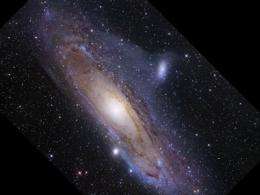
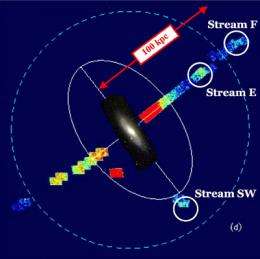
The traditional view of the Andromeda galaxy (above) shows only its bright bulge and inner disk, extending to about 65,000 light years from the galaxy's center. The stellar halo in which new tidal streams were found extends more than 500,000 light years from the center. The image below is a false-color map of the density of red giant stars in Andromeda, showing the newly discovered tidal streams in the stellar halo, with the traditional view of the galaxy in the central inset. Images courtesy of P. Guhathakurta.

(PhysOrg.com) -- An international team of astronomers has identified two new tidal streams in the Andromeda galaxy, the remnants of dwarf galaxies consumed by our large galactic neighbor. Analysis of the stars in Andromeda's tidal streams and other components of its extended halo is yielding new insights into the processes involved in the formation and evolution of massive galaxies, said Puragra Guhathakurta, professor of astronomy and astrophysics at the University of California, Santa Cruz.

Guhathakurta's team presented the latest results from studies of the newly discovered tidal streams on Thursday, January 7, at the 215th meeting of the American Astronomical Society in Washington, D.C.

In the currently favored "Lambda Cold " paradigm of structure formation in the universe, the outer halos of large galaxies like our Milky Way galaxy and the neighboring (also known as M31) are built up through the merger and dissolution of smaller "dwarf" satellite galaxies. "This process of galactic cannibalism is an integral part of the growth of galaxies," Guhathakurta said.
New tidal streams found in Andromeda reveal history of galactic mergers
Enlarge


The smooth, well-mixed population of halo stars in these large galaxies represents the aggregate of the dwarf galaxy victims of this cannibalism process, while the dwarf galaxies that are still intact as they orbit their large parent galaxy are the survivors of this process.

"The merging and dissolution of a dwarf galaxy typically lasts for a couple billion years, so one occasionally catches a large galaxy in the act of cannibalizing one of its dwarf galaxy satellites," Guhathakurta said. "The characteristic signature of such an event is a tidal stream: an enhancement in the density of stars, localized in space and moving as a coherent group through the parent galaxy."

Tidal streams are important because they represent a link between the victims and survivors of galactic cannibalism--an intermediate stage between the population of intact dwarf galaxies and the well-mixed stars dissolved in the halo.

The Andromeda galaxy is a unique test bed for studying the formation and evolution of a large galaxy, said Guhathakurta, who leads the Spectroscopic and Photometric Landscape of Andromeda's Stellar Halo (SPLASH) collaboration, a large survey of red giant stars in Andromeda. "Our external vantage point gives us a global perspective of the galaxy, and yet the galaxy is close enough for us to obtain detailed measurements of individual red giant stars within it," he said.

In a project led by collaborators Mikito Tanaka and Masashi Chiba of Tohoku University, Japan, the researchers used the Subaru 8-meter telescope and Suprime-Cam camera to map the density of red giant stars in large portions of the Andromeda galaxy, including the hitherto uncharted north side. This led to the discovery of two tidal streams to the northwest (streams E and F) at projected distances of 60 and 100 kiloparsecs (200,000 and 300,000 light years) from Andromeda's center. The study also confirmed a few previously known streams, including the little-studied diffuse stream to the southwest (stream SW), which lies at a projected distance of 60 to 100 kiloparsecs (200,000 to 300,000 light years) from Andromeda's center.

The SPLASH team has followed up with a spectroscopic survey of several hundred red giant stars in Streams E, F, and SW, using the Keck II 10-meter telescope and DEIMOS spectrograph at the W. M. Keck Observatory in Hawaii. The spectrograph spreads out the light from each star into a spectrum, which allows astronomers to measure the velocity of the star and distinguish Andromeda red giant stars from foreground stars in the Milky Way. The spectral data confirmed the presence of coherent groups of Andromeda red giant stars moving with a common velocity.

One of the next steps will be to measure the detailed chemical properties of red giant stars in these newly discovered tidal streams in Andromeda. Comparing the chemical properties of tidal streams, intact dwarf satellites, and the smooth halo will be of particular significance, Guhathakurta said.

Complex elements such as iron, magnesium, and calcium in the outer layers of a red giant star were produced within previous generations of massive stars that ended their lives as supernova explosions, spewing out newly forged elements into the interstellar medium. Thus, the fraction of complex elements found in stars indicates the degree to which the host galaxy's gas (the raw material from which new stars are formed) was enriched by supernova explosions from successive generations of massive stars.

"Massive galaxies like the Milky Way and Andromeda are very effective at recycling chemicals and therefore contain stars like our Sun that are relatively rich in complex elements--rich enough for rocky planets to have formed and for those planets to contain complex molecules such as proteins," Guhathakurta said.

Dwarf galaxies are less effective at recycling chemicals than massive galaxies. This is partly because the weaker gravity of a dwarf galaxy makes it harder for it to retain the chemically enriched gas that is blown out of massive stars during supernova explosions. As a result, stars in dwarf galaxies are more anemic (have a smaller fraction of complex elements) than those in the interior of massive galaxies. Moreover, the action of merging with a larger galaxy causes a dwarf galaxy to lose its gas, breaking the chemical cycle altogether.

"Dwarf galaxy cannibalism victims have had less time to recycle their chemicals than survivors, and this should be reflected as a difference between their chemical properties," Guhathakurta said. "Tidal streams should be somewhere between the victims and the survivors in terms of their chemical properties."

At the present time, detailed studies of the chemical properties of tidal streams, intact dwarf satellites, and smooth stellar halos are possible only in the and Andromeda galaxies and their immediate surroundings. Existing telescopes and instruments are simply not powerful enough for astronomers to carry out such studies in more distant galaxies. This situation will improve greatly with the advent of the planned Thirty Meter Telescope later in this decade, Guhathakurta said.

Provided by University of California - Santa Cruz (news : web)

4.1 /5 (8 votes)  

Filter


Move the slider to adjust rank threshold, so that you can hide some of the comments.


Display comments: newest first

yyz
Jan 07, 2010

Rank: 5 / 5 (1)
Perhaps as these streams are more fully characterized measurements of the distribution of dark matter in M 31 will become possible, as was recently determined for our own galaxy via streams (http://www.univer...er-halo/ ).
SincerelyTwo
Jan 07, 2010

Rank: not rated yet
(A little off topic from this article.)

yyz,

(After reading that page) That's interesting to say that dark matter abides by gravity, but it seems to be that only 'normal' matter forms galaxies, but dark matter just sorta clumps and forms halos around 'normal matter'.

What draws the line between only 'normal' matter forming galaxies and dark matter not? Why isn't 'normal' matter forming halos around dark matter galaxies?
Shootist
Jan 07, 2010

Rank: 5 / 5 (1)
Going way off the charts here folks.

Assuming the visible universe is a 3+1 dimensional brane within a larger hyper-structure of n dimensions AND,

assuming that mass is a 3+1 dimensional representation of n dimensional matter,

then mass would exert gravitational influence over a wider area than matter restricted to the classical 3 dimensions + time.

dark matter AND dark energy solved. :) Gravity is both stronger at the medium-large scale (galaxy) and attractive at the Humongous scale (Virgo super cluster) because some of the n dimensional matter (and its attendant gravity) lies beyond the 3+1D creation horizon the Universe is seen to have an accelerated expansion.
brant
Jan 07, 2010

Rank: not rated yet
"One of the next steps will be to measure the detailed chemical properties of red giant stars in these newly discovered tidal streams in Andromeda."

I predict they will find a magnetic field.
frajo
Jan 08, 2010

Rank: 1 / 5 (1)
Assuming the visible universe is a 3+1 dimensional brane within a larger hyper-structure of n dimensions AND,

assuming that mass is a 3+1 dimensional representation of n dimensional matter,

then mass would exert gravitational influence over a wider area than matter restricted to the classical 3 dimensions + time.
I like this kind of thinking. :) Hopefully there'll soon be testable (falsifiable) predictions.
Rank 4.1 /5 (8 votes)
Relevant PhysicsForums posts
  • Titan's lack of impact craters
    created16 hours ago
  • Real pictures of black hole eating a star?
    createdFeb 08, 2012
  • Hypothetical way to travel faster than light, but not technically exceed lightspeed
    createdFeb 06, 2012
  • How do scientists monitor the Sun's activity?
    createdFeb 05, 2012
  • Search patterns in observational studies
    createdFeb 05, 2012
  • Derivation of Pogson's law
    createdFeb 03, 2012
  • More from Physics Forums - General Astronomy

More news stories

New views show old NASA Mars landers

(PhysOrg.com) -- The High Resolution Imaging Science Experiment (HiRISE) camera on NASA's Mars Reconnaissance Orbiter recorded a scene on Jan. 29, 2012, that includes the first color image from orbit showing ...

Space & Earth / Space Exploration

created 20 hours ago | popularity 4.9 / 5 (7) | comments 8 | with audio podcast

Deconstructing a mystery: What caused Snowmaggedon?

In the quiet after the storms, streets and cars had all but disappeared under piles of snow. The U.S. Postal Service suspended service for the first time in 30 years. Snow plows struggled to push the evidence ...

Space & Earth / Earth Sciences

created 12 hours ago | popularity 4.7 / 5 (3) | comments 1 | with audio podcast

Black holes and star formation

(PhysOrg.com) -- It has long been recognized that galaxy mergers or even close interactions can play a vital role in shaping the morphology of galaxies. One way they can do so, it is thought, is by triggering ...

Space & Earth / Astronomy

created 19 hours ago | popularity 4.1 / 5 (7) | comments 5 | with audio podcast

Ocean microbe communities changing, but long-term environmental impact is unclear

As oceans warm due to climate change, water layers will mix less and affect the microbes and plankton that pump carbon out of the atmosphere – but researchers say it's still unclear whether these processes ...

Space & Earth / Earth Sciences

created 14 hours ago | popularity 5 / 5 (2) | comments 2 | with audio podcast

Researchers create 3-D laser maps that show how earthquake changes landscape

Geologists have a new tool to study how earthquakes change the landscape down to a few inches, and it's giving them insight into how earthquake faults behave. In the Feb. 10 issue of the journal Science, a team ...

Space & Earth / Earth Sciences

created 14 hours ago | popularity 5 / 5 (4) | comments 0 | with audio podcast


'Dark plasmons' transmit energy

Microscopic channels of gold nanoparticles have the ability to transmit electromagnetic energy that starts as light and propagates via "dark plasmons," according to researchers at Rice University.

FDA-approved drug rapidly clears amyloid from the brain, reverses Alzheimer's symptoms in mice

Neuroscientists at Case Western Reserve University School of Medicine have made a dramatic breakthrough in their efforts to find a cure for Alzheimer's disease. The researchers' findings, published in the journal Science, show t ...

Hydrogen from acidic water: Researchers develop potential low cost alternative to platinum for splitting water

A technique for creating a new molecule that structurally and chemically replicates the active part of the widely used industrial catalyst molybdenite has been developed by researchers with the Lawrence Berkeley ...

Ultraviolet protection molecule in plants yields its secrets

Lying around in the sun all day is hazardous not just for humans but also for plants, which have no means of escape. Ultraviolet (UV) radiation from the sun can damage proteins and DNA inside cells, leading ...

Soraa LED light may dim 50-watt halogen rivals

(PhysOrg.com) -- Soraa, a Fremont, California company founded in 2008, this week launched its first product, a light that uses LEDS (light emitting diodes). The "Soraa LED MR16 lamp" is the "perfect" replacement ...

Anyone can learn to be more inventive, cognitive researcher says

There will always be a wild and unpredictable quality to creativity and invention, says Anthony McCaffrey, a cognitive psychology researcher at the University of Massachusetts Amherst, because an "Aha moment" is rare and ...