What will the Large Hadron Collider reveal?
January 7, 2010 By Steve Giddings
Large Hadron Collider (LHC)

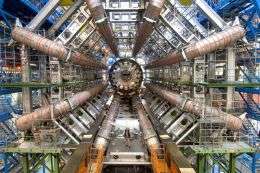
With its successful test run at the end of 2009, the Large Hadron Collider near Geneva, Switzerland, seized the world record for the highest-energy particle collisions created by mankind. We can now reflect on the next questions: What will it discover, and why should we care?

Despite all we have learned in physics -- from properties of faraway galaxies to the deep internal structure of the protons and neutrons that make up an -- we still face vexing mysteries. The collider is poised to begin to unravel them. By colliding protons at ultra-high energies and allowing scientists to observe the outcome in its mammoth detectors, the LHC could open new frontiers in understanding space and time, the microstructure of matter and the laws of nature.

We know, for example, that all the types of matter we see, that constitute our ordinary existence, are a mere fraction -- 20 percent -- of the matter in the universe. The remaining 80 percent apparently is mysterious "dark matter"; though it is all around us, its existence is inferred only via its on visible matter. LHC collisions might produce dark-matter particles so we can study their properties directly and thereby unveil a totally new face of the universe.

The collider might also shed light on the more predominant "," which is causing the universe's expansion to accelerate. If the acceleration continues, the ultimate fate of the universe may be very, very cold, with all particles flying away from one another to infinite distances.

More widely anticipated is the discovery of the Higgs particle -- sometimes inaptly called the -- whose existence is postulated to explain why some matter has mass. Were it not for the Higgs, or something like it, the electrons in our bodies would behave like light beams, shooting into space, and we would not exist.

If the Higgs is not discovered, its replacement may involve something as profound as another layer of substructure to matter. It might be that the most elementary known particles, like the quarks that make up a proton, are made from tinier things. This would be revolutionary -- like discovering the substructure of the atom, but at a deeper level.

More profound still, the LHC may reveal extra dimensions of space, beyond the three that we see. The existence of a completely new type of dimension -- what is called "supersymmetry" -- means that all known particles have partner particles with related properties. Supersymmetry could be discovered by the LHC producing these "superpartners," which would make characteristic splashes in its detectors. Superpartners may also make up dark matter -- and two great discoveries would be made at once.

Or, the LHC may find evidence for extra dimensions of a more ordinary type, like those that we see -- still a major revolution. If these extra dimensions exist, they must be wound up into a small size, which would explain in part why we can't see or feel them directly. The LHC detectors might find evidence of particles related to the ones we know but shooting off into these dimensions.

Even more intriguing, if these extra dimensions are configured in certain ways, the LHC could produce microscopic black holes. As first realized by Stephen Hawking, basic principles of quantum physics tell us that such black holes evaporate in about a billionth of a billionth of a billionth of a second -- in a spectacular spray of particles that would be visible to LHC detectors.

This would let us directly probe the deep mystery of reconciling two conflicting pillars of 20th century physics: Einstein's theory of general relativity and quantum mechanics. This conflict produces a paradox -- related to the riddle of what happens to stuff that falls into a black hole -- whose resolution may involve ideas more mind-bending than those of quantum mechanics or relativity.

Other possible discoveries include new forces of nature, similar to electric or magnetic forces. Any of these discoveries would represent a revolution in physics, though one that had been already considered. We may also discover something utterly new and unexpected -- perhaps the most exciting possibility of all. Even not discovering anything is important -- it would tell us where phenomena we know must exist are not to be found.

Such talk of new phenomena has worried some -- might ultra-high-energy be dangerous? The simple answer is no. Though it will be very novel to produce these conditions in a laboratory, where they can be carefully studied, nature is performing similar experiments all the time, above our heads. Cosmic ray protons with energies over a million times those at the LHC regularly strike the protons in our atmosphere, and in other cosmic bodies, without calamity. Also, there are significant indications that nature performed such experiments early in the universe, near the Big Bang, without untoward consequences. Physicists have carefully investigated these concerns on multiple occasions.

All this may seem like impractical and esoteric knowledge. But modern society would be unrecognizable without discoveries in fundamental physics. Radio and TV, X-rays, CT scans, MRIs, PCs, iPhones, the GPS system, the Web and beyond -- much that we take for granted would not exist without this type of physics research and was not predicted when the first discoveries were made. Likewise, we cannot predict what future discoveries will lead to, whether new energy sources, means of space travel or communication, or amazing things entirely unimagined.

The cost of this research may appear high -- about $10 billion for the LHC -- but it amounts to less than a ten-thousandth of the gross domestic product of the U.S. or Europe over the approximately 10 years it has taken to build the collider. This is a tiny investment when one accounts for the continuing value of such research to society.

But beyond practical considerations, we should ponder what the value of the LHC could be to the human race. If it performs as anticipated, it will be the cutting edge for years to come in a quest that dates to the ancient Greeks and beyond -- to understand what our world is made of, how it came to be and what will become of it. This grand odyssey gives us a chance to rise above the mundane aspects of our lives, and our differences, conflicts and crises, and try to understand where we, as a species, fit in a wondrous universe that seems beyond comprehension, yet is remarkably comprehensible.
___

ABOUT THE WRITER

Steve Giddings is a physics professor at the University of California Santa Barbara and an expert in high-energy and gravitational physics. He co-authored the first papers predicting that black hole production could be an important effect at the LHC and describing certain extradimensional scenarios that the LHC might explore.

(c) 2010, Los Angeles Times.
Distributed by McClatchy-Tribune Information Services.

4.6 /5 (48 votes)  

Filter


Move the slider to adjust rank threshold, so that you can hide some of the comments.


Display comments: newest first

Truth
Jan 07, 2010

Rank: 5 / 5 (2)
Very exciting time. Can't wait to see the first conclusive results of the LHC, primarily concerning new forms, if any, of energy and new dimensions, if any, that may exist right next to us.
ubavontuba
Jan 08, 2010

Rank: 2 / 5 (8)
If this is the same Steve Giddings who co-wrote the LSAG report, he has apparently forgotten his own work - which refutes this article's absolute assertion of safety.

The report states the earth couldn't capture cosmic ray induced black holes, but it could capture LHC black holes. It goes on to state that in the hypothetical (much hypothesized) case of stability, they could also begin accreting the earth.
Mercury_01
Jan 08, 2010

Rank: 5 / 5 (5)
Well i dont know about you tuba, but I havent been accreted in a few billion years. sounds exciting to me. Im all for a fresh start in a new neighborhood. perhaps our protons will meet again in another dimension.
eurekalogic
Jan 08, 2010

Rank: 1 / 5 (3)
I am horrifically anticipating. I just hope that the target sphere has a good mega magnetic collector to suspend any singularity if it did happen. As funny as this sounds the Romulans of Star Trek used singularities as a power source. Maybe your ROFL at the statement but event horizon quantum dialysis produces allot of particles as polar discharge that can be harnessed. I guess we better not ever drop one or we will have a slower but eventual result like the latest star trak movie and losse our precious Vulcan to an oops.
danman5000
Jan 08, 2010

Rank: not rated yet
Very exciting indeed. I hope they can find evidence of the Higgs - generally, the more we know about things the better we are able to control them. I wonder if some day we'll be able to manipulate the Higgs mechanism and enable things like in the Mass Effect universe.

By the way, if dark matter can only be seen by its gravitational interaction, how will the LHC detect it? Gravity is an extremely weak force, and especially when dealing with individual particles it seems like it would be greatly overshadowed by other effects. Can the LHC resolve such tiny forces, or is it able to visualize them in another way?
Rynox77
Jan 08, 2010

Rank: 5 / 5 (2)
The only reason "dark matter" is "dark" is because we can't see or detect it with our current devices. I've long disliked the term "dark matter" because it casts an undue mystical quality to this matter.

There's nothing mystical about it, we just can't see it yet.
Noumenon
Jan 08, 2010

Rank: 5 / 5 (27)
Until its detected its mysterious.
superhuman
Jan 08, 2010

Rank: 1 / 5 (2)
What will the Large Hadron Collider reveal?


I expect it to reveal that Higgs boson, supersymmetry, string theory, WIMPs, extra dimensions, etc are no more then fashionable speculations which have nothing to do with reality.

Yes, I'm probably too optimistic.
Mercury_01
Jan 08, 2010

Rank: 3.8 / 5 (4)
Nothing wrong with thinking of dark matter as mystical. It is quite mysterious, seeing as it probably exists in other dimensions, which was considered a metaphysical concept not long ago. To an initiate of "mysticism", an intrinsic working knowledge of the concepts of information and energy flow across dimensional barriers has been in the works for many thousands of years, and the model can be used in subtle, but practical ways. Now we use scientific terms, and bring to bear the monumental powers of science into the realm of the esoteric. There will be a fusion of these two worlds inside the minds of certain scientists, and whether the scientific community likes it or not, as time goes on, the language and use of science will start to sound a lot like mysticism. perhaps the goals of these two fields will begin to align in an effort to bring these mind expanding concepts to the masses.
Mercury_01
Jan 09, 2010

Rank: 5 / 5 (2)
Write me off if you wish, that wont serve to keep our sacred science as a purely logical pursuit forever. there will come a time for more intellectual leniency in order to explain the phenomena that science will someday undertake.
ubavontuba
Jan 09, 2010

Rank: 5 / 5 (1)
I am horrifically anticipating. I just hope that the target sphere has a good mega magnetic collector to suspend any singularity if it did happen. As funny as this sounds the Romulans of Star Trek used singularities as a power source. Maybe your ROFL at the statement but event horizon quantum dialysis produces allot of particles as polar discharge that can be harnessed. I guess we better not ever drop one or we will have a slower but eventual result like the latest star trak movie and losse our precious Vulcan to an oops.


There's significant hypothetical work which suggests black holes can't either exhibit a magnetic field, or be affected by them.

It really depends on how much faith you put in GR gravity, versus quantum gravity. So far, every successful gravity experiment has proven the strengths of GR, whereas none (that I know of) have demonstrated any verifiable signs of "quantum gravity effects."
frajo
Jan 09, 2010

Rank: 2 / 5 (3)
Write me off if you wish, that wont serve to keep our sacred science as a purely logical pursuit forever.
Your assumption is wrong. Science is no "purely logical pursuit". Science is fed by intuition, phantasy and sweat.
The fundamental thing which separates science from esoteric thinking is falsifiability. Forever.
ubavontuba
Jan 09, 2010

Rank: 1 / 5 (1)
Write me off if you wish, that wont serve to keep our sacred science as a purely logical pursuit forever.
Your assumption is wrong. Science is no "purely logical pursuit". Science is fed by intuition, phantasy and sweat.
The fundamental thing which separates science from esoteric thinking is falsifiability. Forever.


So what happens if the LHC falsifies the "quantum gravity" concept? Should we worry?
mauro48it
Jan 10, 2010

Rank: 3 / 5 (2)
Let joke.
Do you know why we are not able to find other intelligences in the universe?
Because sooner or later these intelligences are trying to find the God particle!
frajo
Jan 10, 2010

Rank: 1 / 5 (1)
So what happens if the LHC falsifies the "quantum gravity" concept? Should we worry?

You should worry about the proper meanings of the words "concept" and "falsification".
Mercury_01
Jan 10, 2010

Rank: 1 / 5 (2)
Frajo,
A great point. But invariably, certain people within the community who are prone to dismiss anything that was not their idea have a penchant for using scientific skepticism as a shield for their own chronic denialism. Take this piece of high strangeness for an off- the- wall example: Over a dozen people with very unusual issues have sought out or been referred to a certain Dr. Roger Leir, who has been more than forthright in his documentation and scientific analysis. He has removed small metallic objects from these patients that have tissues growing into them, rather than rejecting them. They all emit EM at 92.7 and 102.9 megahertz, contain carbon nano structures, are magnetic, have cilia and consist of isotopes not found on earth. This is a fact, yet it can not be true, therefore according to the scientific community, it isn't. No one wants to talk about it, end of story. Talk about it, and say good bye to your career.
flaredone
Jan 10, 2010

Rank: 3 / 5 (2)
Cosmic ray protons with energies over a million times those at the LHC regularly strike the protons in our atmosphere, and in other cosmic bodies, without calamity
They're acting always as a single particle, while LHC protons collide in dense jets with zero rest momentum toward Earth. After all, strangelet things like quark pairs, pentaquark of glueballs were observed already at Tevatron, so we can expect them on LHC as well. BTW top quark pairs have the very same mass, like Higgs boson and the same decay mechanism - it's evident, we observed them already, too.
frajo
Jan 10, 2010

Rank: 1 / 5 (1)
He has removed small metallic objects from these patients that have tissues growing into them, rather than rejecting them. They all emit EM at 92.7 and 102.9 megahertz
That's very interesting as I have an embedded high quality steel screw myself for 30 years and I like it very much. Now I'll tune my tuner to those frequencies. Let's hope the sound is to my taste. Otherwise I'll sue for a replacement.
LeeSawyer
Jan 10, 2010

Rank: 5 / 5 (1)
We detect a particle like a Dark Matter candidate by using energy and momentum conservation. If you have events where large amounts of momentum are going undetected, then something that did not interact with your detector carried away the missing momentum. These missing momentum or missing energy analyses can be very sophisticated.

Very exciting indeed. I hope they can find evidence of the Higgs - generally, the more we know about things the better we are able to control them. I wonder if some day we'll be able to manipulate the Higgs mechanism and enable things like in the Mass Effect universe.

By the way, if dark matter can only be seen by its gravitational interaction, how will the LHC detect it? Gravity is an extremely weak force, and especially when dealing with individual particles it seems like it would be greatly overshadowed by other effects. Can the LHC resolve such tiny forces, or is it able to visualize them in another way?[/ [/blockquote]
baudrunner
Jan 11, 2010

Rank: 1 / 5 (4)
Okay, the idea of a "dark energy particle" is absurd. Dark matter is dark because it does not permit radiation in the visible part of the optical spectrum. Particles do not have the capacity to radiate in that frequency range because they are too small. Since helium gas cannot propagate visible radiation, it is very probably the candidate for what we like to call 'dark matter".

Now then, we know of all the particles which comprise matter, ie. the quarks, leptons, and force carriers. Furthermore, the reason that all the possible combinations of color change within the realm of quantum chromo dynamics cannot be met is that reality must of course be skewed, otherwise there would be no differentiation.

And creating a black hole by colliding a few subatomic particles? Even more ludicrous, since even the sun doesn't have enough mass to become a black hole should it ever collapse in on itself.

The LHC experiments will discover nothing new.
flaredone
Jan 19, 2010

Rank: 3 / 5 (2)
We detect a particle like a Dark Matter candidate by using energy and momentum conservation.
Such energy could be dispersed in form of gravitational waves or neutrinos, so that such energy/momentum disbalance cannot serve as an evidence of new particles.

Since helium gas cannot propagate visible radiation
Helium gas glows under impact of ultraviolet radiation or X-rays emanated by many gallaxies, so we should notice such thing already. I admit, substantial portion of dark matter could be formed by heavily ionized atom nuclei in accordance to Alfven's Plasma Universe theory, thus evading detection in optical range.
Truth
Jan 20, 2010

Rank: 5 / 5 (3)
Of course, one must add a bit of lightness to this very heavy discussion of the LHC....therefore, I highly suggest a neat little video about the LHC called the "LHC Rap"....check it out hear at youtube...http://www.youtub...ZssEojtM
Mercury_01
Jan 25, 2010

Rank: 1 / 5 (1)
Okay, the idea of a "dark energy particle" is absurd. Dark matter is dark because it does not permit radiation in the visible part of the optical spectrum. Particles do not have the capacity to radiate in that frequency range because they are too small. Since helium gas cannot propagate visible radiation, it is very probably the candidate for what we like to call 'dark matter".

Now then, we know of all the particles which comprise matter, ie. the quarks, leptons, and force carriers. Furthermore, the reason that all the possible combinations of color change within the realm of quantum chromo dynamics cannot be met is that reality must of course be skewed, otherwise there would be no differentiation.

And creating a black hole by colliding a few subatomic particles? Even more ludicrous, since even the sun doesn't have enough mass to become a black hole should it ever collapse in on itself.

The LHC experiments will discover nothing new.


Wow. you get your degree at 7-11?
Rank 4.6 /5 (48 votes)
Relevant PhysicsForums posts
  • Question about Gravity?
    created1 hour ago
  • Wearing black in a desert
    created2 hours ago
  • Did space exist before mass?
    created2 hours ago
  • How can E&M Waves be polarized?
    created2 hours ago
  • Does light travel for ever?
    created3 hours ago
  • Infinity by Particles
    created4 hours ago
  • More from Physics Forums - General Physics

More news stories

Putting the squeeze on planets outside our solar system

(PhysOrg.com) -- Using high-powered lasers, scientists at Lawrence Livermore National Laboratory and collaborators discovered that molten magnesium silicate undergoes a phase change in the liquid state, abruptly ...

Physics / Condensed Matter

created 9 hours ago | popularity 4.4 / 5 (5) | comments 0 | with audio podcast

Hovering not hard if you're top-heavy, researchers find

Top-heavy structures are more likely to maintain their balance while hovering in the air than are those that bear a lower center of gravity, researchers at New York University's Courant Institute of Mathematical Sciences ...

Physics / General Physics

created 10 hours ago | popularity 5 / 5 (1) | comments 1 | with audio podcast

SLAC, Stanford team focuses on high-energy electrons to treat cancer

Accelerator physicists at SLAC and cancer specialists from Stanford are working on a new technology that could dramatically reduce the time needed for cancer radiation treatments. The team ran an initial experiment ...

Physics / General Physics

created 13 hours ago | popularity 5 / 5 (1) | comments 0

Measurements from high-energy collisions lead to better understanding of why meson particles disappear

For several years, physicists at the Relativistic Heavy Ion Collider (RHIC) at Brookhaven National Laboratory (BNL), USA, have studied an unusual state of matter called the quark–gluon plasma, which they ...

Physics / General Physics

created 14 hours ago | popularity 4.5 / 5 (2) | comments 0

Explained: Sigma

It's a question that arises with virtually every major new finding in science or medicine: What makes a result reliable enough to be taken seriously? The answer has to do with statistical significance -- but ...

Physics / General Physics

created Feb 09, 2012 | popularity 5 / 5 (16) | comments 53


Anonymous knocks CIA website offline (Update)

The website of the Central Intelligence Agency was inaccessible on Friday after the hacker group Anonymous claimed to have knocked it offline.

Google users warned of threat to smartphone wallets

Users of Google smartphone wallets were being warned on Friday that there is a way to crack pass codes intended to thwart thieves from going on illicit shopping sprees.

New error-correcting codes guarantee the fastest possible rate of data transmission

Error-correcting codes are one of the triumphs of the digital age. They’re a way of encoding information so that it can be transmitted across a communication channel — such as an optical fiber o ...

Complex wiring of the nervous system may rely on a just a handful of genes and proteins

Researchers at the Salk Institute have discovered a startling feature of early brain development that helps to explain how complex neuron wiring patterns are programmed using just a handful of critical genes. ...

Humans may have helped the decline of African rainforests 3000 years ago

(PhysOrg.com) -- Large areas of rainforests in Central Africa mysteriously disappeared over three thousand years ago, to be replaced by savannas. The prevailing theory has been that the cause was a change ...

The power of estrogen -- male snakes attract other males

A new study has shown that boosting the estrogen levels of male garter snakes causes them to secrete the same pheromones that females use to attract suitors, and turned the males into just about the sexiest ...