Physicists Solve Difficult Classical Problem with One Quantum Bit
January 8, 2010 By Lisa Zyga feature
Physicists Solve Difficult Classical Problem with One Quantum Bit

Enlarge

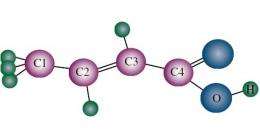
The molecule transcrotonic acid was used in the quantum algorithm DQC1. The molecule’s four carbon nuclei represent the algorithm’s four qubits, only one of which is initially controlled. The algorithm can solve the Jones polynomial, a difficult classical problem that involves distinguishing different knots. Image copyright: G. Passante, et al.

(PhysOrg.com) -- Quantum information algorithms have the potential to solve some problems exponentially faster than current classical methods. However, most research on quantum information systems has concentrated on models that use multiple quantum bits. In a new study, physicists have demonstrated how to solve a difficult classical problem that completely encapsulates a quantum model that requires only one quantum bit.

The scientists, Gina Passante, et al., from the University of Waterloo in Ontario, Canada, have presented their experimental results for the quantum solution of the approximation of the Jones polynomial, which is a knot invariant. By approximating the Jones polynomial, researchers can determine whether two knots are different. Making this distinction is a fundamental problem in knot theory, and has applications in statistical mechanics, , and quantum gravity. Although approximation of the Jones polynomial is a classical problem that is very difficult to solve, the results show that the problem can be solved using a “one model.” The study is published in a recent issue of .

In order to approximate the Jones polynomial, the scientists implemented a quantum algorithm called deterministic quantum computation with one quantum bit (DQC1). For the purposes of the algorithm, the knots were written as braids, or a series of strands crossing over and under each other with the top and bottom ends connected. Given the braid representations of different knots, the quantum algorithm could distinguish between distinct knots.

As the researchers explain, the DQC1 algorithm extracts the power of one bit of quantum information alongside a register of several qubits.

“The ‘one quantum bit model’ means that there is one initialized in the experiment, meaning that we can only control the initial state of one qubit,” Passante told PhysOrg.com. “For four qubits, the other three qubits are initially in a completely random state.”

The scientists experimentally implemented the algorithm using a liquid state nuclear magnetic resonance (NMR) quantum information processor. They implemented the model with the molecule transcrotonic acid, with its four carbon nuclei representing the algorithm’s four qubits. Then the researchers generated radio frequency pulses, starting randomly and improving through iterations.

“Successful experimental implementation of this algorithm relies on our ability to manipulate the qubits to perform the unitary transformations,” Passante said. “These manipulations must be done very accurately and quickly in order to get a reliable result, since the quantum states are very fragile.”

In simulations, the researchers found that, in the case of knots whose braid representations have four strands and three crossings, the algorithm could identify distinct knots 91% of the time. In the future, the scientists plan to apply the quantum algorithm to larger knots, and determine what size knot can be experimentally implemented before noise and control errors destroy the quantum advantage.

“This work demonstrates the use of an NMR quantum computer to solve an important and practical problem that is not feasible on classical computers,” Passante said. “It is the first experimental implementation of a complete problem for the class of DQC1. In the near future, processing devices hope to solve exciting problems with countless applications, and this experiment is an important stepping stone to realizing larger quantum computers.”

More information: G. Passante, O. Moussa, C.A. Ryan, and R. Laflamme. “Experimental Approximation of the Jones Polynomial with One Quantum Bit.” Physical Review Letters 103, 250501 (2009)

Copyright 2010 PhysOrg.com.
All rights reserved. This material may not be published, broadcast, rewritten or redistributed in whole or part without the express written permission of PhysOrg.com.

4.7 /5 (35 votes)  

Filter


Move the slider to adjust rank threshold, so that you can hide some of the comments.


Display comments: newest first

flaredone
Jan 10, 2010

Rank: not rated yet
Well, 640 kB ought to be enough for everyone..
Quantum_Conundrum
Jan 14, 2010

Rank: not rated yet
Not really.

So far, almost every quantum computing experiment has been in making an extremely specialized machine (if we can even really call this a machine in this case,)...ahem...machine which runs exactly one algorithm.

To be practical, we need quantum processors that are capable of performing a wide variety of calculations or at least being networked like the components of a PC: CPU, video card, sound card, modem, etc.

In addition, even if the amount of information you could store on a molecule were unlimited in theory, in reality there will be a physical limit in the number and size of detectors needed to "read" and interpret those memory positions for practical computing purposes.

A 640kb quantum computer made by extrapolating the apparatus these scientists are using would probably be like the size of the computers from Forbidden Planet...
fuzz54
Jan 15, 2010

Rank: not rated yet
@Qunatum_Conundrum: I think you're missing the historical humor here in flaredone's post.

Also, a quantum computer cannot do some of the things that a classical computer can. Computers of the far future will be a hybrid of the two technologies.
flaredone
Jan 15, 2010

Rank: not rated yet
Computers of the far future will be a hybrid of the two technologies.
Quantum computers could be parallelized easily with compare to von Neumann architecture. In fact, we can use them for simulation of quantum mechanics phenomena - just in more controlled, larger scale. After all, human brain does similar stuff with its sound solitons. These solitons are quite similar to real 1D quantum waves - i.e. strings of string theory, just simulated in approximately 40 kqubit scale. This scale is sufficiently robust, but it still enables high informational density.
Rank 4.7 /5 (35 votes)
Related Stories
Relevant PhysicsForums posts

More news stories

Physics research suggests new pathways for cancer progression

Observing that certain cancer cells may exhibit greater flexibility than normal cells, some scientists believe that this capability promotes rapid tumor growth. Now computer simulations developed by Boston University Biomedical ...

Physics / General Physics

created 56 minutes ago | popularity not rated yet | comments 0

Borexino Collaboration succeeds in spotting pep neutrinos emitted from the sun

(PhysOrg.com) -- To learn more about how the sun works, scientists study particles that are emitted from it into space due to thermonuclear reactions that occur inside; by applying known physics principles, ...

Physics / General Physics

created 3 hours ago | popularity 5 / 5 (4) | comments 0 | with audio podcast report

Transparent iron? For the first time, an experiment shows that atomic nuclei can become transparent

At the high-brilliance synchrotron light source PETRA III, a team of DESY scientists headed by Dr. Ralf Röhlsberger has succeeded in making atomic nuclei transparent with the help of X-ray light. At the ...

Physics / General Physics

created 22 hours ago | popularity 5 / 5 (8) | comments 3 | with audio podcast

Physicists build highly efficient 'no-waste' laser

A team of University of California, San Diego researchers has built the smallest room-temperature nanolaser to date, as well as an even more startling device: a highly efficient, "thresholdless" laser that ...

Physics / General Physics

created 22 hours ago | popularity 5 / 5 (17) | comments 4 | with audio podcast

Explained: Sigma

It's a question that arises with virtually every major new finding in science or medicine: What makes a result reliable enough to be taken seriously? The answer has to do with statistical significance -- but ...

Physics / General Physics

created 3 hours ago | popularity 5 / 5 (3) | comments 2


Tidal forces could squeeze out planetary water

Alien planets might experience tidal forces powerful enough to remove all their water, leaving behind hot, dry worlds like Venus, researchers said.

Can indigenous insects be used against the light brown apple moth?

The light brown apple moth (LBAM), Epiphyas postvittana (Walker), an invasive insect from Australia, was found in California in 2006. The LBAM feeds on apples, pears, stonefruits, citrus, grapes, berries and many other plants ...

NASA sees Tropical Cyclone Jasmine over Vanuatu and New Caledonia

NASA's Aqua satellite passed over Tropical Cyclone Jasmine on Feb. 8, 2012 as it was passing between Vanuatu and New Caledonia. NASA imagery showed Jasmine had a 20 nautical mile-wide eye.

Physically abused children report higher levels of psychosomatic symptoms

Children who display multiple psychosomatic symptoms, such as regular aches and pains and sleep and appetite problems, are more than twice as likely to be experiencing physical abuse at home than children who do not display ...

Facebook sees slowing growth

Few experts were surprised when Facebook disclosed in its recent IPO filing that its user growth had slowed in the U.S. and Canada. But a deeper look at Facebook's user numbers shows its growth is also slowing ...

New technology platform for molecule-based electronics

Researchers at the Nano-Science Center at the University of Copenhagen have developed a new nano-technology platform for the development of molecule-based electronic components using the wonder material graphene. At the same ...