Bering Strait influenced ice age climate patterns worldwide

In a vivid example of how a small geographic feature can have far-reaching impacts on climate, new research shows that water levels in the Bering Strait helped drive global climate patterns during ice age episodes dating back more than 100,000 years.
The international study, led by scientists at the National Center for Atmospheric Research (NCAR), found that the repeated opening and closing of the narrow strait due to fluctuating sea levels affected currents that transported heat and salinity in the Atlantic and Pacific oceans. As a result, summer temperatures in parts of North America and Greenland oscillated between warmer and colder phases, causing ice sheets to alternate between expansion and retreat and affecting sea levels worldwide.
While the findings do not directly bear on current global warming, they highlight the complexity of Earth's climate system and the fact that seemingly insignificant changes can lead to dramatic tipping points for climate patterns, especially in and around the Arctic.
"The global climate is sensitive to impacts that may seem minor," says NCAR scientist Aixue Hu, the lead author. "Even small processes, if they are in the right location, can amplify changes in climate around the world."
The study is being published this week in Nature Geoscience. Funded by the Department of Energy and the National Science Foundation, NCAR's sponsor, it used the latest generation of supercomputers to study past climate at a level of detail that would have been impossible just a few years ago.
New clues to an ice age mystery
Hu and his colleagues set out to solve a key mystery of the last glacial period: Why, starting about 116,000 years ago, did northern ice sheets repeatedly advance and retreat for about the next 70,000 years? The enormous ice sheets held so much water that sea levels rose and dropped by as much as about 100 feet (30 meters) during these intervals.
In other cases, scientists have associated such major oscillations in climate with fluctuations in Earth's orbit around the Sun. But in the time period that the research team looked at, the orbital pattern did not correspond with the geologic movement of the ice sheets and associated sea level changes.
The study team considered an alternative possibility: that changes in the Bering Strait, the main gateway in the Northern Hemisphere between the Atlantic and Pacific oceans, might have affected ocean currents across much of the globe. Although small-the strait is currently about 50 miles (80 kilometers) wide between Russia and the westernmost islands of Alaska-it allows water to circulate from the relatively fresh north Pacific to the saltier north Atlantic via the Arctic Ocean. This flow is instrumental to regulating the strength of a current known as the meridional overturning circulation, a key driver of heat from the tropics to the poles.
Supercomputers reveal a pattern of warming and cooling
Using the NCAR-based Community Climate System Model, a powerful computer tool for studying worldwide climate, the researchers compared the responses of ice age climate to conditions in the Bering Strait. They ran the model on new supercomputers at NCAR and the Department of Energy's Oak Ridge National Laboratory, enabling them to focus on smaller-scale geographic features that, until recently, could not be captured in long-term simulations of global climate.
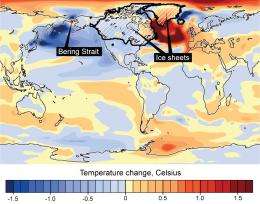
The simulations accounted for the changes in sea level, revealing a recurring pattern-each time playing out over several thousand years-in which the reopening and closing of the strait had a far-reaching impact on ocean currents and ice sheets.
- As the climate cooled because of changes in Earth's orbit, northern ice sheets expanded. This caused sea levels to drop worldwide, forming a land bridge from Asia to North America and nearly closing the Bering Strait.
- With the flow of relatively fresh water from the Pacific to the Atlantic choked off, the Atlantic grew more saline. The saltier and heavier water led to an intensification of the Atlantic's meridional overturning circulation, a current of rising and sinking water that, like a conveyor belt, pumps warmer water northward from the tropics.
- This circulation warmed Greenland and parts of North America by about 3 degrees Fahrenheit (1.5 degrees Celsius)-enough to reverse the advance of ice sheets in those regions and reduce their height by almost 400 feet (112 meters) every thousand years. Although the Pacific cooled by an equivalent amount, it did not have vast ice sheets that could be affected by the change in climate.
- Over thousands of years, the Greenland and North American ice sheets melted enough to raise sea levels and reopen the Bering Strait.
- The new inflow of fresher water from the Pacific weakened the meridional overturning circulation, allowing North America and Greenland to cool over time. The ice sheets resumed their advance, sea levels dropped, the Bering Strait again mostly closed, and the entire cycle was repeated.
The combination of the ocean circulation and the size of the ice sheets-which exerted a cooling effect by reflecting sunlight back into space-affected climate throughout the world. The computer simulations showed that North America and Eurasia warmed significantly during the times when the Bering Strait was open, with the tropical and subtropical Indian and Pacific Oceans, as well as Antarctica, warming slightly.
Learning from the past
The pattern was finally broken about 34,000 years ago, the point in Earth's 95,000-year orbital cycle at which the planet was so far from the Sun at certain times of year that the ice sheets continued to grow even when the Bering Strait closed. When the orbital cycle brought Earth closer to the Sun in the northern winter, the ice sheets retreated sufficiently about 10,000 years ago to reopen the strait. This helped lead to a relatively stable climate, nurturing the rise of civilization.
"This kind of study is critical for teasing out the nuances of our climate system," says NCAR scientist Gerald Meehl, a co-author of the paper. "If we can improve our understanding of the forces that affected climate in the past, we can better anticipate how our climate may change in the future."
More information: Nature Geoscience: www.nature.com/ngeo
Provided by National Center for Atmospheric Research


