A solid case of entanglement
January 11, 2010
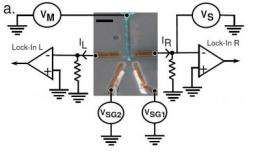
This is an SEM image of a typical Cooper pair splitter. The bar is 1 micrometer. A central superconducting electrode (blue) is connected to two quantum dots engineered in the same single wall carbon nanotube (in purple). Entangled electrons inside the superconductor can be coaxed to move in opposite directions in the nanotube, ending up at separate quantum dots, while remaining entangled. Credit: L.G. Herrmann, F. Portier, P. Roche, A. Levy Yeyati, T. Kontos, and C. Strunk
Physicists have finally managed to demonstrate quantum entanglement of spatially separated electrons in solid state circuitry.
For the first time, physicists have convincingly demonstrated that physically separated particles in solid-state devices can be quantum-mechanically entangled. The achievement is analogous to the quantum entanglement of light, except that it involves particles in circuitry instead of photons in optical systems. Both optical and solid-state entanglement offer potential routes to quantum computing and secure communications, but solid-state versions may ultimately be easier to incorporate into electronic devices.
The experiment is reported in an upcoming issue of Physical Review Letters and highlighted with a Viewpoint in the January 11 issue of Physics.
In optical entanglement experiments, a pair of entangled photons may be separated via a beam splitter. Despite their physical separation, the entangled photons continue to act as a single quantum object. A team of physicists from France, Germany and Spain has now performed a solid-state entanglement experiment that uses electrons in a superconductor in place of photons in an optical system.
As conventional superconducting materials are cooled, the electrons they conduct entangle to form what are known as Cooper pairs. In the new experiment, Cooper pairs flow through a superconducting bridge until they reach a carbon nanotube that acts as the electronic equivalent of a beam splitter. Occasionally, the electrons part ways and are directed to separate quantum dots -- but remain entangled. Although the quantum dots are only a micron or so apart, the distance is large enough to demonstrate entanglement comparable to that seen in optical systems.
In addition to the possibility of using entangled electrons in solid-state devices for computing and secure communications, the breakthrough opens a whole new vista on the study of quantum mechanically entangled systems in solid materials.
More information: Carbon Nanotubes as Cooper-Pair Beam Splitters, L. G. Herrmann, F. Portier, P. Roche, A. Levy Yeyati, T. Kontos, and C. Strunk, Phys. Rev. Lett. 104, 026801 (2010) - Published January 11, 2010, Download PDF
Provided by American Physical Society
-
Quantum electronics: Two photons and chips
Jan 20, 2006 |
not rated yet |
0
-
Researchers violate Bell’s inequality with an atom and a photon
Aug 31, 2004 |
not rated yet |
0
-
Creating a six-qubit cluster state
Nov 02, 2009 |
not rated yet |
0
-
JQI researchers create entangled photons from quantum dots
Nov 18, 2009 |
not rated yet |
0
-
Shining light in quantum computing
Sep 12, 2006 |
not rated yet |
0
-
Engineers build first sub-10-nm carbon nanotube transistor
Feb 01, 2012 |
4.9 / 5 (31) |
30
-
Something old, something new: Evolution and the structural divergence of duplicate genes
Jan 31, 2012 |
4.6 / 5 (7) |
1
-
The hidden nanoworld of ice crystals: Revealing the dynamic behavior of quasi-liquid layers
Jan 30, 2012 |
5 / 5 (3) |
1
-
Stock market network reveals investor clustering
Jan 27, 2012 |
3.9 / 5 (23) |
8
-
Of microchemistry and molecules: Electronic microfluidic device synthesizes biocompatible probes
Jan 26, 2012 |
5 / 5 (1) |
0
-
Conceptual issue with rolling sphere and friction.
4 hours ago
-
Conservation of momentum/energy
5 hours ago
-
Membrane Beam Transition Modelling Transition
8 hours ago
-
second law of thermodynamics
21 hours ago
-
Static Electric Orbiting of H2O Droplet to Knitting Needle
21 hours ago
-
Acousto optical modulators
23 hours ago
- More from Physics Forums - Classical Physics
More news stories
Putting the squeeze on planets outside our solar system
(PhysOrg.com) -- Using high-powered lasers, scientists at Lawrence Livermore National Laboratory and collaborators discovered that molten magnesium silicate undergoes a phase change in the liquid state, abruptly ...
1 hour ago |
5 / 5 (1) |
0
|
Hovering not hard if you're top-heavy, researchers find
Top-heavy structures are more likely to maintain their balance while hovering in the air than are those that bear a lower center of gravity, researchers at New York University's Courant Institute of Mathematical Sciences ...
2 hours ago |
5 / 5 (1) |
1
|
SLAC, Stanford team focuses on high-energy electrons to treat cancer
Accelerator physicists at SLAC and cancer specialists from Stanford are working on a new technology that could dramatically reduce the time needed for cancer radiation treatments. The team ran an initial experiment ...
5 hours ago |
5 / 5 (1) |
0
Measurements from high-energy collisions lead to better understanding of why meson particles disappear
For several years, physicists at the Relativistic Heavy Ion Collider (RHIC) at Brookhaven National Laboratory (BNL), USA, have studied an unusual state of matter called the quarkgluon plasma, which they ...
6 hours ago |
5 / 5 (1) |
0
Quantum physicist explains $100K offer for proof scaled-up quantum computing is impossible
(PhysOrg.com) -- MIT researcher Scott Aaronson has certainly riled the physics community with his offer this past Friday, of $100,000 to anyone who can prove that scaled-up quantum computing is impossible. ...
Human cognitive performance suffers following natural disasters, researchers find
Not surprisingly, victims of a natural disaster can experience stress and anxiety, but a new study indicates that it might also cause them to make more errors - some serious - in their daily lives. In their upcoming Human Fa ...
The power of estrogen -- male snakes attract other males
A new study has shown that boosting the estrogen levels of male garter snakes causes them to secrete the same pheromones that females use to attract suitors, and turned the males into just about the sexiest ...
New error-correcting codes guarantee the fastest possible rate of data transmission
Error-correcting codes are one of the triumphs of the digital age. Theyre a way of encoding information so that it can be transmitted across a communication channel such as an optical fiber o ...
Both maternal and paternal age linked to autism
Older maternal and paternal age are jointly associated with having a child with autism, according to a recently published study led by researchers at The University of Texas Health Science Center at Houston (UTHealth).
Curry spice component may help slow prostate tumor growth
Curcumin, an active component of the Indian curry spice turmeric, may help slow down tumor growth in castration-resistant prostate cancer patients on androgen deprivation therapy (ADT), a study from researchers ...
Humans may have helped the decline of African rainforests 3000 years ago
(PhysOrg.com) -- Large areas of rainforests in Central Africa mysteriously disappeared over three thousand years ago, to be replaced by savannas. The prevailing theory has been that the cause was a change ...
Jan 11, 2010
Rank: 2.6 / 5 (5)
"In optical entanglement experiments, a pair of entangled photons may be separated via a beam splitter. Despite their physical separation, the entangled photons continue to act as a single quantum object."
Any proof of the above statement? If one reflects one of the entangled photons does the other get reflected at the same time? If not, how can they be considered entangled? These two "entangled" photons or pulses of light are like two sides of a coin. Split the coin in half, head from the tales, and as soon as you see that one half is heads, you know the other half is tales. Does one half of this coin have any influence on the other half once they are separated?
Jan 11, 2010
Rank: 3.7 / 5 (3)
Jan 11, 2010
Rank: 3 / 5 (4)
Jan 11, 2010
Rank: 3.7 / 5 (3)
Jan 11, 2010
Rank: 2.3 / 5 (3)
Jan 11, 2010
Rank: not rated yet
Jan 11, 2010
Rank: not rated yet
Actually, imagine that you have one coin and it's spinning in space and it's not going to stop until you slap it on the table. Now you take two coins and you spin them both at the same time, but in a special way, that actually causes them to somehow become entangled. (In the real world there are various ways to do it.) Now, imagine that you slap one down and it's heads, but the other one is still spinning. Now you slap the second one down and it is tails. Repeat. Every single time they are opposites no matter how you try to make them different they are entangled.
Jan 11, 2010
Rank: not rated yet
There is lots of proof of that ... the interference pattern caused by light interacting in the two-slit experiment was the first evidence of that. Given the fact that the two-slit experiment has shown that a single photon will interfere with itself as well, this cannot be explained by classical physics. You'd probably enjoy this video on YouTube about the two-slit experiment: http://www.youtub...eprQ7oGc
Jan 11, 2010
Rank: 3 / 5 (4)
And the two slit experiment can also be considered proof that light is made up of waves of particles and not a single particle called the photon.
Jan 11, 2010
Rank: 2.3 / 5 (3)
I provided an introductory video describing just how it happens and how it's proven. It's up to you if you want to remain ignorant or learn.
Jan 12, 2010
Rank: 5 / 5 (1)
This is because of the particle-wave duality. Why do you favor waves? You've clearly seen light behave both ways. Surely even you can understand how in everyday physics particles could be the foundation of waves and vice versa. You seem to have made up your mind to favor waves without any proper reason to do so.
The quantum world is telling us that all data is both particle and wave, and that depending on which specific piece of data we observe we'll find it to be more like one or the other.
Jan 12, 2010
Rank: 3.3 / 5 (4)
Jan 12, 2010
Rank: 1 / 5 (1)
Jan 12, 2010
Rank: 5 / 5 (1)
I think you are not understanding that quantum and classical physics work differently - that is what this all about.
Entangled photon pairs will have the same "spin", even if you split them and change the spin of one of the 2 photons again after the initial split the two will still always remain entangled. That may not have been the best way to explain this, but space is limited for this text.
The mystery comes from how the two photons "communicate" their change instantaneously even if they are light years apart. This is the main difference between quantum and classical physics. Someone correct me if I am wrong - I am not an expert in the field, I just love learning about it.
Jan 12, 2010
Rank: 1 / 5 (2)
Jan 12, 2010
Rank: 5 / 5 (2)
Jan 12, 2010
Rank: 5 / 5 (1)
You can't be shown how two "quantum" coins can be made to come up opposites. That's just how it works. It's the possibility that the coins are heads, tails, or both that allows for quantum computing and entanglement. This possibility vanishes once you observe what one coin is, but until you make the observation, the crazy idea that both coins are tails or heads contains useful information. In this way entanglement can store information on all of the possible states of an unknown system at once and do operations on each state simultaneously.
Jan 12, 2010
Rank: 5 / 5 (1)
The observation of quantum particle is analogous to situation, when sailor touches the boat for a moment, thus exchanging some kinetic energy with it. What will happen, after then? The wharf and boat will begin to oscillate at phase. It means, the sailor will keep his relative position with respect to boat, so he cannot detect any boat wobbling anymore, because he moves by the same way. We can say, the wave motion/function of boat has collapsed from local perspective of that sailor.
Jan 12, 2010
Rank: 1 / 5 (1)
Jan 12, 2010
Rank: not rated yet
The resulting parts will remain undulate at phase with respect to the center of their common mass. The smaller droplets will therefore "remember" the state of original droplet - so they can serve as a model of quabit memory. Such pair will create their own "inertial reference frame" and/or "local universe" by many worlds interpretation. The original state of droplet could be restored only by combining of both halves back again (no other droplet vibrating at same phase can be used) - on this fact the quantum cryptography is based. The main difference is, the droplets system exhibit an extremelly high quantum number with compare to electron in nanotube.
Jan 12, 2010
Rank: 5 / 5 (2)
Entanglement is mediated by gravitational waves - you can imagine like communication by underwater sound waves at water surface, which ignores the surface wave spreading. So it could violate causality, but violation of causality is not sufficient as a proof of superluminal communication: you can be never sure by your partner in such communication.
Jan 12, 2010
Rank: 5 / 5 (2)
We should never replace understanding of reality by its numeric regression. The fact, we can extrapolate path free fall by parabola still doesn't mean, we understand, why is it so. The same mistake was done by proponents of Ptolemaic epicycles: they could describe path of planets well and they can even lead to testable predictions of eclipses and conjuctions - the only "subtle" problem is, their underlying physical model is completelly wrong. Just because it replaced understanding by its formal model fitted onto observations.
Jan 12, 2010
Rank: not rated yet
Jan 12, 2010
Rank: not rated yet
We have no true understanding of reality. It's all just an approximation and all of our current theories could be in error. Nobody will pat us on the back someday and tell us that we finally got things right. Using logic based theories instead of emprical approaches is better in my opinion too.
Jan 14, 2010
Rank: not rated yet
This is still a classical situation.
The first coin was heads all along (you just didn't know it until you measured it), as was the 2nd coin was tails.
Unless you can 100% control the outcome of the first coin, there is no 'action at a distance'....
Jan 14, 2010
Rank: not rated yet
On 12JAN Flaredone said, "We can say, the wave motion/function of boat has collapsed from local perspective of that sailor."
That's preceded by a lotta mental imaging just to slip in the notion of 'wave function collapse' as if something in the real world were collapsing.
But like entanglement (see the excellent original comment by 'Question' on 11 Jan), what's bobbing up/down in the theorist's head is 'information' perceived probabilistically and that, my friends, is readily entangled.
We 'know' the whole coin has a 50-50 chance of landing heads while it's spinning in mid-air and that knowledge 'collapses' to 0 or 100% when the coin lands and is read. If there is a similar coin a mile away, no magical entanglement allows us knowledge of its state before it lands.
But if the quantum mechanic initially 'prepares the entangled state' by splitting the coin into head and tail...
QED
Jan 16, 2010
Rank: 1 / 5 (1)
Jan 16, 2010
Rank: 5 / 5 (1)
Jan 17, 2010
Rank: not rated yet
If we do know whether an electron is entangled or not, then why that can't be used for FTL communication?
Jan 17, 2010
Rank: not rated yet
Double slit experiment (or its equivalent for spin). If it had collapsed earlier there would be no interference pattern. But we do observe interference patterns so he collapse must happen at the point of measurement.
Because you either collapse one now and then send the other particle (which is regular - i.e. non-FTL - information transmission. Here entanglement is pointless since you can do it better in other ways.)
Or you transmit the particle and collapse it later. But since you _don't know_ which state it will collapse into (and since there is no way to force it to collapse into one state) you will not know _what_ you 'transmit'. So you'll be sending completely random noise which carries an informational value of zero (see Shannon information theory)
Jan 18, 2010
Rank: not rated yet
I understand that. But - if we can detect for a particular particle whether it is entangled state or not - we can collapse particles at 'transmitter' side and simply observe time intervals at which particles become de-entangled at 'receiver' site. Say if interval between two de-entanglements is 1s, that means bit 0 was sent, if interval is 2s, that means bit 1 was sent. So we don't care into which states particles will collapse at either side, just whether they did collapse or not - which, according to the article, should be possible...?