Shipworm threatens archaeological treasures
January 11, 2010
Shipworm threatens archaeological treasures

Enlarge

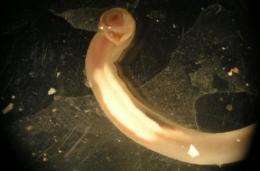
This is the shipworm Teredo navalis. Credit: University of Gothenburg

The dreaded shipworm is moving into the Baltic Sea, threatening artefacts of the area's cultural heritage. Researchers at the University of Gothenburg, Sweden, suspect that the unfortunate spread is due to climate change, and are currently involved in an EU project to determine which archaeological remains are at risk.

The shipworm is capable of completely destroying large maritime archaeological finds in only 10 years, and while it has avoided the Baltic Sea in the past, since it does not do well in low salinity water, it can now be spotted along both the Danish and German Baltic Sea coasts.

Malmö landmark infested

'The shipworm has for example attacked shipwrecks from the 1300s off the coast of Germany, and we are also starting to see its presence along the Swedish coast, for example at the Ribersborg cold bath house in Malmö,' says Christin Appelqvist, doctoral student at the Department of Marine Ecology, University of Gothenburg.

Effect of climate change

Appelqvist and her colleagues believe that the development may be due to . In short, the increased may help the shipworms to become adapted to lower salinity. The group is part of the EU project WreckProtect, a cooperative effort to assess which archaeological treasures are at risk. The project includes researchers from Sweden, Denmark and the Netherlands, as well as experts from France and Germany.
Shipworm threatens archaeological treasures
Enlarge

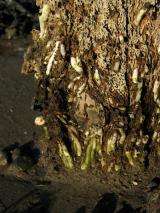
The shipworm can survive a salinity of 4-6 practical salinity unit (PSU) for short periods of time (the salinity of the Stockholm archipelago is around 5 PSU), but needs at least 8 PSU to be able to reproduce. Credit: University of Gothenburg

Covering the shipwrecks

One of the objectives is to develop methods to protect the shipwrecks, for example by covering them with geotextile and bottom sediment, and another is to try to predict to which areas the shipworm is likely to spread in the future. The researchers say there are some 100 000 well-preserved shipwrecks in the .

'Around 100 wrecks are already infested in the Southern Baltic, but yet it hasn't even spread past Falsterbo. We know it can survive the salinity of the Stockholm archipelago, although it needs water with higher salinity than that to be able to reproduce,' says Appelqvist.

Provided by University of Gothenburg (news : web)

3.8 /5 (4 votes)  

Rank 3.8 /5 (4 votes)
Related Stories
Relevant PhysicsForums posts
  • Squishing cells
    created46 minutes ago
  • Any books/articles for evolutionary stable strategy models in humans?
    created12 hours ago
  • Science behind the bore feeling?
    created18 hours ago
  • Homo Sapien vs. Chimpanzee - Divergence Timeline
    created22 hours ago
  • a single mRNA strand is attached to sevaral ribosomes?
    createdFeb 08, 2012
  • Oestrogen and FSH
    createdFeb 07, 2012
  • More from Physics Forums - Biology

More news stories

Ultraviolet protection molecule in plants yields its secrets

Lying around in the sun all day is hazardous not just for humans but also for plants, which have no means of escape. Ultraviolet (UV) radiation from the sun can damage proteins and DNA inside cells, leading ...

Biology / Plants & Animals

created 8 hours ago | popularity 5 / 5 (4) | comments 0 | with audio podcast

Deadly bird parasite evolves at exceptionally fast rate

A new study of a devastating bird disease that spread from poultry to house finches in the mid-1990s reveals that the bacteria responsible for the disease evolves at an exceptionally fast rate. What's more, ...

Biology / Biotechnology

created 6 hours ago | popularity 5 / 5 (2) | comments 0 | with audio podcast

Decoding the molecular machine behind E. coli and cholera

Scientists from Queen Mary, University of London have discovered the workings behind some of the bacteria that kill hundreds of thousands every year, possibly paving the way for new antibiotics that could treat infections ...

Biology / Cell & Microbiology

created 6 hours ago | popularity not rated yet | comments 0 | with audio podcast

Deciding to go left or right: Researchers use device to determine that lower animals can navigate too

For decades, scientists have associated binary decision making — opting to go left or right — with higher-ranking animals, including humans. A team of Harvard researchers, however, is rewriting that ...

Biology / Plants & Animals

created 14 hours ago | popularity not rated yet | comments 2 | with audio podcast

New research reveals why fishermen keep fishing despite dwindling catches

Half of fishermen would not give up their livelihood in the face of drastically declining catches according to research led by the University of East Anglia (UEA).

Biology / Ecology

created 6 hours ago | popularity not rated yet | comments 0


'Dark plasmons' transmit energy

Microscopic channels of gold nanoparticles have the ability to transmit electromagnetic energy that starts as light and propagates via "dark plasmons," according to researchers at Rice University.

Hydrogen from acidic water: Researchers develop potential low cost alternative to platinum for splitting water

A technique for creating a new molecule that structurally and chemically replicates the active part of the widely used industrial catalyst molybdenite has been developed by researchers with the Lawrence Berkeley ...

FDA-approved drug rapidly clears amyloid from the brain, reverses Alzheimer's symptoms in mice

Neuroscientists at Case Western Reserve University School of Medicine have made a dramatic breakthrough in their efforts to find a cure for Alzheimer's disease. The researchers' findings, published in the journal Science, show t ...

Anyone can learn to be more inventive, cognitive researcher says

There will always be a wild and unpredictable quality to creativity and invention, says Anthony McCaffrey, a cognitive psychology researcher at the University of Massachusetts Amherst, because an "Aha moment" is rare and ...

Cell biologists describes mechanism by which some people may be more susceptible to colon cancer

An international research team led by cell biologists at the University of California, Riverside has uncovered a new insight into colon cancer, the third leading cause of cancer-related deaths in the United ...

Flexible paper robots

(PhysOrg.com) -- These inexpensive robots can stretch, bend and twist under control, and lift objects up to 120 times their own weight. Being soft, they can apply gentle and even pressure, and adapt to varied ...