The solution to a 200-year-old encryption
January 11, 2010
The solution to a 200-year-old encryption

Enlarge

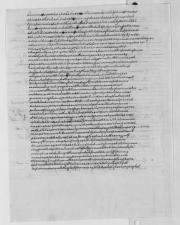
(PhysOrg.com) -- The mathematician who deciphered the final, encrypted page of a letter sent to President Thomas Jefferson in 1801 will visit the University of Oregon to tell how he did it.

The encrypted page -- a mystery to Jefferson and everyone else -- was solved in 2007 by Smithline, then 36, an expert in code-breaking. He detailed his solution in the American Scientist.

The letter was written by Jefferson's colleague in the American Philosophical Society, Robert Patterson, a math professor at the University of Pennsylvania. The ciphered page was devoid of capital letters or spaces and scrambled in a way that left no readable segments. Preceding pages had described the nature of the code but not the specific key required to unlock this message. The code was unlike any normally used at the time. Patterson predicted it would never be broken.

"This is a fascinating topic for historians as well as puzzle enthusiasts," says UO computer scientist Eugene Luks, who met Smithline in California, where Smithline described his solution to a group of cryptanalysts. "Jefferson, an expert cryptographer himself, was enthusiastic about the code. He recommended that it be used in diplomatic correspondence, but others did not appreciate his warnings about the weakness of the codes they were already using."

The solution involved both linguistic intuition and a to find the digital key. While the required 100,000 calculations would be easy on today's computers, Smithline's method could have been done over time in Patterson's day. In his talk, Smithline will tell how he was pulled into the mystery, how he broke the code and what was written on the page.

Lawren Smithline of the Center for Communications Research in Princeton, N.J., will speak at 4 p.m., Tuesday, Jan. 26, in Room 100 of Willamette Hall, 1371 E. 13th Ave. Admission is free. The talk is part of the Distinguished Lecture Series of the UO's department of computer and and co-sponsored by the math department.

Provided by University of Oregon (news : web)

4.4 /5 (22 votes)  

Rank 4.4 /5 (22 votes)
Related Stories
Relevant PhysicsForums posts

More news stories

US workers are 'giving away the store,' costing firms billions

Nearly 70 percent of the nation's service employees give away free goods and services – from hamburgers to cable TV – costing companies billions of dollars a year, according to a groundbreaking study.

Other Sciences / Economics & Business

created 11 hours ago | popularity not rated yet | comments 8

Storm warning: Financial tsunami heading this way

In today's global village, national coffers are more interconnected than ever before. And as the current economic crisis has proven, a downturn in one country can travel in a wave across the globe, like a financial tsunami. ...

Other Sciences / Economics & Business

created 12 hours ago | popularity 3 / 5 (2) | comments 6

Prague gets hold of modern genetics founder Mendel's papers

Germany has handed to the Czech Republic a manuscript of Johann Gregor Mendel, founder of modern genetics, on his plant hybridization experiments, the Czech foreign minister said Thursday.

Other Sciences / Other

created 8 hours ago | popularity 5 / 5 (1) | comments 1

Kids show cultural gender bias

(PhysOrg.com) -- Talk about gender confusion! A recent study by University of Alberta researchers Elena Nicoladis and Cassandra Foursha-Stevenson in the Journal of Cross-Cultural Psychology into whether speaki ...

Other Sciences / Social Sciences

created 17 hours ago | popularity 2 / 5 (1) | comments 2

'Flipped classroom' teaching model gains an online community

Researchers at Harvard University have launched the Peer Instruction (PI) Network, a new global social network for users of interactive teaching methods.

Other Sciences / Social Sciences

created 12 hours ago | popularity 5 / 5 (2) | comments 0


'Dark plasmons' transmit energy

Microscopic channels of gold nanoparticles have the ability to transmit electromagnetic energy that starts as light and propagates via "dark plasmons," according to researchers at Rice University.

FDA-approved drug rapidly clears amyloid from the brain, reverses Alzheimer's symptoms in mice

Neuroscientists at Case Western Reserve University School of Medicine have made a dramatic breakthrough in their efforts to find a cure for Alzheimer's disease. The researchers' findings, published in the journal Science, show t ...

Hydrogen from acidic water: Researchers develop potential low cost alternative to platinum for splitting water

A technique for creating a new molecule that structurally and chemically replicates the active part of the widely used industrial catalyst molybdenite has been developed by researchers with the Lawrence Berkeley ...

Ultraviolet protection molecule in plants yields its secrets

Lying around in the sun all day is hazardous not just for humans but also for plants, which have no means of escape. Ultraviolet (UV) radiation from the sun can damage proteins and DNA inside cells, leading ...

Anyone can learn to be more inventive, cognitive researcher says

There will always be a wild and unpredictable quality to creativity and invention, says Anthony McCaffrey, a cognitive psychology researcher at the University of Massachusetts Amherst, because an "Aha moment" is rare and ...

Soraa LED light may dim 50-watt halogen rivals

(PhysOrg.com) -- Soraa, a Fremont, California company founded in 2008, this week launched its first product, a light that uses LEDS (light emitting diodes). The "Soraa LED MR16 lamp" is the "perfect" replacement ...