Butterflies Reeling From Impacts of Climate and Development
January 11, 2010
Butterflies reeling from impacts of climate and development

Enlarge

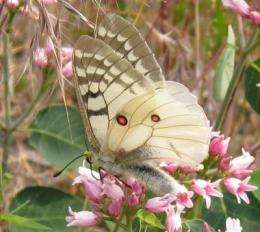
California butterflies are reeling from a one-two punch of climate change and land development, says an unprecedented analysis led by UC Davis butterfly expert Arthur Shapiro. In one example, this butterfly, the Clodius Parnassian (Parnassius clodius), is more common at the top of its elevation range in California mountains than in the past. Credit: Heather Dwyer / UC Davis

(PhysOrg.com) -- California butterflies are reeling from a one-two punch of climate change and land development, says an unprecedented analysis led by UC Davis butterfly expert Arthur Shapiro.

The new analysis, scheduled to be published online this week in the journal , gives insights on how a major and much-studied group of organisms is reacting to the Earth's warming climate.

"Butterflies are not only charismatic to the public, but also widely used as indicators of the health of the environment worldwide," said Shapiro, a professor of evolution and ecology. "We found many lowland species are being hit hard by the combination of warmer temperatures and habitat loss."

The results are drawn from Shapiro's 35-year database of butterfly observations made twice monthly at 10 sites in north-central California from to tree line. The Shapiro butterfly database is unique in science for its combination of attributes: one observer (which reduces errors), very long-term, multiple sites surveyed often, a large number of species (more than 150), and attendant climatological data.

Shapiro's co-authors include three other UC Davis researchers and two former Shapiro graduate students, including lead analyst Matthew Forister, now an assistant professor of biology at the University of Nevada, Reno.

Their most significant findings:

• Butterfly diversity (the number of different species present) is falling fast at all the sites near sea level. It is declining more slowly or holding roughly constant in the mountains, except at tree line.

• At tree line, butterfly diversity is actually going up, as lower-elevation species react to the warming climate by moving upslope to higher, cooler elevations.

• Diversity among high-elevation is beginning to fall as temperatures become uncomfortably warm for them and, Shapiro says, "There is nowhere to go except heaven."

Using a battery of statistical approaches, Shapiro and his colleagues concluded that alone cannot account in full for the deteriorating low-elevation numbers. Land-use data show that the butterfly losses have been greatest where habitat has been converted from rural to urban and suburban types.

He added that one of the most surprising findings was that ruderal (“weedy”) butterfly species that breed on “weedy” plants in disturbed habitats and are highly mobile are actually declining faster than “non-weedy” species -- those that specialize in one habitat type.

This is especially true in the mountains, where such species do not persist over winter but must recolonize every year from lower altitudes. As their numbers drop in the valleys, fewer are available to disperse uphill, and the rate of colonization drops.

“Butterfly folks generally consider these ruderal species to be ‘junk species,’ sort of the way bird watchers think of pigeons and starlings,” said Shapiro. “So it came as a shock to discover that they were being hit even harder than the species that conservationists are used to thinking about.

"Some of the 'weedy' species have been touted as great success stories, in which native had successfully adapted to the changed conditions created by European colonization of California. That was the case for many decades, but has apparently caught up with them now.”

More information: The study, "Compounded effects of climate change and habitat alteration shift patterns of butterfly diversity," will be online at http://www.pnas.org . It was funded by the National Science Foundation.

The Shapiro database is online at http://butterfly.ucdavis.edu . It includes butterfly observations and study site maps, together with climate data from nearby weather stations, descriptions of study sites and habitats, and numerous photos. The 10 survey sites lie along Interstate 80 and range from low-lying Suisun Marsh on San Francisco Bay to 9,103-foot-high Castle Peak near Donner Summit. The database was made public in 2007, also with funding from the National Science Foundation.

Provided by UC Davis (news : web)

Filter


Move the slider to adjust rank threshold, so that you can hide some of the comments.


Display comments: newest first

deatopmg
Jan 12, 2010

Rank: not rated yet
Climate change; the butterflies will evolve, as they always have done, to deal with the change, but the 800 lb gorilla = too many people leading to habitat loss will never be compensated for. So, how do we, as a society, fix the problem?
antialias
Jan 12, 2010

Rank: not rated yet
Adaptation takes time. If the climate changes to fast then the species will disappear (as the study already shows).

You can't 'reappear' a species once it is gone. Change only is possible as long as the species hangs around. So saying that 'the butterfly will adapt' is a bit simplistic.
Rank 2 /5 (4 votes)
Related Stories
Relevant PhysicsForums posts
  • Protease cleavage
    created2 hours ago
  • Pertubance in a model
    created9 hours ago
  • Cancer drugs and Alzheimer's, Oh my!
    created17 hours ago
  • Squishing cells
    created17 hours ago
  • Any books/articles for evolutionary stable strategy models in humans?
    createdFeb 09, 2012
  • Science behind the bore feeling?
    createdFeb 09, 2012
  • More from Physics Forums - Biology

More news stories

The power of estrogen -- male snakes attract other males

A new study has shown that boosting the estrogen levels of male garter snakes causes them to secrete the same pheromones that females use to attract suitors, and turned the males into just about the sexiest ...

Biology / Plants & Animals

created 6 hours ago | popularity 5 / 5 (2) | comments 0 | with audio podcast

Experts reveal how plants don't get sunburn

(PhysOrg.com) -- Experts at the University of Glasgow have discovered how plants survive the harmful rays of the sun.

Biology / Cell & Microbiology

created 6 hours ago | popularity 5 / 5 (2) | comments 0 | with audio podcast

Grass to gas: Researchers' genome map speeds biofuel development

Researchers at the University of Georgia have taken a major step in the ongoing effort to find sources of cleaner, renewable energy by mapping the genomes of two originator cells of Miscanthus x giganteus, a large perenn ...

Biology / Biotechnology

created 3 hours ago | popularity 3.7 / 5 (3) | comments 0 | with audio podcast

Protein libraries in a snap

(PhysOrg.com) -- A Rice University undergraduate will depart with not only a degree but also a possible patent for his invention of an efficient way to create protein libraries, an important component of biomolecular ...

Biology / Cell & Microbiology

created 10 hours ago | popularity 5 / 5 (2) | comments 0 | with audio podcast

Miami battling invasion of giant African snails

No one knows how they got there. But an invasion of African giant snails has southern Florida in a panic over potential crop damage, disease and general yuckiness surrounding the slimy gastropods.

Biology / Ecology

created 10 hours ago | popularity not rated yet | comments 2


Complex wiring of the nervous system may rely on a just a handful of genes and proteins

Researchers at the Salk Institute have discovered a startling feature of early brain development that helps to explain how complex neuron wiring patterns are programmed using just a handful of critical genes. ...

CIA website offline, Anonymous takes credit

The website of the Central Intelligence Agency was unresponsive on Friday after the hacker group Anonymous claimed to have knocked it offline.

Q&A: Obama and the birth control controversy

(AP) -- What birth control debate? A half-century after the introduction of the pill, acceptance of birth control by American women is virtually universal.

New error-correcting codes guarantee the fastest possible rate of data transmission

Error-correcting codes are one of the triumphs of the digital age. They’re a way of encoding information so that it can be transmitted across a communication channel — such as an optical fiber o ...

Humans may have helped the decline of African rainforests 3000 years ago

(PhysOrg.com) -- Large areas of rainforests in Central Africa mysteriously disappeared over three thousand years ago, to be replaced by savannas. The prevailing theory has been that the cause was a change ...

Both maternal and paternal age linked to autism

Older maternal and paternal age are jointly associated with having a child with autism, according to a recently published study led by researchers at The University of Texas Health Science Center at Houston (UTHealth).