The secrets of the Sahara revealed
January 11, 2010 By Diana Lutz
The secrets of the Sahara revealed

Enlarge

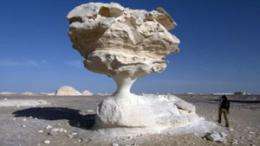
Jennifer Smith, Ph.D., associate professor of earth and planetary science at Washington University in St. Louis circles a beautifully bizarre geological formation carved by sand-bearing wind after the Sahara became a desert. This image is a still taken from "How the Earth Was Made: Sahara," a History (formerly History Channel) documentary in which Smith stars.

"When I first arrived in the Sahara, I was struck by how utterly barren it was, like the color green was removed from the palette when they made this place, just nothing, grays and browns, and not a scrap of life," Jennifer Smith says at the beginning of a History TV channel documentary on the Sahara.

Smith, Ph.D., associate professor of earth and planetary sciences in Arts & Sciences at Washington University in St. Louis, is setting up an astonishing revelation: The bone dry Sahara we know today hides a wet, occasionally dripping-wet, geologic past. In fact, there are still giant aquifers beneath the sand that hold as much fresh water as the Great Lakes.

So the Sahara is a geological mystery. To figure out what happened and why, Smith and her colleagues must follow a trail of improbable clues that include marine fossils in the pyramids, fossil whales in a remote wadi, or dry valley, Saharan sand in deep ocean cores, and paintings in desert caves of people swimming.

Smith's specialty is geoarchaeology, which uses classic earth science methods and concepts to address questions of archaeological interest. She is particularly interested in the climate in North Africa during the past few hundred thousand years, when it seems to have alternated between savannah and desert. Her work suggests, among other things, that periodic humid conditions throughout the Sahara may have enabled the movement of modern humans out of Africa to Europe and Asia.

The documentary airs Jan. 19 at 12:00 p.m. and again at 6 p.m CST.

In the first section of the documentary, part of the History (formerly The History Channel) series "How the was Made," Smith takes the viewers to the Great pyramid of Giza, where she shows them ancient marine fossils called nummulites, a diminutive form of the Latin nummulus meaning "little coin," embedded in the blocks that make up the pyramids.

Where did these marine fossils come from?

Smith next takes the viewers to Wadi al-Hitan (Valley of the Whales) where the rocks are the same age as those from which the pyramid blocks were quarried. There she shows the viewers the fossil skeleton of a 21-foot whale. The wadi has a remarkably high concentration of fossils, and almost all of them are marine animals.

What are whales doing in the desert?

After revealing the astonishing answer to that question, Smith and her colleagues set off to solve two more Saharan mysteries: when, exactly, did the Sahara become a desert, and why, after that cataclysmic event, has it oscillated between grassland and wasteland roughly every 20,000 years?

The last swing of the pendulum, which took place about 5,500 years ago, is particularly poignant because farmers had settled parts of the then green . They scratched into the wall of a Libyan cave a cloud unleashing long streaks of rain. But this supplication in stone went unheard and unanswered -- the rains failed, and the people disappeared.

At the end of the film, Smith takes the viewer to see pumping stations that are drawing water from the giant aquifers beneath the desert to irrigate crops. She points out that the water spilling from the pumps is warm. Earth's temperature increases with depth so, in the absence of local volcanic activity, the water's temperature indicates it comes from deep underground, three-quarters of a mile down or deeper.

This is water, Smith says, that accumulated over at least the last 1 million years. In some parts of the Egyptian , wells may run dry in as little as 100 years and, based on the work she and her colleagues have done, it might be another 15,000 years before they have a chance to refill.

Provided by Washington University in St. Louis (news : web)

4.6 /5 (7 votes)  

Rank 4.6 /5 (7 votes)
Related Stories
Relevant PhysicsForums posts
  • Discrepancy between oxygen and carbon-dioxide levels
    createdFeb 09, 2012
  • where gems are found in the world
    createdFeb 09, 2012
  • Wind Waves in Reservoir ~ Wind run-up and Wind set-up
    createdFeb 08, 2012
  • Balance of oxygen in the atmosphere
    createdFeb 01, 2012
  • The case for a methanol-based economy
    createdJan 30, 2012
  • Weather in a rotating cylinder
    createdJan 25, 2012
  • More from Physics Forums - Earth

More news stories

Humans may have helped the decline of African rainforests 3000 years ago

(PhysOrg.com) -- Large areas of rainforests in Central Africa mysteriously disappeared over three thousand years ago, to be replaced by savannas. The prevailing theory has been that the cause was a change ...

Space & Earth / Environment

created 17 hours ago | popularity 4.2 / 5 (9) | comments 11 | with audio podcast report

Could Venus be shifting gear?

(PhysOrg.com) -- ESA’s Venus Express spacecraft has discovered that our cloud-covered neighbour spins a little slower than previously measured. Peering through the dense atmosphere in the infrared, the ...

Space & Earth / Space Exploration

created 13 hours ago | popularity 5 / 5 (7) | comments 7 | with audio podcast

NASA sees wide-eyed cyclone Jasmine

Cyclone Jasmine's eye has opened wider on NASA satellite imagery, as it moves through the Southern Pacific Ocean.

Space & Earth / Earth Sciences

created 5 hours ago | popularity 3.5 / 5 (2) | comments 1

NASA budget will axe Mars deal with Europe: scientists

US President Barack Obama's budget proposal to be submitted next week for 2013 will cut NASA's budget by 20 percent and eliminate a major partnership with Europe on Mars exploration, scientists said Thursday.

Space & Earth / Space Exploration

created 16 hours ago | popularity 5 / 5 (2) | comments 18

Mars Science Laboratory computer issue resolved

(PhysOrg.com) -- Engineers have found the root cause of a computer reset that occurred two months ago on NASA's Mars Science Laboratory and have determined how to correct it.

Space & Earth / Space Exploration

created 14 hours ago | popularity 4.7 / 5 (6) | comments 3 | with audio podcast


Google users warned of threat to smartphone wallets

Users of Google smartphone wallets were being warned on Friday that there is a way to crack pass codes intended to thwart thieves from going on illicit shopping sprees.

Anonymous knocks CIA website offline (Update)

The website of the Central Intelligence Agency was inaccessible on Friday after the hacker group Anonymous claimed to have knocked it offline.

Complex wiring of the nervous system may rely on a just a handful of genes and proteins

Researchers at the Salk Institute have discovered a startling feature of early brain development that helps to explain how complex neuron wiring patterns are programmed using just a handful of critical genes. ...

New error-correcting codes guarantee the fastest possible rate of data transmission

Error-correcting codes are one of the triumphs of the digital age. They’re a way of encoding information so that it can be transmitted across a communication channel — such as an optical fiber o ...

The power of estrogen -- male snakes attract other males

A new study has shown that boosting the estrogen levels of male garter snakes causes them to secrete the same pheromones that females use to attract suitors, and turned the males into just about the sexiest ...

New power source discovered

(PhysOrg.com) -- Researchers at the Massachusetts Institute of Technology (MIT) and RMIT University have made a breakthrough in energy storage and power generation.