Solar Scientists Use 'Magnetic Mirror Effect' to Reproduce IBEX Observation
January 12, 2010 by Laura Layton
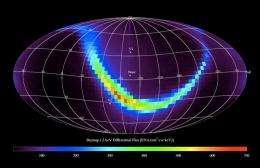
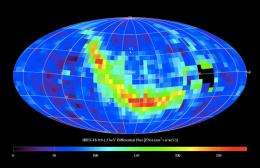
These two maps (see below) show the entire sky in the emission of neutral hydrogen. The energetic neutral atom (ENA) measurements by the IBEX mission (bottom image) show a ribbon feature spanning across the entire sky. A group of solar physicists led by Jacob Heerikhuisen discovered that this feature can be closely reproduced by sophisticated models (top image) after adding an unpredicted “mirror effect”. The two images show modeled and observed ENAs, respectively, at comparable speeds. Credit: Heerikhuisen et al.
(PhysOrg.com) -- Ever since NASA's Interstellar Boundary Explorer, or IBEX, mission scientists released the first comprehensive sky map of our solar system's edge in particles, solar physicists have been busy revising their models to account for the discovery of a narrow "ribbon" of bright emission that was completely unexpected and not predicted by any model at the time.
Further study by a team of scientists funded through NASA's Heliophysics Guest Investigator program has produced a revised model that explains and closely reproduces the IBEX result by incorporating a single new effect into an existing model. The new effect, put forward by the IBEX team soon after sighting of the ribbon, is that the magnetic field surrounding our solar system—called the local galactic magnetic field—acts like a mirror for the particles that IBEX sees.
The results appear in the January 10 issue of the Astrophysical Journal Letters. Jacob Heerikhuisen, a solar physicist at the University of Alabama in Huntsville, is the lead author of the paper. Heerikhuisen and his colleagues believe the orientation of the local galactic magnetic field is closely related to the location of the ribbon in the sky.
Charged particles "orbit" magnetic field lines. When they suddenly lose their charge, they fly off in a straight line maintaining their current direction. Only particles that orbit the magnetic mirror, where it faces us directly, can flow back toward us and are captured by IBEX.
These particles originate in our magnetized solar system, or heliosphere—the region from the sun to where the solar wind meets the local interstellar medium (LISM). First these particles lose their charge and fly out of the heliosphere. At some distance they charge again and start “orbiting” a field line of the local interstellar magnetic field, where they get “recycled” by losing their charge again.
Solar physicists did not expect this “mirror effect,” which is "somewhat analogous to exploring an unknown cave," says Arik Posner, IBEX program scientist at NASA Headquarters. "By activating IBEX, we suddenly see that the solar system has a lit candle and see its light reflected in the 'cave walls' shining back at us," says Posner. "What we find is that the 'cave wall' acts more like a faint mirror than like a normal wall," he adds.
What we saw with IBEX is that this “cave” we are exploring apparently has very straight and smooth magnetic walls, being shaped somewhat like a subway tunnel. IBEX can remotely observe the direction of the local interstellar magnetic field and may observe whether it stays the same or changes over time.
The sun’s presence affects the local interstellar magnetic field, bulging the field out to form something larger that is similar to a subway station. However, the “station” itself, our heliosphere, slowly moves along the tunnel, not subway cars.
Straight magnetic field lines are only found in plasmas where the magnetic field is strong and shapes the flow of particles, such as the smooth magnetic loops observed in the sun’s corona.
The IBEX results appear consistent with a recent finding by the Voyager mission that the surrounding galactic magnetic field in the LISM is much stronger than previously thought.
Assuming this "magnetic mirror effect" produces the narrow "ribbon" discovered by IBEX, then the orientation of the local galactic magnetic field is closely related to the location of the ribbon. With the help of global 3D models, this mechanism could help accurately determine the magnetic field's direction. The finding would also suggest that IBEX is detecting the particles from both inside and outside the heliopause, which is the boundary region between the outer solar system and the local interstellar medium.
"The IBEX mission has from the outset stressed both the criticality of new measurements and the collaboration between observations and theoretical research," explains Robert MacDowall, IBEX mission scientist at NASA Goddard. "The discovery by Heerikhuisen and colleagues demonstrates how successful this approach can be."
The IBEX spacecraft was launched in October 2008. Its science objective was to discover the nature of the interactions between the solar wind and the interstellar medium at the edge of our solar system. The Southwest Research Institute developed and leads the mission with a team of national and international partners. The spacecraft is the latest in NASA's series of low-cost, rapidly developed Small Explorers Program.
-
Galactic magnetic fields may control the boundaries of our solar system
Oct 16, 2009 |
not rated yet |
0
-
Scientists Explore Galactic Frontier, Release First-Ever All-Sky Map (w/ Video)
Oct 15, 2009 |
not rated yet |
0
-
IBEX collecting science data, building first all-sky map of the edge of the solar system
Jan 14, 2009 |
not rated yet |
0
-
Novel diamond-like films on board NASA satellite
Feb 16, 2009 |
not rated yet |
0
-
New space show highlights IBEX spacecraft's mission of discovery
Mar 05, 2009 |
not rated yet |
0
-
Engineers build first sub-10-nm carbon nanotube transistor
Feb 01, 2012 |
4.9 / 5 (31) |
30
-
Something old, something new: Evolution and the structural divergence of duplicate genes
Jan 31, 2012 |
4.6 / 5 (7) |
1
-
The hidden nanoworld of ice crystals: Revealing the dynamic behavior of quasi-liquid layers
Jan 30, 2012 |
5 / 5 (3) |
1
-
Stock market network reveals investor clustering
Jan 27, 2012 |
3.9 / 5 (23) |
8
-
Of microchemistry and molecules: Electronic microfluidic device synthesizes biocompatible probes
Jan 26, 2012 |
5 / 5 (1) |
0
-
Scale of the Universe
1 hour ago
-
Titan's lack of impact craters
Feb 09, 2012
-
Real pictures of black hole eating a star?
Feb 08, 2012
-
Hypothetical way to travel faster than light, but not technically exceed lightspeed
Feb 06, 2012
-
How do scientists monitor the Sun's activity?
Feb 05, 2012
-
Search patterns in observational studies
Feb 05, 2012
- More from Physics Forums - General Astronomy
More news stories
NASA sees wide-eyed cyclone Jasmine
Cyclone Jasmine's eye has opened wider on NASA satellite imagery, as it moves through the Southern Pacific Ocean.
Space & Earth / Earth Sciences
1 hour ago |
not rated yet |
0
NASA sees Giovanna reach cyclone strength, threaten Madagascar
Tropical Storm 12S built up steam and became a cyclone on February 10, 2012 as NASA's Terra satellite passed overhead. Residents of east-central Madagascar should prepare for this cyclone to make landfall ...
Space & Earth / Earth Sciences
1 hour ago |
not rated yet |
0
Humans may have helped the decline of African rainforests 3000 years ago
(PhysOrg.com) -- Large areas of rainforests in Central Africa mysteriously disappeared over three thousand years ago, to be replaced by savannas. The prevailing theory has been that the cause was a change ...
Could Venus be shifting gear?
(PhysOrg.com) -- ESAs Venus Express spacecraft has discovered that our cloud-covered neighbour spins a little slower than previously measured. Peering through the dense atmosphere in the infrared, the ...
Space & Earth / Space Exploration
9 hours ago |
5 / 5 (7) |
7
|
Mars Science Laboratory computer issue resolved
(PhysOrg.com) -- Engineers have found the root cause of a computer reset that occurred two months ago on NASA's Mars Science Laboratory and have determined how to correct it.
Space & Earth / Space Exploration
10 hours ago |
4.7 / 5 (6) |
3
|
Google users warned of threat to smartphone wallets
Users of Google smartphone wallets were being warned on Friday that there is a way to crack pass codes intended to thwart thieves from going on illicit shopping sprees.
CIA website offline, Anonymous takes credit
The website of the Central Intelligence Agency was unresponsive on Friday after the hacker group Anonymous claimed to have knocked it offline.
Complex wiring of the nervous system may rely on a just a handful of genes and proteins
Researchers at the Salk Institute have discovered a startling feature of early brain development that helps to explain how complex neuron wiring patterns are programmed using just a handful of critical genes. ...
Putting the squeeze on planets outside our solar system
(PhysOrg.com) -- Using high-powered lasers, scientists at Lawrence Livermore National Laboratory and collaborators discovered that molten magnesium silicate undergoes a phase change in the liquid state, abruptly ...
The power of estrogen -- male snakes attract other males
A new study has shown that boosting the estrogen levels of male garter snakes causes them to secrete the same pheromones that females use to attract suitors, and turned the males into just about the sexiest ...
New error-correcting codes guarantee the fastest possible rate of data transmission
Error-correcting codes are one of the triumphs of the digital age. Theyre a way of encoding information so that it can be transmitted across a communication channel such as an optical fiber o ...
