Scientists crack brain's codes for noun meanings
January 13, 2010
Carnegie Mellon scientists crack brain's codes for noun meanings

Enlarge

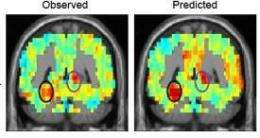
As one slice of the observed brain image from a human participant (left) and the theory (right) shows, the theory makes precise predictions, particularly about the two shelter-related coding areas in this slice (circled), where brighter red indicates more activation. Credit: Carnegie Mellon University

Two hundred years ago, archaeologists used the Rosetta Stone to understand the ancient Egyptian scrolls. Now, a team of Carnegie Mellon University scientists has discovered the beginnings of a neural Rosetta Stone. By combining brain imaging and machine learning techniques, neuroscientists Marcel Just and Vladimir Cherkassky and computer scientists Tom Mitchell and Sandesh Aryal determined how the brain arranges noun representations. Understanding how the brain codes nouns is important for treating psychiatric and neurological illnesses.

"In effect, we discovered how the brain's dictionary is organized," said Just, the D.O. Hebb Professor of Psychology and director of the Center for Cognitive Brain Imaging. "It isn't alphabetical or ordered by the sizes of objects or their colors. It's through the three basic features that the brain uses to define common nouns like apartment, hammer and carrot."

As the researchers report today in the journal , the three codes or factors concern basic human fundamentals: (1) how you physically interact with the object (how you hold it, kick it, twist it, etc.); (2) how it is related to eating (biting, sipping, tasting, swallowing); and (3) how it is related to shelter or enclosure. The three factors, each coded in three to five different locations in the brain, were found by a that searched for commonalities among in how participants responded to 60 different nouns describing physical objects. For example, the word apartment evoked high activation in the five areas that code shelter-related words.

In the case of hammer, the was the brain area activated to code the physical interaction. "To the brain, a key part of the meaning of hammer is how you hold it, and it is the sensory-motor cortex that represents 'hammer holding,'" said Cherkassky, who has a background in both computer science and neuroscience.

The research also showed that the noun meanings were coded similarly in all of the participants' brains. "This result demonstrates that when two people think about the word 'hammer' or 'house,' their brain activation patterns are very similar. But beyond that, our results show that these three discovered brain codes capture key building blocks also shared across people," said Mitchell, head of the Machine Learning Department in the School of Computer Science.

This study marked the first time that the thoughts stimulated by words alone were accurately identified using brain imaging, in contrast to earlier studies that used picture stimuli or pictures together with words. The programs were able to identify the thought without benefit of a picture representation in the visual area of the brain, focusing instead on the semantic or conceptual representation of the objects.

Additionally, the team was able to predict where the activation would be for a previously unseen noun. A computer program assigned a score to each word for each of the three dimensions, and that score predicted how much brain activation there would be in each of 12 specified brain locations. The theory generated a prediction of the activation for apartment based only on the patterns derived from the other 59 words. As one slice of the observed brain image from a human participant (left) and the theory (right) shows, the theory makes precise predictions, particularly about the two shelter-related coding areas in this slice (circled), where brighter red indicates more activation.

To test the theory, the team used the word scores to identify which word a participant was thinking about, just by analyzing the person's brain activation patterns for that word. The program was able to tell which of the 60 words a participant was thinking about, with a rank accuracy as high as 84 percent for two of the participants, and an average rank accuracy of 72 percent across all 10 participants (where pure guessing would be accurate 50 percent of the time).

One absent code in the study that is essential for the human species concerns sex or love or reproduction. "Our vocabulary of 60 test nouns lacked any words related to the missing dimension, such as 'spouse' or 'boyfriend' or even 'person,'" Just said. "We certainly expect some human dimension to be part of the brain's coding of nouns, in addition to the three dimensions we found."

"With psychiatric and neurological illnesses, the meanings of certain concepts are sometimes distorted," Just said. "These new techniques make it possible to measure those distortions and point toward a way to 'undistort' them. For example, a person with agoraphobia, the fear of open spaces, might have an exaggerated coding of the shelter dimension. A person with autism might have a weaker coding of social contact."

Another implication is in developing and testing domain expertise at the neural level. "We teach to the mind but we are shaping the brain, and now we can give the brain a test of how well it has learned a concept," says Just. "If an instructor knows how an advanced concept is represented in the brains of experts in that area, she will be able to teach to the brain test. We can do it for hammers and carrots right now. In the near future isotope and telomere may soon be on some researcher's agenda."

More information: http://dx.plos.org … pone.0008622

Provided by Carnegie Mellon University (news : web)

4.7 /5 (21 votes)  

Filter


Move the slider to adjust rank threshold, so that you can hide some of the comments.


Display comments: newest first

TheBigYin
Jan 13, 2010

Rank: 3 / 5 (2)
Imagine your boss knowing what you were reading while you surf the web instead of working :}
ArtflDgr
Jan 13, 2010

Rank: 3 / 5 (2)
imagine your significant other knowing what you were thinking during sex... oh the litigious nature of the west, and the follies that would sprout
Sciencebee
Jan 13, 2010

Rank: 3 / 5 (2)
Imagine the CIA knowing you're a double agent(good use). ..Or imagine the next Hitler knowing all people who want to plot against him/her(bad use).
jimbo92107
Jan 13, 2010

Rank: 5 / 5 (3)
This is a huge clue for AI researchers, because it hints at the basic layout of the architecture of instinct. That is the framework upon which we accumulate and refine our ability to survive and operate well within our environment. It's the core kernel of a living operating system.
toyo
Jan 13, 2010

Rank: 5 / 5 (2)
So I wonder how abstract concepts are encoded in the brain? After all, that's what (supposedly) differentiates us from other animals... :))
rmuldavin
Jan 14, 2010

Rank: 1 / 5 (1)
Yesterday's Internet Item: 800K years ago human pre-homo sapiens lived in caves with separate spaces that appear to be similar to the ones described in this article.

800K years, that's about six Ice ages ago.

This makes me feel evolved around the essentials, glad the sexual evolution was left out of the study. My feeling my whole brain would light up.

Best for the New Years, rm
Auxon
Jan 15, 2010

Rank: 2 / 5 (1)
"If an instructor knows how an advanced concept is represented in the brains of experts in that area, she will be able to teach to the brain test. We can do it for hammers and carrots right now. In the near future isotope and telomere may soon be on some brain researcher's agenda."

The implications of that are enormous. There's no reason why you couldn't stimulate the areas of the brain required to reinforce the connections to upload knowledge and languages etc..., especially with the ability to stimulate individual neurons with non-evasive procedures, just lasers or perhaps sasers (ultrasonic "lasers" developed recently). Very interesting. Perhaps it won't be long before monkeys are speaking English as well. lol
Tachyon8491
Jan 18, 2010

Rank: not rated yet
Although I appreciate the correlation displayed in this functional neurological mapping, I find it simplistic and reductionistic - anyone who has an adequate understanding of the attributional complexity of conceptually encoded percepts knows that these are composed of a huge number of enormously integrated fundamental elements (as in conical integration per PNI)and therefore act very much like illuminated peaks in a landscape while not seeing their massive substructure and basements. Although this technique may have more future resolving power, at present it is like poking around in the dark with a short stick hoping to encounter identifiable solidities. fMRI and NMR show differential blood-flows that are only very coarsely indicative of neurological domain activation. Research by Pribram and Penfield is more indicative of the complexity involved. E.g. those who think the term "shoelace-tying" consists of two fundamental modelling components are out by a factor of several thousands...
Rank 4.7 /5 (21 votes)
Relevant PhysicsForums posts
  • Is Everyday Technology Killing Us?
    createdFeb 08, 2012
  • Exercise and weight loss
    createdFeb 08, 2012
  • Why do we have head aches? Our brains can't feel anything.
    createdFeb 07, 2012
  • "The end of diseases" by David Agus, interview from Daily Show with Jon Stewart
    createdFeb 04, 2012
  • Oncolytic adenovirus
    createdFeb 04, 2012
  • Nutrition label stuffs and diets
    createdFeb 02, 2012
  • More from Physics Forums - Medical Sciences

More news stories

Complex wiring of the nervous system may rely on a just a handful of genes and proteins

Researchers at the Salk Institute have discovered a startling feature of early brain development that helps to explain how complex neuron wiring patterns are programmed using just a handful of critical genes. ...

Medicine & Health / Research

created 7 hours ago | popularity 4.9 / 5 (9) | comments 0 | with audio podcast

Both maternal and paternal age linked to autism

Older maternal and paternal age are jointly associated with having a child with autism, according to a recently published study led by researchers at The University of Texas Health Science Center at Houston (UTHealth).

Medicine & Health / Psychology & Psychiatry

created 11 hours ago | popularity 4 / 5 (2) | comments 0 | with audio podcast

New understanding of DNA repair could eventually lead to cancer therapy

A research group in the Faculty of Medicine & Dentistry at the University of Alberta is hoping its latest discovery could one day be used to develop new therapies that target certain types of cancers.

Medicine & Health / Cancer

created 11 hours ago | popularity 4.8 / 5 (4) | comments 0 | with audio podcast

Curry spice component may help slow prostate tumor growth

Curcumin, an active component of the Indian curry spice turmeric, may help slow down tumor growth in castration-resistant prostate cancer patients on androgen deprivation therapy (ADT), a study from researchers ...

Medicine & Health / Cancer

created 12 hours ago | popularity 4.4 / 5 (8) | comments 0 | with audio podcast

Team isolates nerve cells involved in storing long term memory and gene proteins associated with them

(Medical Xpress) -- A research team in Taiwan has succeeded in isolating two nerve cells in fruit fly brains that are believed to be the major players in allowing for the formation of long term memories. Furthermore, ...

Medicine & Health / Neuroscience

created 13 hours ago | popularity 5 / 5 (4) | comments 1 | with audio podcast report


Anonymous knocks CIA website offline (Update)

The website of the Central Intelligence Agency was inaccessible on Friday after the hacker group Anonymous claimed to have knocked it offline.

Google users warned of threat to smartphone wallets

Users of Google smartphone wallets were being warned on Friday that there is a way to crack pass codes intended to thwart thieves from going on illicit shopping sprees.

New error-correcting codes guarantee the fastest possible rate of data transmission

Error-correcting codes are one of the triumphs of the digital age. They’re a way of encoding information so that it can be transmitted across a communication channel — such as an optical fiber o ...

Humans may have helped the decline of African rainforests 3000 years ago

(PhysOrg.com) -- Large areas of rainforests in Central Africa mysteriously disappeared over three thousand years ago, to be replaced by savannas. The prevailing theory has been that the cause was a change ...

The power of estrogen -- male snakes attract other males

A new study has shown that boosting the estrogen levels of male garter snakes causes them to secrete the same pheromones that females use to attract suitors, and turned the males into just about the sexiest ...

New power source discovered

(PhysOrg.com) -- Researchers at the Massachusetts Institute of Technology (MIT) and RMIT University have made a breakthrough in energy storage and power generation.