Ancient Volcanic Eruptions Still Taking Lives
January 13, 2010
Ancient Volcanic Eruptions Still Taking Lives

Enlarge

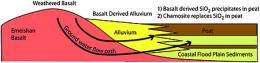
Acid rain from volcanic eruptions is thought to have eroded silicon dioxides from rocks, subsequently tainting peat bogs and the coal that formed from the bogs, over millions of years

(PhysOrg.com) -- A cancer epidemic under way in southeast China may have been initiated by a string of Siberian volcanoes that spewed ash across the Earth 250 million years ago, according to a study published in the journal Environmental Science and Technology.

Nonsmoking women in the Xuan Wei County, Yunnan Province, China suffer from the world’s highest known rate of , and Geosciences Research Professor Robert Finkelman, one of the study’s co-authors, said researchers believe the answer is in the coal that women in the province use for heating and cooking.

“Peak lung cancer mortality in women in one specific area of China—Xuan Wei—has been reported at 400 deaths per 100,000 people, which is nearly 20 times the mortality levels in the rest of China,” Finkelman said.

The extraordinarily high rate of lung cancer and the constant use of coal by women for heating and cooking led geoscientists to study the native coal from area mines.

“We discovered that the regional coal that formed after the Permo-Triassic times, about 250 million years ago, was very high in , which has been linked to cancer in recent studies,” Finkelman said.

The team concluded that volcanoes in Siberia erupted for 5 million years, blasting acidic gasses and particulates into the atmosphere, which cooked into a toxic soup of . The acidic rain decimated life on Earth and eroded area rocks, freeing up silica, which washed into surrounding peat bogs. Over millions of years, the Xuan Wei peat bogs converted into coal fields, becoming the source of the tainted coal.

“We think the risk comes from burning the coal, not from harvesting it,” Finkelman said. “There is probably a linkage between the gasses being mobilized by the burning coal and the very fine-grained silica particulates that are rafted up by these gasses.”

More information: http://pubs.acs.or … %2Fes902033j

Provided by University of Texas at Dallas (news : web)

4.4 /5 (9 votes)  

Filter


Move the slider to adjust rank threshold, so that you can hide some of the comments.


Display comments: newest first

PinkElephant
Jan 13, 2010

Rank: not rated yet
In other words, sand dust causes lung cancer? If that were true, there ought to be elevated lung cancer levels in desert communities: the Middle East and sub-Saharan countries (particularly on Sahara's western shores) come to mind...
dachpyarvile
Jan 13, 2010

Rank: not rated yet
The grains of desert sand are too large to pierce the lung tissue like minerals such as asbestos can. But, very fine grains of SiO2 would be small enough to damage tissue and cause cancer in a similar manner.

In addition, desert peoples tend to cover their faces in and around sandstorms. The people in China who are using this tainted coal likely do not cover their faces at all while using it in their homes.
jamesrm
Jan 13, 2010

Rank: not rated yet
Larger particles of Silica(sand)in the lung is more a cause of Emphysema
http://oem.bmj.co...abstract
dachpyarvile
Jan 13, 2010

Rank: not rated yet
This is still more dust than grains of desert sand, although there is a host of other diseases that can be contracted from inhaling desert sands in the Middle East. Depending upon where one goes one can also pick up one of a number of parasites.
Caliban
Jan 17, 2010

Rank: 1 / 5 (1)
Silicon dioxide(SiO2) and silicate(SiO4)minerals-sand, for example- are, as you now know, two different things. Apparently, SiO2 is very reactive chemically, especially relative to sand, which is essentially the very familiar glass used in every day life, which we all know to be a very stable, non-reactive substance.
dachpyarvile
Jan 21, 2010

Rank: not rated yet
No, SiO2 (also known as Silica) is the majority chemical constituent of sand the world over. There also are silicate minerals.

Silica is not all that chemically reactive. It is found alone in nature, being the most common chemical in earth's crust. It can, however, be reacted with basic metal oxides to produce other chemical compounds.

On the other hand, SiO4 is often found bound-up with various metallic elements as in the following minerals and many more:

Forsterite Mg2SiO4
Fayalite Fe2SiO4
Tephroite Mn2SiO4
Kirschsteinite CaFeSiO4
Monticellite CaMgSiO4.

Glass, additionally, also is SiO2 but not allowed to crystallize. SiO2 is melted and then rapidly cooled to produce glass. Colored glass can be made by adding impurities to the molten mass.
Rank 4.4 /5 (9 votes)
Relevant PhysicsForums posts
  • Discrepancy between oxygen and carbon-dioxide levels
    created11 hours ago
  • where gems are found in the world
    created14 hours ago
  • Wind Waves in Reservoir ~ Wind run-up and Wind set-up
    createdFeb 08, 2012
  • Balance of oxygen in the atmosphere
    createdFeb 01, 2012
  • The case for a methanol-based economy
    createdJan 30, 2012
  • Weather in a rotating cylinder
    createdJan 25, 2012
  • More from Physics Forums - Earth

More news stories

Mars Science Laboratory computer issue resolved

(PhysOrg.com) -- Engineers have found the root cause of a computer reset that occurred two months ago on NASA's Mars Science Laboratory and have determined how to correct it.

Space & Earth / Space Exploration

created 43 minutes ago | popularity 5 / 5 (1) | comments 1 | with audio podcast

Clam fields found at deep, low-temperature Mariana vents

(PhysOrg.com) -- Scientists have marveled at the unusual life forms thriving at high temperature hydrothermal vents of the deep ocean.

Space & Earth / Earth Sciences

created 18 minutes ago | popularity not rated yet | comments 0 | with audio podcast

Streams need trees to withstand climate change

(PhysOrg.com) -- More than twenty years of biological monitoring have confirmed the importance of vegetation for protecting Australia's freshwater streams and rivers against the ravages of drought and climate ...

Space & Earth / Environment

created 27 minutes ago | popularity not rated yet | comments 0

The turbulent birth of super star clusters in galaxy mergers

By combining two of the most advanced telescopes in the world -- the new Atacama Large Millimeter Array (ALMA) and the Very Large Telescope (VLT) of ESO -- a team of French astronomers from the Institut d'astrophysique ...

Space & Earth / Astronomy

created 9 minutes ago | popularity not rated yet | comments 0

Putin receives 'prehistoric' water from Antarctic lake

Prime Minister Vladimir Putin was given a water sample Friday taken from a pristine lake hidden under Antarctic ice for over a million years, after Russian scientists drilled down to its surface.

Space & Earth / Earth Sciences

created 49 minutes ago | popularity 5 / 5 (1) | comments 0


A frank discussion of the power law and linking correlation to causation

(PhysOrg.com) -- Michael Stumpf a mathematics professor at Imperial College in London, and Mason Porter a lecturer at Oxford have teamed together to write and publish a perspective piece in Science regarding the in ...

Advanced power-grid model finds low-cost, low-carbon future in West

(PhysOrg.com) -- The least expensive way for the Western U.S. to reduce greenhouse gas emissions enough to help prevent the worst consequences of global warming is to replace coal with renewable and other ...

Small modular reactor design could be a 'SUPERSTAR'

(PhysOrg.com) -- Though most of today's nuclear reactors are cooled by water, we've long known that there are alternatives; in fact, the world's first nuclear-powered electricity in 1951 came from a reactor ...

Seeing colors in music, tasting flavors in shapes may happen in life's early months

Famed violinist Itzhak Perlman sees a deep forest green whenever he plays a B-flat on his Stradivarius' G string. The A on the E string is red.

The question of life in the ancient world

There’s a general feeling that we don’t get the Greeks – ancient or modern. Many, including heads of state like Angela Merkel, visibly shake their head in exasperation, rightly or wrongly, at ...

Study suggests girls can 'rewire' brains to ward off depression

(Medical Xpress) -- What if you could teach your brain to respond differently to things that make you feel sad, down or stressed out? What if doing that helped ward off depression?