Asteroid To Fly By Earth Wednesday Is a Natural
January 13, 2010
Asteroid To Fly By Earth Wednesday Is a Natural

Enlarge

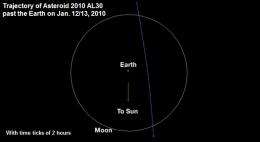
Orbital diagram depicts the trajectory of asteroid 2010 AL30 during its flyby of Earth in the early morning hours of Jan. 13. Image credit: NASA/JPL

(PhysOrg.com) -- Asteroid 2010 AL30, discovered by the LINEAR survey of MIT's Lincoln Laboratories on Jan. 10, will make a close approach to the Earth's surface to within 76,000 miles on Jan. 13 at 12:46 pm Greenwich time (7:46 am EST, 4:46 am PST).

Because its orbital period is nearly identical to the Earth's one year period, some have suggested it may be a manmade rocket stage in about the . However, this object's orbit reaches the orbit of Venus at its closest point to the sun and nearly out to the orbit of Mars at its furthest point, crossing the Earth's orbit at a very steep angle.

This makes it very unlikely that 2010 AL30 is a rocket stage. Furthermore, trajectory extrapolations show that this object cannot be associated with any recent launch and it has not made any close approaches to the since well before the Space Age began.

It seems more likely that this is a near-Earth about 10-15 meters in size, one of approximately 2 million such objects in near-Earth space. One would expect a near-Earth asteroid of this size to pass within the moon's distance about once every week on average. The asteroid does not pose a risk, in fact, stony asteroids under 25 meters in diameter would be expected to burn up in our atmosphere, causing little or no ground damage.

Provided by JPL/NASA (news : web)

4.9 /5 (13 votes)  

Filter


Move the slider to adjust rank threshold, so that you can hide some of the comments.


Display comments: newest first

meeker
Jan 13, 2010

Rank: 3.7 / 5 (6)
Before they didn't know what it was ... and now they are saying it's an "asteroid," huh?

This has conspiracy written all over it, which is then blacked out with a Sharpie.

UPDATE: I just checked the skies with my new trinoculars and yup ... it's definitely a flying saucer and it's spinning out of control. Aaaaahhhh. Aaah. Oh, wait ... nevermind. It was just my thumb.
RayCherry
Jan 13, 2010

Rank: 5 / 5 (2)
The asteroid does not pose a risk, in fact, stony asteroids under 25 meters in diameter would be expected to burn up in our atmosphere, causing little or no ground damage.


Just like the 10m one in Peru two years ago? :-/
otto1923
Jan 13, 2010

Rank: 1 / 5 (4)
Tell me people here dont like conspiracy theories... How about this: one exercise during the secret post-Apollo US/USSR space program involved redirecting asteroids toward earth. Why you say? Why toward earth and not away from it? Possibly to begin accruing construction materials in accessible orbits. Possibly for use in pending large-scale social engineering events. Or instead, maybe the number of near-misses we've seen over the past 10 years or so were successful diversions. At any rate this latest visitor was the result of shepherding. Indeed, the number of near-misses we have had in this short time span make one wonder why we havent been hit by something tsunguska-sized more frequently. Or perhaps Nemesis is real? Or something is otherwise swarming the inner system that we arent supposed to know about?
Eco_R1
Jan 14, 2010

Rank: 5 / 5 (3)
the 10 meter on in peru was infact 10m, but it was 10 m when it reached the earth
winthrom
Jan 14, 2010

Rank: 5 / 5 (3)
The reason we have more near misses lately is because we are aware they are happening. Better telescopes! Previously we were "fat-dumb-and-happy" now we are not happy but still fat and dumb.
yyz
Jan 14, 2010

Rank: 4 / 5 (2)
Images, movies & decent animation of the Earth seen from 2010 AL30 over at Universe Today: http://www.univer...10-al30/ . A possible connection to Venus Express-Fregat booster (launched 2005) is mentioned. Also, initial reports from Goldstone reveal an object with fairly high reflectivity that's tumbling rapidly. Is this a general feature of Apollo asteroids (as some have attributed this objects status) or fairly rare?
bmerc
Jan 14, 2010

Rank: 2 / 5 (1)
It is hard to believe that in this day and age that people can start claiming all sorts of things to something flying around in space and makes some people post rambaling that is impossible to know what they are claiming, but just look at some of the posts about this news or during the time Comet Hale-Bopp was visible and the cult the Heaven's Gate drank the coolaid, these type of things really does draw the wackos out.
otto1923
Jan 14, 2010

Rank: not rated yet
Well, I see at least 2 people disagree...
The reason we have more near misses lately is because we are aware they are happening.
Assumption. The volume and proximity I submit are worrisome. Does anyone know if this is unusual or not?
rambaling
I can spell better than you. Paranoia is only a heightened sense of awareness.
Phelankell
Jan 14, 2010

Rank: not rated yet
Keep in mind some of these near earth objects were not always near Earth.

The Solar system moves through the galaxy on epically long time scales. How are we to know that we won't be passing through an overly large asteroid belt that is not gravitationally locked to us? Looking at the history of the solar system it's potentially feasable that we could enter another "mass bombardment" period simply by reentering or initially entering a hidden cache of these legacy extrasolar belts.
antialias
Jan 14, 2010

Rank: 5 / 5 (2)
It's very hard to detect objects of that size early. AFAIK there is an effort under way to catalog objects larger than 1km in diameter in the solar system. Smaller obects are hard to spot (and depending on their albedo this may be next to impossible)

Also note that we aren't looking in all directions at once since the detection requires some intense focusing and long exposures. Sometimes such objects are found by hobby astronomers who just happen to look in unusual directions. Commercial/scientific telescopes usually have strict timetables for scientific observations and aren't really set up for willy-nilly searches of probably empty patches of sky for the the odd tumbling rock. They aim to get the most bang for the buck.
RayCherry
Jan 17, 2010

Rank: 4 / 5 (1)
@Phelankell: I was not aware that our Soler System was moving 'through' any galaxy. Could you please indicate the source of this information? According to the literature I have read, there is some agreement that we are near the end of one of the two extending spiral arms of the Milky Way, quite a distance from the majority of the solar systems and clusters orbiting the galactic center. Unless the Milky Way is converging with another galaxy, (for which I have no information), then our solar system is in a (relatively) safe place and on a clear course around the periphery of the galaxy. The only materials with a remote chance of hitting Earth are of original within this Solar System, and can be asteroids from the Main or Kuiper belts, or Comets from the Oort Cloud. A bombardment of materials from beyond this system is very remote, especially as no astronomer has seen any other star system on a converging course with ours. Brown Dwarf planetary systems may exist, but can detect them now.
RayCherry
Jan 17, 2010

Rank: not rated yet
@antialias: I get what you are saying, and a couple of years ago I was saying the same kind of thing.

Recently however there have been multiple launches of 'Wide Field' and and extremely sensitive infrared telescopes that are not just looking far into the outer Universe, but are also cataloging relatively nearby low-reflection and cold objects. Hopefully these near-sky surveys will yield more information about the numbers, variety and potential risk of many more asteroids, planetoids and comets.

I am particularly hopeful of some better figures for the Oort Cloud. Understand how much material is sitting in orbit in the distant spherical periphery of our Solar System is essential not only for risk/response analysis, but also for potential (seemingly distant future) attempts at bringing water and life to other planets/moons of this system.

For more information about these surveys, look up the "WIRE" and "WISE" projects, and the new Antarctic telescope location being considered.
antialias_physorg
Jan 17, 2010

Rank: not rated yet
Unless the Milky Way is converging with another galaxy, (for which I have no information)

We are on a collision course with the Andromeda galaxy. But that will still take another 4-5 billion years to happen.

How are we to know that we won't be passing through an overly large asteroid belt that is not gravitationally locked to us?

Because if they are gravitationally locked to us (and our galaxy in general) they will be mostly moving in the same direction as us. So there's little chance of suddenly meeting up with huge nmuber of objects on a collision course.

That said: it only needs one object of the right speed and the right size to cause us serious problems. So I think it's really a good idea that we're stepping up out catalogueing efforts. Shoemaker-Levy 9 _should_ have been a wake-up call.
otto1923
Jan 18, 2010

Rank: not rated yet
Ray-
Our movement relative to other objects and vice versa, and to the galaxy in general, is far from static or isolated:
http://adsabs.har...21..125D
-This ocillation is only one movement which some think puts us in peril-
RayCherry
Jan 18, 2010

Rank: not rated yet
@Otto: this study is looking for a possible coincidence between large impacts and the passage of our Solar System above and below the ecliptic plane of the Milky Way. If the rotation of the galaxy is approx. three thousand years, then we may pass through that plane once each fifteen hundred years. The large impacts and possible consequent large extinction events are calendared to within hundreds of thousands of years. Even if we could get down to tens of thousands of years, that would permit six or seven passages through the galactic plane. Not very convincing, but an interesting idea.

Some people are convinced that a bombardment of Oort Cloud objects has occurred before and will again ... but it is still a bit "Planet X". However, the passage through the galactic plane must disrupt normal orbit patterns for all Solar System bodies, and perhaps can cause Oort Cloud collisions providing a group of new long period comets.
otto1923
Jan 19, 2010

Rank: not rated yet
Ray buddy,
rotation of the galaxy is approx. three thousand years
Thats a little too fast. Try this one:
http://www.centau.../?p=1378
-Note nice pic-
-I think youre picturing us as stuck in some kind of interstellar glue which makes everything in the vicinity move in sync. Truth is we're moving significantly in relation to everything around us and vice versa. this movement takes us through many boundaries, clouds, shock waves, etc which can perturb oort cloud objects and send foreigners sailing through our midst at considerable speeds. Just because we havent seen Nemesis doesnt rule out the possibility that the sun is part of a binary system either.

-Anybody consider this flyby as a harbinger? Comets were traditionally considered portents of disaster. Flyby on Weds; Haiti on Tues. Scary stuff, eh boys and girls?
Phelankell
Jan 20, 2010

Rank: not rated yet
Because if they are gravitationally locked to us (and our galaxy in general) they will be mostly moving in the same direction as us. So there's little chance of suddenly meeting up with huge nmuber of objects on a collision course.

Two things,

1) I did say not gravitationally locked to the solar system.
2)Gravitationally locked to the Milky Way says nothing of the relative speed within the galaxy as it relates to our solar system.

Rank 4.9 /5 (13 votes)
Related Stories
Relevant PhysicsForums posts
  • Scale of the Universe
    created10 hours ago
  • Titan's lack of impact craters
    createdFeb 09, 2012
  • Real pictures of black hole eating a star?
    createdFeb 08, 2012
  • Hypothetical way to travel faster than light, but not technically exceed lightspeed
    createdFeb 06, 2012
  • How do scientists monitor the Sun's activity?
    createdFeb 05, 2012
  • Search patterns in observational studies
    createdFeb 05, 2012
  • More from Physics Forums - General Astronomy

More news stories

Humans may have helped the decline of African rainforests 3000 years ago

(PhysOrg.com) -- Large areas of rainforests in Central Africa mysteriously disappeared over three thousand years ago, to be replaced by savannas. The prevailing theory has been that the cause was a change ...

Space & Earth / Environment

created 21 hours ago | popularity 4.3 / 5 (12) | comments 12 | with audio podcast report

Could Venus be shifting gear?

(PhysOrg.com) -- ESA’s Venus Express spacecraft has discovered that our cloud-covered neighbour spins a little slower than previously measured. Peering through the dense atmosphere in the infrared, the ...

Space & Earth / Space Exploration

created 17 hours ago | popularity 5 / 5 (7) | comments 7 | with audio podcast

NASA budget will axe Mars deal with Europe: scientists

US President Barack Obama's budget proposal to be submitted next week for 2013 will cut NASA's budget by 20 percent and eliminate a major partnership with Europe on Mars exploration, scientists said Thursday.

Space & Earth / Space Exploration

created 20 hours ago | popularity 5 / 5 (2) | comments 18

Two new moons for Jupiter

Advances in technology have lead to the discovery of new planets outside of our Solar System, and now even new moons in our own backyard.

Space & Earth / Space Exploration

created 17 hours ago | popularity 4 / 5 (1) | comments 7

Mars Science Laboratory computer issue resolved

(PhysOrg.com) -- Engineers have found the root cause of a computer reset that occurred two months ago on NASA's Mars Science Laboratory and have determined how to correct it.

Space & Earth / Space Exploration

created 18 hours ago | popularity 4.7 / 5 (6) | comments 3 | with audio podcast


Anonymous knocks CIA website offline (Update)

The website of the Central Intelligence Agency was inaccessible on Friday after the hacker group Anonymous claimed to have knocked it offline.

New error-correcting codes guarantee the fastest possible rate of data transmission

Error-correcting codes are one of the triumphs of the digital age. They’re a way of encoding information so that it can be transmitted across a communication channel — such as an optical fiber o ...

Google users warned of threat to smartphone wallets

Users of Google smartphone wallets were being warned on Friday that there is a way to crack pass codes intended to thwart thieves from going on illicit shopping sprees.

New power source discovered

(PhysOrg.com) -- Researchers at the Massachusetts Institute of Technology (MIT) and RMIT University have made a breakthrough in energy storage and power generation.

The power of estrogen -- male snakes attract other males

A new study has shown that boosting the estrogen levels of male garter snakes causes them to secrete the same pheromones that females use to attract suitors, and turned the males into just about the sexiest ...

Small modular reactor design could be a 'SUPERSTAR'

(PhysOrg.com) -- Though most of today's nuclear reactors are cooled by water, we've long known that there are alternatives; in fact, the world's first nuclear-powered electricity in 1951 came from a reactor ...