Radio pulses from pulsar appear to move faster than light
January 14, 2010 by Lin Edwards report
pulsar

Enlarge

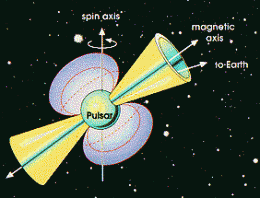
A diagram of a pulsar, showing its rotation axis and its magnetic axis. Image: NASA

(PhysOrg.com) -- Laboratory experiments in the last few decades have shown that some things can appear to move faster than light without contradicting Einstein's special theory of relativity, but now astrophysicists have seen real examples of superluminal speeds in the form of radio pulses from a pulsar.

Superluminal, or faster than light, speeds are associated with anomalous dispersion, which is a process in which the refractive index of a medium increases with the wavelength of light passing through it. If a light pulse (consisting of a group of at different wavelengths) passes through such a medium, the group velocity of the pulse can increase to a velocity greater than any of the waves within the pulse, but the energy of the pulse still travels at the speed of light, which means information is transmitted in accordance with Einstein's theory.

Astrophysicists, led by Frederick Jenet of the University of Texas at Brownsville, have been monitoring a , PSR B1937+21, which is about 10,000 light years from Earth. They used the Arecibo Observatory in Puerto Rico to obtain radio data over three days at 1420.4 MHz with a bandwidth of 1.5 MHz. They found that pulses closer to the center arrived earlier than the normal timing, which suggests they had travelled faster than the speed of light.

A pulsar is a neutron star that is spinning rapidly and emitting a rotating beam of radio radiation as it spins, which is observed on Earth at regular intervals rather like light from a lighthouse. The pulses of radiation can be affected by several factors as they travel through the interstellar medium (ISM). Their polarization can be rotated if they pass through a magnetic field, for example, and they can be scattered if they encounter , and can be absorbed by neutral hydrogen in the ISM. Jenet and his colleagues think anomalous dispersion also affects the pulses.

According to Jenet and colleagues, the pulses from the pulsar traveled through a cloud of neutral hydrogen, which has a resonance of 1420.4 MHz -- the exact center of the bandwidth studied. Passing through the cloud caused anomalous dispersion that resulted in a superluminal group velocity, and pulses with frequencies closest to the resonance frequency arrived earlier than other pulses.

The scientists believe the pulses appear to travel faster than light because of an "interplay between the time scales present in the pulse and the time scales present in the medium." The faster-than-light pulses do not violate Einstein's theory because technically the pulse carries no information. The effect has been known in laboratory experiments, but these observations were the first in an astrophysical context.

The findings, to be published in the Astrophysical Journal, could help astronomers gain a more complete understanding of the composition of space in the regions between stars, and in particular the properties of neutral clouds in our galaxy.

More information: A preprint of the article is available at http://arxiv.org/a … /0909.2445v2 .

© 2010 PhysOrg.com

4.5 /5 (55 votes)  

Filter


Move the slider to adjust rank threshold, so that you can hide some of the comments.


Display comments: newest first

El_Nose
Jan 14, 2010

Rank: 5 / 5 (8)
How can we detect these faster pulses if they contain no information?
Bob_Kob
Jan 14, 2010

Rank: 3.7 / 5 (11)
Ive always believed that we are somehow looking upon the universe incorrectly. What we see down here is probably not what actually happens out there. We know the universe is full of laws that alter perceptions so i'm not sure how we can take astronomical information as facts.
croghan26
Jan 14, 2010

Rank: 3.7 / 5 (3)
"The pulses of radiation can be affected by several factors as they travel through the interstellar medium (ISM)."

They can't mean ether????
Objectivist
Jan 14, 2010

Rank: 3.4 / 5 (10)
Ive always believed that we are somehow looking upon the universe incorrectly. What we see down here is probably not what actually happens out there. We know the universe is full of laws that alter perceptions so i'm not sure how we can take astronomical information as facts.

What happens "out there" is definitely not what we see here, which e.g. special relativity and the uncertainty principle tell us. But that is true for any distance, so I don't see how you can justify information extracted at astronomical distances as being nonfactual. It seems to me that your logic stretches as far as "I don't understand it, hence it cannot be" which saddens me.
pjvc
Jan 14, 2010

Rank: not rated yet
Is it theoretically possible for these pulses to be somehow modulated? Am I seeing this wrong? What constitutes 'information' per relativity?
Phelankell
Jan 14, 2010

Rank: not rated yet
Neutron stars are super dense, how did they account for the warping of local space time in their calculations?
Pharago
Jan 14, 2010

Rank: 2.3 / 5 (4)
Noboby dears to contradict stablished theory with only a few numbers coming from a pulsar, it's easier to invent some neutral hydrogen cloud that reasonates at some freqs and give speed to it. I hope the cloud is in there, but that dosn't explain why something in the way makes it faster than vacuum.
la7dfa
Jan 14, 2010

Rank: 5 / 5 (2)
Sensing if a signal is present or not is information in my book.
croghan26
Jan 14, 2010

Rank: not rated yet
"I hope the cloud is in there, but that dosn't explain why something in the way makes it faster than vacuum."

Sometimes when scientists (and indeed everybody) is confronted with a question they do not understand immediately they will give off a bullshite answer just to get the asker off their case and get some time to think about it.

I guess the neutral hydrogen cloud is possible - but where is the evidence of it beyond the disparity of the light arrival time?
Has it happened before?
Does it happen regularily?
Is there another explaination? (Does Occams's razor countenence creating a neutral hydrogen cloud?)
Mayday
Jan 14, 2010

Rank: 1 / 5 (3)
What if there were two close beams that crossed and separated at regular intervals. Wouldn't the combined energies/frequencies(?) at the radiating intersection point produce an "apparent" pulse of radio energy to the observer at the end of the vector of the outwardly radiating intersection?

It would be analogous to intersecting telephone wires visually crossing as they move in the wind. The illusion of the denser "intersection" can appear to travel at extremely high speeds.

Or a beam sweeping through a narrow gas cloud could do the same thing. No?
Bob_Kob
Jan 14, 2010

Rank: 4.4 / 5 (7)
But that is true for any distance, so I don't see how you can justify information extracted at astronomical distances as being nonfactual. It seems to me that your logic stretches as far as "I don't understand it, hence it cannot be" which saddens me.


Distance DOES matter. You can't possibly tell me that relativity plays little role where you are sitting there but not out in the heart of a black hole. Simply put we are looking out from earth as our point of reference without understanding the universe completely. We make up stop gap solutions like Dark matter, but these observations may just stem from our incomplete understanding of how galaxies work.
Phelankell
Jan 14, 2010

Rank: 4.2 / 5 (5)
Since the theoretical speed limit requires knowledge of gravity in order to determine local effect, there's no way to certify anythign until we have a fully functional definition and causation for gravity. We're making well educated assumptions, but, they're still assumptions. The "laws" of the Universe may not be homogenously applied in all places at all times.
LKD
Jan 14, 2010

Rank: 2.3 / 5 (4)
The "laws" of the Universe may not be homogenously applied in all places at all times.


I disagree. If either Laws or Theories, or both, can not be applied to all areas of the universe, that can only mean our reasoning is faulty, not that some areas are exempt.
Phelankell
Jan 14, 2010

Rank: 4.3 / 5 (3)
I disagree. If either Laws or Theories, or both, can not be applied to all areas of the universe, that can only mean our reasoning is faulty, not that some areas are exempt.
At what point in time did I state any exemption?
LKD
Jan 14, 2010

Rank: 4.3 / 5 (3)
The way I read your comment. My apologies if I read wrong, Phelankell.
Quantum_Conundrum
Jan 14, 2010

Rank: 3.5 / 5 (2)
"Sensing if a signal is present or not is information in my book."

====

My thoughts exactly. Either you have "something" or you have "nothing at all".

If you DETECT "something" then you MUST have "information" of some sort: A photon, a gravity wave, "something". Any "something" must have some form of information, energy, particle, or mass of some sort.

If this "something" moved faster than the speed of light, either Einstein's theory is wrong, or some form of teleportation or non-local motion took place.

This article is almost like saying, "I heard a noise, but detected no energy."

Clearly it is a contradiction.
Quantum_Conundrum
Jan 14, 2010

Rank: 2.7 / 5 (3)
The "laws" of the Universe may not be homogenously applied in all places at all times.


Do you realize the consequences of that is that it would be 100% impossible to prove anything as it regards space and time of an event?

You can't even prove yesterday existed, if this is the case, since it might be some sort of ghost or illusion caused by changes in the laws since the "real" yesterday, in which case, physics is an entirely vain endeavor.
El_Nose
Jan 14, 2010

Rank: 4.6 / 5 (8)
I get it now -- I think I and everyone else read the article expecting to to find somewhere that 'something made it go faster than the speed of light'

WE ALL MISSED IT the first time through - lol

the pulses from the pulsar traveled through a cloud of neutral hydrogen, which has a resonance of 1420.4 MHz -- the exact center of the bandwidth studied. Passing through the cloud caused anomalous dispersion that resulted in a superluminal group velocity, and pulses with frequencies closest to the resonance frequency arrived earlier than other pulses.


so in other words the pulses in the center were not slowed down.. and everything else was. They did not get here faster than light - they just never had to go through a substance that diffracted them and made them go slower

-- it like there was a giant torus of water out there and and light that went through the middle (where there was no water) never slowed down and the outer ring went through the water and arrived late
Phelankell
Jan 14, 2010

Rank: 5 / 5 (2)

Do you realize the consequences of that is that it would be 100% impossible to prove anything as it regards space and time of an event?
That's not accurate. It would be increasingly more difficult.

If the laws applied chaotically then you'd be correct, however, we can assume that may not be the case.

We already have cursory evidence that gravity is not homogenously applied due to the voyager perturbations as well as the percieved motion of different astral bodies.

You can't even prove yesterday existed, if this is the case, since it might be some sort of ghost or illusion caused by changes in the laws since the "real" yesterday, in which case, physics is an entirely vain endeavor.

And without any form of understanding about time, that's the case now.

Prove yesterday happened to an amnesiac:)
Ronan
Jan 14, 2010

Rank: 5 / 5 (1)
Quantum Conundrum: With the caveat that I know next to nothing about any of this, I think you may be making a mistake with your objections about information traveling superluminally. I suspect that "information" as used by physicists means something similar to but different than "information" as used by, well, the rest of us, so that by a physicist's definition, it is actually true that no information has been transmitted. That seems a bit more probable, to my mind, than that physicists in general have overlooked such a simple logical issue.
physpuppy
Jan 14, 2010

Rank: 5 / 5 (3)
"I hope the cloud is in there, but that dosn't explain why something in the way makes it faster than vacuum."

Sometimes when scientists (and indeed everybody) is confronted with a question they do not understand immediately they will give off a bullshite answer just to get the asker off their case and get some time to think about it.


It's not a BS answer - it's just a plausible one. Maybe they're right, maybe they're wrong.

This effect stated is known - I learned about it 30 years ago when I took optics and back then it wasn't a new concept. I don't remember much else about it, but if you want to learn more about it, here are some good links:

http://www.iitk.a...ght.html
Taratajoom
Jan 14, 2010

Rank: 5 / 5 (1)
I totally agree with El Nose.I recall this has happened again( the story in the article) and again the explanation was the exlpanation given after some time was the same as El Nose wrote.

P.S. The truth is out there.
antialias
Jan 14, 2010

Rank: 5 / 5 (4)
We should remember that 'superluminal speed' does not refer to greater than c (which is the speed of light in _vaccum_), but simply to greater speeds than the speed of light _in that medium_ (in the case of the pulsar radiation a medium is present as explained in the article where they talk about a cloud of neutral hydrogen atoms).

Speeds exceeding speed of light in a medium are not exactly new (many nuclear reactors exhibit those. It causes Cherenkov radiation)

(Actually there is a theoretical way to legally exceed the speed of light in vacuum by emitting a photon in a space where the Casimir effect is noticeable.)
Parsec
Jan 14, 2010

Rank: 5 / 5 (2)
No physicist or astronomer worth the title would ever claim we know exactly how the universe works. However, the effect described in this article has a simple explanation that corresponds to the laws of physics as we know it. Unless there is evidence to the contrary, the simplest explanation is usually the correct one. (Occam's Razor Principle)
Question
Jan 14, 2010

Rank: 5 / 5 (2)
I can never quite understand these faster than light articles. The only way I can visualize them is to see them as a wave within the waves of light. That is a wave of intensity appears to move faster than light. This would be kind of like the spokes on a wheel at certain speeds appear to move faster or slower than the wheel is actually rotating in a motion picture.

otto1923
Jan 14, 2010

Rank: not rated yet
El nose smelled a rat. But what is the stuff about not carrying information? Does the other radiation carry info about the material that slowed it down while the faster picked up no such new info? Is that what the cryptospeak really means?
tkjtkj
Jan 14, 2010

Rank: not rated yet
I have never ever heard that Einstein's limit for the 'C' was constrained by the condition that 'no information' transfer can exceed that velocity.

Are the authors rewriting Dr. Einstein's postulation ?

tkjtkj@gmail.com
PinkElephant
Jan 14, 2010

Rank: not rated yet
@antialias,

Actually there is a theoretical way to legally exceed the speed of light in vacuum by emitting a photon in a space where the Casimir effect is noticeable.


Sorry, I just had to ask: what happens if you exceed the speed of light illegally? Do you get a cosmic speeding ticket? =)

At any rate, I wonder what the theory is you're mentioning. Casimir requires a very small cavity, so wavelength of light is constrained by the width of the cavity (which is responsible for the Effect in the first place.) So the more noticeable the effect (the tighter the cavity), the shorter the wavelength you'd have to emit -- and even though you're removing some long-wave turbulence from the vacuum inside the cavity, by using higher-frequency photons you're interacting more with short-wave turbulence. Without calculating, intuitively it seems like it should just balance out to 0 net effect -- and that's before looking at more intense electromagnetic 'cable effects' for higher energies.
PinkElephant
Jan 14, 2010

Rank: 5 / 5 (3)
I have never ever heard that Einstein's limit for the 'C' was constrained by the condition that 'no information' transfer can exceed that velocity.

Are the authors rewriting Dr. Einstein's postulation?

tkjtkj@gmail.com


No. In fact, Einstein's postulate of C as the highest possible speed is crucially connected to Einstein's use of light as the fundamental carrier of information. In other words, Einstein postulated that light is the absolutely fastest and most fundamental way we can obtain information about any object or experiment: which is why he always uses light as the measuring stick in all his thought experiments (and how he derives things like time dilation/length contraction.)

If information could propagate faster than light, then that method of signaling (whatever it is) would be superior, represent a more fundamental process, and would/should be used instead. Then Relativity would be relegated exclusively to the electromagnetic domain.
PinkElephant
Jan 14, 2010

Rank: 5 / 5 (1)
ctd.

Consider: Maxwell explained that light is basically a pair of waves in the electromagnetic field. One wave is in the electric field, the other in the magnetic field. The waves are orthogonal, and their phases are arranged precisely so that as one wanes it reinforces the other, and as it strengthens it weakens the other. Thus the waves mutually reinforce and refocus each other locally, and prevent each other from dissipating. But basically, a photon can propagate through space only as fast as a disturbance can propagate through either the electric, or the magnetic field (or the electromagnetic field, if you like.)

Let's assume the electromagnetic "field" is just an abstract subset of some more general entity -- called The Vacuum. Einstein's postulate is that all disturbances in The Vacuum propagate at the same and invariant speed: C. This is similar to how the speed of sound in air is constant, assuming invariance of the air's temperature, pressure, and composition
PinkElephant
Jan 14, 2010

Rank: 5 / 5 (1)
ctd.

So, everything in the universe is either pure Vacuum, or some contortion within the vacuum -- both what we call "energy" and what we call "matter" are just different types of disturbances within the vacuum. "Energy" travels in waves, in straight lines, at maximum speed -- might be thought of as equivalent to "sound" within the vacuum. Matter is somehow more convoluted and twisted up (maybe it contorts the very vacuum itself), and so it cannot propagate at as high a speed -- perhaps it's the equivalent of "vortices", or "tornadoes", within the vacuum. All other phenomena are also expressed within the Vacuum: all the other "forces" like weak, strong, and gravitation. So looked at this way, it sort of becomes "obvious" that 1) energy and matter are interchangeable and can transform into each other, and 2) nothing can ever move within the vacuum at speeds exceeding the speed of light.

Whew, done. No more spam from me on this issue =)
antialias
Jan 14, 2010

Rank: 5 / 5 (1)
@pinkelephant:
At any rate, I wonder what the theory is you're mentioning.

Within a Casimir cavity the number of modes is limited. This means that there will be less virtual particle pairs creation than in an 'open' vacuum. (This also causes the casimir effect since more virtual particle pairs outside create a higher 'pressure' than inside and hence you get a net attractive force between the walls of the cavity)

The theory says that virtual particle pairs can be seen as a very thin medium (effectively saying that that a vacuum devoid of matter is not really 100% empty all the time). So c should be slightly higher within the cavity since the medium density therein is lower.

The Uncertainty principle makes sure that there is no such thing as a perfect vacuum.
Parsec
Jan 14, 2010

Rank: 3 / 5 (2)
There are a large number of very thoughtful and knowledgeable posts here. I guess I have been visiting too many articles detailing yet more evidence of global warming, and the inevitable cascade of deniers describing why that evidence is meaningless.

Thanks PinkElephant for your posts. Also antialias, but I suspect that your proposed faster than light proton idea will go the way of all those wonderful sounding and convincing ideas for violating the second law of thermodynamics (maxwell's demon springs to mind).
PinkElephant
Jan 14, 2010

Rank: 5 / 5 (1)
@antialias,

So c should be slightly higher within the cavity since the medium density therein is lower.


You state it more succinctly than I did, but my counterargument remains the same. Basically, if what you're saying is true, then a volume of "dirty" vacuum would act like a prism if embedded in a "clean" vacuum that somehow excluded some or all fluctuations. Prisms refract (or in other words, slow down) different wavelengths by different amounts. Higher frequencies slow down ('bend') more than low frequencies. So as you shrink your cavity, you must increase the frequency of the photons you want to send through it (otherwise they won't "fit" inside the cavity!) Thus, even as you thin the medium, you're simultaneously ratcheting up the frequency: the two effects seem diametrically opposed and indeed proportional. Thus, no net effect?
Truth
Jan 14, 2010

Rank: 5 / 5 (1)
El Nose, very good observation. Knowing that the pulses arrived earlier than expected is itself a form of "information". So is the ability to differentiate those pulses from the other slower ones, and that they passed through the neutral hydrogen layer. Sounds like a lot of infomation to me too!
Parsec
Jan 14, 2010

Rank: not rated yet
Ok I take it back. alialias, that is probably true.
Parsec
Jan 14, 2010

Rank: 5 / 5 (1)
El Nose has the truth of it. Bottom line is that both the earlier and later pulses did not travel faster than light in a vacuum, some just traveled faster than light normally would in a hydrogen cloud (hence the superluminal claim). Some just traveled faster than others.
antialias
Jan 14, 2010

Rank: 5 / 5 (2)
Well, it's not my theory (it's called the Scharnhorst effect and does not seem to violate any laws we have - though it does cast doubt on causality).

It's not been shown experimentally and with the effect being on the order of 1 part in 10^36 being pretty miniscule it's likely to remain so for a while. The argument behind it just makes sense to me for the moment. c postulates a perfect vacuum. However the universe does not supply that anywhere.

On an unrelated note:
There has been an experiment that tried to show that higher energy (read: frequency) photons are slightly faster than lower energy photons by observing distant starburst. The results were inconclusive. If the speeds are truly the same no matter the frequency then then the Scharnhorst effect should be observable in a casimir cavity.
tkjtkj
Jan 14, 2010

Rank: 1 / 5 (2)
my qualifications: none, other than undergrad degrees in engineering and bio, and a graduate degree in medicine; oh.ya, my father-in-law worked with Einstein at Princeton..
tkjtkj
Jan 14, 2010

Rank: 1 / 5 (1)

If information could propagate faster than light, then that method of signaling (whatever it is) would be superior, represent a more fundamental process, and would/should be used instead. Then Relativity would be relegated exclusively to the electromagnetic domain.


But doesn't atomic teleportation violate that concept? information in such cercumstances is instantaneously transmitted....
tkjtkj
Jan 14, 2010

Rank: 1 / 5 (1)
The fact that the polarization of light is instantaneously 'teleported' to infinitely remote destinations would seem to counter your arguement .. and this has been done at Stanford, i hear ....
tkjtkj
Jan 14, 2010

Rank: not rated yet
ctd.
Whew, done. No more spam from me on this issue =)


well, i have profited by your views... At the same time, i must say that your thoughts are conjectures (not unreasonable!) that are not in agreement with all particle people ..

I think the LHC will add much data to this intrigueing topic. thanks for you views!
PinkElephant
Jan 14, 2010

Rank: not rated yet
@tkjtkj,

Einstein thought the EPR paper showed conclusively that something was very wrong with QM (he ridiculed his own prediction, which he thought was preposterous, as "spooky action at a distance".)

Now, as to what's *really* going on, I personally won't claim to know! Still, I tend to be very suspicious of "teleportation" claims. Really, any instantaneous phenomenon would imply that there is no underlying mechanism (because mechanisms take time to do their thing) -- in other words, teleportation is a rather blatantly magical concept. To me, it "feels" thoroughly unphysical; I'm not alone in this. So, I suspect such results are fundamentally nothing more than synchronization coupled with delayed measurement rather than actual teleportation. Even those who take "teleportation" seriously, state unequivocally that it is mathematically impossible to transmit information (including, obviously, structure) faster than light via this 'phenomenon'.
RayCherry
Jan 15, 2010

Rank: not rated yet
http://www.amazon...38205257

Very old Einsteinian problem. Speed of light is constant within the media it travels, and the vaccuum of space produces a constant speed the Einstein used in all his thought experiments for the Theories of Relativity. However, he recognised that any change of media may alter the speed up or down from that 'constant'.

Hence, we con not trust all that 'space' permits us to see.
fuzz54
Jan 15, 2010

Rank: 5 / 5 (1)
@tkjtkj,

Einstein thought the EPR paper showed conclusively that something was very wrong with QM (he ridiculed his own prediction, which he thought was preposterous, as "spooky action at a distance".)

Now, as to what's *really* going on, I personally won't claim to know! Still, I tend to be very suspicious of "teleportation" claims. Really, any instantaneous phenomenon would imply that there is no underlying mechanism (because mechanisms take time to do their thing) -- in other words, teleportation is a rather blatantly magical concept.


An instantaneous phenomenon could have a mechanism that doesn't depend on time. Things are happening instantaneously around us all the time. A particle exhibits localized particle properties instead of wave properties the moment we make an observation. As far as I know there is no time in between. Now we just have to stretch our way of thinking enough to allow for instantaneous actions in space as well as time.
Phelankell
Jan 15, 2010

Rank: 5 / 5 (1)
The reason why people don't understand this is because space is flexible.

You could store 5 volkswagons in a space the size of an atom if you can warp space to a significant enough degree. Space and volume are not fixed. They will always appear to be, and we perceive that to be the case, however, if you compress space-time the speed of light appears to slow down to an external observer. Conversely if you stretch space-time, light appears to move "faster than light".

We assume gravity, and by extension, mass affect the shape and stretch of space-time. Hence why I put my earlier question into the discussion. How did they account for the calculated warping of space due to the presence of a neutron star?
LKD
Jan 15, 2010

Rank: 3 / 5 (2)
An instantaneous phenomenon could have a mechanism that doesn't depend on time. Things are happening instantaneously around us all the time.


I do speak with depths of ignorance, but the only thing I have ever read or heard of that applied its mechanism or process instantaneous or superluminally is the Big Bang.
antialias
Jan 15, 2010

Rank: 1.5 / 5 (2)
Just a quick note on 'spooky action at a distance'. While it is a weird phenomenon it cannot be used to transmit information. The state of the linked (entangled) entities is not known prior to measurement. Mesuring one particle fixes the property for the other. But it is not possible to _force_ one to be in one state (and thereby forcing the other to the same state). However, this would be required if one were to use it to transmit information (i.e. in order to transmit meaningful information you must be able to _modulate_ it willfully)
PinkElephant
Jan 15, 2010

Rank: 4.5 / 5 (2)
@fuzz64,

An instantaneous phenomenon could have a mechanism that doesn't depend on time.


That is a nonsensical statement. Try to think a bit more carefully, about the meaning of the word "mechanism". Mechanism implies a *process*. A process is a sequence of causally linked state changes. A sequence of state changes is the very definition of time. There is not, nor can there be by definition, a "timeless mechanism".
otto1923
Jan 15, 2010

Rank: not rated yet
@antialias
linked (entangled) entities is not known prior to measurement
I understand there's lots of discussion on this. What seems reasonable to me is if the particles were sent in a known series, the odd one out would be info. xxxx xxxx xxox xxxx The receiver would be checking and collapsing all particles. The home particle would have to be changed before it's twin was read by the receiver, but that could be a millisecond. Home particles could be stored until ready for use.
PinkElephant
Jan 15, 2010

Rank: not rated yet
if the particles were sent in a known series


Sorry, no cigar. As soon as the relevant property of the particles is known (a.k.a. measured), they are no longer entangled (i.e. their wavefunction has collapsed.) So if you're going to send out pre-collapsed particles, then you aren't doing any better than just sending signals out via modulated radio waves (i.e. light-speed communication.)
otto1923
Jan 15, 2010

Rank: not rated yet
Can't you create pairs with known properties without actually measuring them? You would collapse the home particle just before it's twin reached it's destination. Also- there was an article here not too long ago about measuring particles without actually collapsing them. Maybe communication isn't possible yet, but some day-
http://www.physor...970.html
-wow that was easier than I thought-
antialias_physorg
Jan 15, 2010

Rank: not rated yet
Can't you create pairs with known properties without actually measuring them?


Yes - but what would be the point for transmitting information? Upon creation they are in the same place. The fastest one of these particles can move is the speed of light - so you cannot exceed c for getting that information from 'here' to 'there' (i.e. you may as well spare yourself the effort and use radio waves).

What _would_ be FTL-indformation dissemination is if you could create indeterminate pairs, then separate them and then force one into being in certain configuration when you measure it (but you can't do that since that would be 'measuring it before measuring it')

Oops...just noticed that pinkelephant has already said that. My bad.

PinkElephant
Jan 16, 2010

Rank: not rated yet
Can't you create pairs with known properties without actually measuring them?


The whole point of 'entanglement' is that the property of the particle that we're going to be measuring, cannot be determined ahead of time. That's what creates the "superposition" of quantum states. Any setup that creates particle pairs with already-known properties, will fail to create entangled particles by definition.

As for the article you linked, first of all thanks. I didn't know about that find, and it's a beautiful thing -- because it argues pretty strongly *against* the philosophical underpinnings of the Copenhagen Interpretation. In other words, it argues for an underlying reality that exists and evolves independently of measurement.
KBK
Jan 16, 2010

Rank: 3.7 / 5 (3)
Look up some of the more hidden or 'lost' works of astrophysicist Nikolay Kosyrev, who had done experiments where he had created a 'detector' for superluminal waves..and then looked at where stars actually ARE right now vs where they appear to be in our skies, with regards to their visible light...through the eyes of this detector he had built.

What he found, was a carrier wave or signal of a sort that was near 'instantaneous', and was coming from the exact point where the given star is in reality, not at the received light location. He had done enough work in that area to try shielding the 'wave' he detected with nearly the entire table of elements and the only thing he found that shielded this wave was aluminum.

Look it up, track it down.

Science is not supposed to be dogma - that weakness comes from human frailties, misapplied in science. All is open to interpretation and re-interpretation.

If science fails in that critical point - it slips into dogma and religion.
otto1923
Jan 16, 2010

Rank: 1 / 5 (1)
Yes - but what would be the point for transmitting information? Upon creation they are in the same place.
Well, you would first have to produce entangled pairs, all with identical properties, in bulk and in SERIES; xxxx xxxx xxxx xxxx. The pairs would be separated; one stream would be stored at the origin and one would be sent out to establish a continuous stream between the home site and the remote site. The series would be preserved in each. This stream would act as a 'wire'. The remote site would be measuring each particle it recieves; when the sender at the home site collapsed a particle in the series whose twin was about to reach the remote site, this twin would be seen as an anomaly in the series and thus information. xxxx xxxx xxox xxxx. The important things would be a calibrated and timed stream along with a way of storing the home particles while preserved in series. The connection would take c to establish, but once online communication could be instantaneous.
otto1923
Jan 16, 2010

Rank: 1 / 5 (1)
One stream generator could be on the transport as it leaves and one remaining at home, providing 2 streams for 2-way communication and continuous calibration. Particles could also be used by the transport for energy to offset what is expended in generating its stream. I suppose one stream could be modulated to allow 2-way communication w/o a 2nd stream. Or, as long as youre sending energy, send an excess for use as propulsion.
otto1923
Jan 16, 2010

Rank: not rated yet
The question is, would the anomalous particle be seen as different by the receiver? Could the sender alter the anomalous particle at home so its twin would be detected as an 'o' at the other end, and not just another 'x'? Yes or what??
antialias_physorg
Jan 16, 2010

Rank: 5 / 5 (1)
he remote site would be measuring each particle it recieves; when the sender at the home site collapsed a particle in the series whose twin was about to reach the remote site, this twin would be seen as an anomaly in the series and thus information. xxxx xxxx xxox xxxx

As noted this doesn't work (because you have already collapsed it in the known 'x' configuration and cannot change that to an 'o'). You cannot _force_ the collapse of an entangled/unknown state into _one_ definite state.

That would be like saying: "I will create an indefinite state that is definitely in state 'x' "

That makes no sense.
otto1923
Jan 17, 2010

Rank: 3 / 5 (2)
spintronics
http://en.wikiped...ntronics
"To make a spintronic device, the primary requirements are a system that can generate a current of spin-polarized electrons comprising more of one spin species—up or down—than the other (called a spin injector)"... If I understand correctly, this means that the state of these electrons is known statistically without measuring them. If they are created at a known ratio, then changing this ratio in the home beam of entangled particles would be conveyed to the remote receiver in the system I described above.
"Manipulation of the electron spin during transport between injector and detector (especially in semiconductors) via spin precession can be accomplished using real external magnetic fields or effective fields caused by spin-orbit interaction... Spin polarization in non-magnetic materials can be achieved either through the Zeeman effect in large magnetic fields and low temperatures, or by non-equilibrium methods."
-Possible?
otto1923
Jan 17, 2010

Rank: not rated yet
Or are these electrons already collapsed in the act of polarizing them? Can electrons be affected in any way without collapsing them? Say in a magnetic field or even gravity? Jus tryin to conceptulate my mind around this.
purringrumba
Jan 17, 2010

Rank: 5 / 5 (2)
The effect has been known in laboratory experiments, but these observations were the first in an astrophysical context.


I think everyone is missing this bit in the article. Phase velocity and group velocity exceeding speed of light c in absorptive media is nothing ground breaking. A physics student usually solves this problem as homework assignment in first year college physics class. It's a simple application of differential calculus with wave equation and wavelength dependent dispersion relationship.

This phenomenon is very common in many of technological devices we use: lasers, fiber optics, electro-optic devices, etc.

The only thing novel about this article is that this well known phenomenon was discovered in an astronomical object. No need to invoke any other exotic theories or hypotheses to account for this observation.
Expiorer
Jan 18, 2010

Rank: not rated yet
Maybe the pulses not in center of the beam are rotating around the center while traveling. That is a bit longer distance add that`s why it comes to earth later.
otto1923
Jan 18, 2010

Rank: not rated yet
I think everyone is missing this bit in the article.
Only the opportunity to muse and debate a bit about minimally related stuff... and I think elnose made your point already-
flaredone
Jan 18, 2010

Rank: not rated yet
I think el nose made your point already
Not quite. El Nose presented it as an apparent violation of Lorentz symmetry, in which no information can propagate faster, then the speed of light - i.e. like apparent paradox of mainstream science. Whereas purringrumba presents the same observation as a routinelly solved question - this is dual stance, in fact.

And it's not true, this phenomenon was described in an astronomical object first - the same effect was disputed before years for jet of M87 galaxy, where it has supposedly the same explanation.

http://www.stsci....m87.html
otto1923
Jan 18, 2010

Rank: not rated yet
What elnose said:
so in other words the pulses in the center were not slowed down.. and everything else was. They did not get here faster than light - they just never had to go through a substance that diffracted them and made them go slower
-which is the subject of the article. Purringgumbo said:
Phase velocity and group velocity exceeding speed of light c in absorptive media is nothing ground breaking
Which is where Cherenkov radiation comes from. And you said:
the same effect was disputed before years for jet of M87 galaxy, where it has supposedly the same explanation
which is a third thing: 
http://en.wikiped...l_motion
M87 jet superluminosity is an illusion. So elnose is still right, everybody else is wrong including me. Thanks for clearing that up. EXcept what did the author mean by 'carries no information'? Nothing went faster than c for the given medium right?
broglia
Jan 19, 2010

Rank: 5 / 5 (1)
..M87 jet superluminosity is an illusion. So elnose is still right..
It's quite easy to say, "something is an illusion" and to start with conclusions immediately - but why you're so sure about it? The naive superficiality of TV generation is quite apparent here.
Objectivist
Jan 19, 2010

Rank: not rated yet
Simply put we are looking out from earth as our point of reference without understanding the universe completely. We make up stop gap solutions like Dark matter, but these observations may just stem from our incomplete understanding of how galaxies work.
Our understanding of elementary particles is also incomplete -- and by your logic the proposed composition of water, consisting of hydrogen and oxygen, which in turn consists of protons and neutrons (or which in turn consist of up and down quarks) and electrons, should be considered nonfactual? Or is that false because it is within _your_ understanding? You're undermining astronomy simply because you don't understand such methods of measurements. There are many sophisticated ways in measuring astronomical distances, just as there are sophisticated ways in measuring nano distances.
otto1923
Jan 19, 2010

Rank: not rated yet
It's quite easy to say, "something is an illusion" and to start with conclusions
Oh not me sir or madam- I suppose i should have interjected 'according to the wiki article' but you know bravery is the soul of twits- I only wish to truncate at any cost-

Anybody with any illumination on my spintronics comments above and entanglement communicating??
jsaldea12
Jan 20, 2010

Rank: not rated yet
What is seen is the lighted object neutron star and that length of super-jet which is now calculated LONGER than speed of light. For light is INVISIBLE except such source object That super=luminous jet, regardless of wavelength, could be real...
jsaldea12
Jan 20, 2010

Rank: not rated yet
Light is visible from its source and object it comes in contact with, in-between light is invisible. And that light is taken as whole, constant at 186,000 miles per/sec. but when two references, like two collidng galaxies whose sources (galaxies) are visible and moving toward one another..it is the speed of both galaxies that are recorded, not speed of light. In the case of that super-jet, the length of that super-jet is NOT THE SPEED OF LIGHT but exactly the length itself of JET which is measured faster than light in relation to time duration.

jsaldea12
jsaldea12@yahoo.com

1.21.10
Phelankell
Jan 21, 2010

Rank: not rated yet
Anybody with any illumination on my spintronics comments above and entanglement communicating??

Very tough to explain or quantify, however, it's not a matter of "it can't be done" it's a matter of fighting with the HUP and finding a way to compensate.

Effectively the answer is "it's not economical".
otto1923
Jan 21, 2010

Rank: not rated yet
Just for the record, here is something from wiki "superluminal communication" which otto in his own insightful ignorance was approaching at:
"If Alice wishes to transmit a '0', she measures the spin of her electron in the z direction, collapsing Bob's state to either |z+>B or |z->B. If Alice wishes to transmit a '1', she measures the spin of her electron in the x direction, collapsing Bob's state to either |x+>B or |x->B. Bob creates many copies of his electron's state, and measures the spin of each copy in the z direction. If Alice transmitted a '0', all his measurements will produce the same result; otherwise, his measurements will be split evenly between +1/2 and -1/2. This would allow Alice and Bob to communicate across space-like separations, potentially violating causality. But violation of causality is not sufficient as proof of no superluminal communication. So superluminal communication remains an open issue."
-Too expensive or being attempted somewhere as we speak?
PinkElephant
Jan 21, 2010

Rank: 5 / 5 (1)
Too expensive or being attempted somewhere as we speak?


There's something in QM that prevents the above scenario: the so-called "No Cloning Theorem" (look it up on Wikipedia.)

Basically, Bob can make copies of a particle whose state had been collapsed, but he can't make copies of a particle whose state is entangled. By attempting to make a copy of an entangled particle, Bob will cause it to collapse its state. Thereupon, that copy and all other copies will have identical spins (if they're good-quality copies, that is...) -- i.e. the result would be indistinguishable from Alice sending a '0'.
otto1923
Jan 21, 2010

Rank: not rated yet
The article addresses that in the previous paragraph:
"The no cloning theorem prevents superluminal communication via quantum cloning. However, this does not in itself prevent faster-than-light or superluminal communication, since it is not the only proposed method of such communication. But, consider the EPR thought experiment, and suppose quantum states could be cloned. Alice could send bits to Bob in the following way: (see quoted paragraph above)
-All theorems are fair game.
zzephyr
Jan 22, 2010

Rank: not rated yet
ummm, no. El Nose did not quite interpret the article correctly. The anomalous dispersion caused the light toward the center of the bandwidth measured to be sped up, not the light at the outer frequencies to slow down.

physpuppy has already posted this link, which discusses the anomalous dispersion phenomenon in greater detail (and goes into technicalities of group velocity and phase velocity):
http://www.iitk.a...ght.html

If anyone's interested, light at 1420.4 Mhz has a wavelength of 0.211 meters (if c = 3*10^8 m/s), so the light measured and reported in this article was well outside the visible range...

Fascinating discussion, thanks! :)
Rank 4.5 /5 (55 votes)
Related Stories
Relevant PhysicsForums posts
  • How to remove the magnetic property for screw driver?
    created3 hours ago
  • How to magnetize a concrete wall?
    created7 hours ago
  • Physics behind Nerf Guns
    created7 hours ago
  • Upward speed of an object in water
    created8 hours ago
  • flipping quarks
    created8 hours ago
  • partial derivation question
    created8 hours ago
  • More from Physics Forums - General Physics

More news stories

Quantum physicist explains $100K offer for proof scaled-up quantum computing is impossible

(PhysOrg.com) -- MIT researcher Scott Aaronson has certainly riled the physics community with his offer this past Friday, of $100,000 to anyone who can prove that scaled-up quantum computing is impossible. ...

Physics / Quantum Physics

created 21 hours ago | popularity 4 / 5 (10) | comments 29 | with audio podcast weblog

Physicists build highly efficient 'no-waste' laser

A team of University of California, San Diego researchers has built the smallest room-temperature nanolaser to date, as well as an even more startling device: a highly efficient, "thresholdless" laser that ...

Physics / General Physics

created 16 hours ago | popularity 5 / 5 (17) | comments 3 | with audio podcast

Transparent iron? For the first time, an experiment shows that atomic nuclei can become transparent

At the high-brilliance synchrotron light source PETRA III, a team of DESY scientists headed by Dr. Ralf Röhlsberger has succeeded in making atomic nuclei transparent with the help of X-ray light. At the ...

Physics / General Physics

created 16 hours ago | popularity 5 / 5 (7) | comments 1 | with audio podcast

Unusual 'collapsing' iron superconductor sets record for its class

(PhysOrg.com) -- A team from the National Institute of Standards and Technology and the University of Maryland has found an iron-based superconductor that operates at the highest known temperature for a material ...

Physics / Superconductivity

created 20 hours ago | popularity 4.3 / 5 (3) | comments 2 | with audio podcast

Dutch team has solution for troubled ITER nuclear fusion reactor

(PhysOrg.com) -- The superconducting cables designed for the ITER fusion reactor (cost: 16 billion euros = $21.2 billion) are unable to withstand the planned forty to sixty thousand charge cycles. Barring a solution, the ...

Physics / General Physics

created 20 hours ago | popularity 5 / 5 (2) | comments 3


Amazing skin gives sharks a push

Shark skin has long been known to improve the fish's swimming performance by reducing drag, but now George Lauder and Johannes Oeffner from Harvard University show that in addition, the skin generates thrust, giving the fish ...

Fruit flies drawn to the sweet smell of youth

Aging takes its toll on sex appeal and now an international team of researchers led by Baylor College of Medicine and the University of Michigan find that in fruit flies, at least, it even diminishes the come-hither ...

Life in Antarctic lake? It's everywhere else

If scientists find microbes in a frigid lake two miles beneath the thick ice of Antarctica, it will illustrate once again that somehow life finds a way to survive in the strangest and harshest places.

New study shows high cost of defensive medicine

Vanderbilt University Medical Center researchers estimate that U.S. orthopaedic surgeons create approximately $2 billion per year in unnecessary health care costs associated with orthopaedic care due to the practice of defensive ...

Continental mosquito with 'vector' potential found breeding in UK after 60 year absence

A species of mosquito has been discovered breeding in the UK that has not been seen in the country since 1945. Populations of the mosquito, found across mainland Europe and known only by its Latin name Culex modestus, were r ...

Presdisposition to common heart disease 'passed on from father to son'

A common heart disease which kills thousands each year may be passed genetically from father to son, according to a study led by the University of Leicester.