Scientists cautiously optimistic as Doomsday clock reset
January 14, 2010
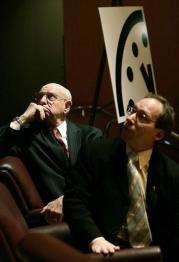
Ambassador Thomas Pickering (L) and Lawrence Krauss (R) participate in a press conference held by the The Bulletin of Atomic Scientists in 2006 in Washington, DC. The minute hand of the Doomsday clock was moved back slightly Thursday, indicating the world has inched away from nuclear or environmental catastrophe, but stressing it was not out danger.
The minute hand of the Doomsday clock was moved back slightly Thursday, indicating the world has inched away from nuclear or environmental catastrophe, but stressing it was not out danger.
"It is six minutes to midnight," the Bulletin of Atomic Scientists, which created the Doomsday clock in 1947, said in a statement read out as the clock's countdown to midnight was nudged back by one minute from where it has been since 2007.
"For the first time since atomic bombs were dropped in 1945, leaders of nuclear weapons states are cooperating to vastly reduce their arsenals and secure all nuclear bomb-making material," the statement by the panel of international scientists, including 19 Nobel laureates, said.
"For the first time ever, industrialized and developing countries alike are pledging to limit climate-changing gas emissions that could render our planet nearly uninhabitable.
"These unprecedented steps are signs of a growing political will to tackle the two gravest threats to civilization -- the terror of nuclear weapons and runaway climate change," it said.
Since it was created by scientists who helped to develop the world's first atomic weapons, the Doomsday clock has come to be seen as a barometer of what progress, if any, the world has made in moving away from the risk of nuclear, climate-caused or bio-warfare catastrophe.
Midnight on the clock signifies the apocalypse, and the minute hand symbolizes the countdown to disaster.
The last time the minute hand of the clock was moved was in 2007, when it was bumped two minutes closer to midnight.
In resetting the clock this year, the scientists said they were encouraged by recent developments, but had put back the clock by only one minute to show they were "mindful that the clock is ticking," said BAS's Lawrence Krauss.
"We moved it back by just one minute and what that means is that there's great potential for it to move again, in either direction," said Krauss, a physicist and co-chair of BAS's board of sponsors.
"We have a unique opportunity right now to begin to free ourselves from the terror of nuclear weapons and to slow drastic changes to our shared global environment.
"We must take advantage of that opportunity now," said Krauss, calling on world leaders, scientists and ordinary people to work together to make the world safer.
"Let's not blow it," he urged.
The Bulletin of Atomic Scientists was founded in 1945 by scientists from the University of Chicago who had helped to develop the first atomic weapons.
(c) 2010 AFP
-
Bulletin of Atomic Scientists 60 years old
Nov 30, 2005 |
not rated yet |
0
-
U.S. says it will discard some plutonium
Sep 18, 2007 |
not rated yet |
0
-
U. S. envisions a new generation of nuclear weapons
Mar 19, 2007 |
not rated yet |
0
-
American Physical Society Urges Public Debate of Potential Nuclear Weapons Use
Apr 27, 2006 |
not rated yet |
0
-
A step closer to an ultra precise atomic clock
Apr 16, 2009 |
not rated yet |
0
-
Engineers build first sub-10-nm carbon nanotube transistor
Feb 01, 2012 |
4.9 / 5 (31) |
30
-
Something old, something new: Evolution and the structural divergence of duplicate genes
Jan 31, 2012 |
4.6 / 5 (7) |
1
-
The hidden nanoworld of ice crystals: Revealing the dynamic behavior of quasi-liquid layers
Jan 30, 2012 |
5 / 5 (3) |
1
-
Stock market network reveals investor clustering
Jan 27, 2012 |
3.9 / 5 (23) |
8
-
Of microchemistry and molecules: Electronic microfluidic device synthesizes biocompatible probes
Jan 26, 2012 |
5 / 5 (1) |
0
-
Bohr-Einstein debate: why did Bohr not simply say...
Feb 06, 2012
-
Best/Worst U.S. Presidents
Jan 31, 2012
- More from Physics Forums - History & Humanities
More news stories
Employers feel no love for unscrupulous practice of 'service sweethearting'
A new study led by two Florida State University marketing professors finds that some frontline service employees who are rewarded for hikes in customer loyalty and satisfaction also may engage in "service ...
Other Sciences / Economics & Business
5 hours ago |
4 / 5 (1) |
4
A frank discussion of the power law and linking correlation to causation
(PhysOrg.com) -- Michael Stumpf a mathematics professor at Imperial College in London, and Mason Porter a lecturer at Oxford have teamed together to write and publish a perspective piece in Science regarding the in ...
The question of life in the ancient world
Theres a general feeling that we dont get the Greeks ancient or modern. Many, including heads of state like Angela Merkel, visibly shake their head in exasperation, rightly or wrongly, at ...
Other Sciences / Archaeology & Fossils
10 hours ago |
1 / 5 (1) |
4
Sonic Cradle lands spot in TED exhibition
A Simon Fraser University graduate student project that melds music, meditation and modern technology has landed a rare spot as an exhibit at TEDActive 2012 in Palm Springs, California this month.
7 hours ago |
not rated yet |
0
Chilean miners' rescue capsule on show in London
The capsule used to rescue Chilean miners trapped underground for two months goes on display Saturday at the Science Museum in London -- the first time it has been seen in Europe.
9 hours ago |
not rated yet |
0
Google users warned of threat to smartphone wallets
Users of Google smartphone wallets were being warned on Friday that there is a way to crack pass codes intended to thwart thieves from going on illicit shopping sprees.
Anonymous knocks CIA website offline (Update)
The website of the Central Intelligence Agency was inaccessible on Friday after the hacker group Anonymous claimed to have knocked it offline.
Complex wiring of the nervous system may rely on a just a handful of genes and proteins
Researchers at the Salk Institute have discovered a startling feature of early brain development that helps to explain how complex neuron wiring patterns are programmed using just a handful of critical genes. ...
NASA sees wide-eyed cyclone Jasmine
Cyclone Jasmine's eye has opened wider on NASA satellite imagery, as it moves through the Southern Pacific Ocean.
NASA sees Giovanna reach cyclone strength, threaten Madagascar
Tropical Storm 12S built up steam and became a cyclone on February 10, 2012 as NASA's Terra satellite passed overhead. Residents of east-central Madagascar should prepare for this cyclone to make landfall ...
Putting the squeeze on planets outside our solar system
(PhysOrg.com) -- Using high-powered lasers, scientists at Lawrence Livermore National Laboratory and collaborators discovered that molten magnesium silicate undergoes a phase change in the liquid state, abruptly ...
Jan 14, 2010
Rank: 1 / 5 (1)
Population Growth:estimated 9,309,051,539 by 2050
Religious: (God/Allah/- save the world!)
The Egyptians,Greeks,Romans,Mayans, would suggest differently, but perhaps there were not enough sacrifices,(hindus/muslims - must try harder.)
Climate Change: If you add sugar to tea it's going to get sweeter.
If you add C02 to the atmosphere its going to get Hotter. C02 is now at 387.27ppm up from 385.54ppm last year.
Habitat loss: By 2022, 20% of all living species in recent times will be extinct. This suggests there will be 0% living in the future.
World war 3, disease,famine,war should cull the human population to sustainable levels. Estimates suggest 1 in 6 will survive.(subsistence farmers, nomads)
Earth's resources have been used up. No easily available natural gas or oil, surface coal has been mined.
Back to pre-iron age.
Sodit
Jan 14, 2010
Rank: 5 / 5 (2)