Punishment important in plant-pollinator relationship
January 14, 2010
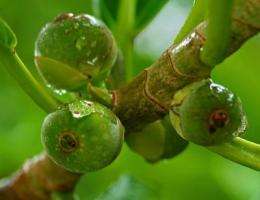
Female wasps enter fig inflorescences. Inside, they usually pollinate the fig and lay their eggs. However, sometimes wasps do not carry any pollen. What happens in this case? Credit: Marcos Guerra
Figs and the wasps that pollinate them present one of biologists' favorite examples of a beneficial relationship between two different species. In exchange for the pollination service provided by the wasp, the fig fruit provides room and board for the wasp's developing young. However, wasps do not always pollinate the fig. Fig trees "punish" these "cheaters" by dropping unpollinated fruit, killing the wasp's offspring inside, report researchers working at the Smithsonian Tropical Research Institute.
Their results, published in the Proceedings of the Royal Society, show that sanctions against cheaters may be critical to maintain the relationship.
"Relationships require give and take. We want to know what forces maintain this 80-million-year-old arrangement between figs and their wasp pollinators." said lead author, Charlotte Jandér, graduate student in Cornell University's Department of Neurobiology and Behavior, who conducted the study as a Smithsonian pre-doctoral fellow. "What prevents the wasps from reaping the benefits of the relationship without paying the costs?"
Some wasp species passively carry pollen that sticks to their bodies. Others actively collect pollen in special pouches. Jandér evaluated the ability of six different fig tree-fig wasp species pairs to regulate cheating. She introduced either a single pollen-free wasp, or a wasp carrying pollen, into a mesh bag containing an unpollinated fig. The wasps entered the figs to lay their eggs. Jandér found that trees often dropped unpollinated figs before young wasps could mature.
"This is really about the all-too-human theme of crime and punishment. We found that in actively pollinated fig species—when wasps expend time and energy to collect and deposit pollen-- wasps that did not provide the basic service of pollination were sanctioned. However, in passively pollinated species—when the wasps do not need to make an effort to pollinate--sanctions were absent," said Allen Herre, STRI staff scientist. "Although we still need to clearly understand the costs associated with applying sanctions, it seems like sanctions were only present where needed."
"Sanctions seem to be a necessary force in keeping this, and other, mutually-beneficial relationships on track when being part of a mutualism is costly," said Jandér. "In our study, we saw less cheating when sanctions were stronger. Similar results have been found among human societies and in social insects. It is very appealing to think that the same general principles could help maintain cooperation both within and among species."
Provided by Smithsonian Tropical Research Institute
-
Cooperation between figs, wasps and parasites proves 3 is not always a crowd
Mar 11, 2008 |
not rated yet |
0
-
Well-traveled wasps provide hope for vanishing species
Nov 09, 2009 |
not rated yet |
0
-
Hawaii looks at wasps to control invaders
Feb 28, 2008 |
not rated yet |
0
-
Scientists study insect 'egg police'
Nov 08, 2006 |
not rated yet |
0
-
Research on viral origins suggests new definition of virus may be needed
Feb 12, 2009 |
not rated yet |
0
-
Engineers build first sub-10-nm carbon nanotube transistor
Feb 01, 2012 |
4.9 / 5 (31) |
30
-
Something old, something new: Evolution and the structural divergence of duplicate genes
Jan 31, 2012 |
4.6 / 5 (7) |
1
-
The hidden nanoworld of ice crystals: Revealing the dynamic behavior of quasi-liquid layers
Jan 30, 2012 |
5 / 5 (3) |
1
-
Stock market network reveals investor clustering
Jan 27, 2012 |
3.9 / 5 (23) |
8
-
Of microchemistry and molecules: Electronic microfluidic device synthesizes biocompatible probes
Jan 26, 2012 |
5 / 5 (1) |
0
-
Stem cell question.
1 hour ago
-
Protease cleavage
8 hours ago
-
Pertubance in a model
14 hours ago
-
Cancer drugs and Alzheimer's, Oh my!
22 hours ago
-
Squishing cells
23 hours ago
-
Any books/articles for evolutionary stable strategy models in humans?
Feb 09, 2012
- More from Physics Forums - Biology
More news stories
The power of estrogen -- male snakes attract other males
A new study has shown that boosting the estrogen levels of male garter snakes causes them to secrete the same pheromones that females use to attract suitors, and turned the males into just about the sexiest ...
12 hours ago |
4.8 / 5 (5) |
1
|
Grass to gas: Researchers' genome map speeds biofuel development
Researchers at the University of Georgia have taken a major step in the ongoing effort to find sources of cleaner, renewable energy by mapping the genomes of two originator cells of Miscanthus x giganteus, a large perenn ...
9 hours ago |
3.8 / 5 (5) |
0
|
Experts reveal how plants don't get sunburn
(PhysOrg.com) -- Experts at the University of Glasgow have discovered how plants survive the harmful rays of the sun.
12 hours ago |
4.7 / 5 (3) |
0
|
Miami battling invasion of giant African snails
No one knows how they got there. But an invasion of African giant snails has southern Florida in a panic over potential crop damage, disease and general yuckiness surrounding the slimy gastropods.
16 hours ago |
4 / 5 (1) |
4
Protein libraries in a snap
(PhysOrg.com) -- A Rice University undergraduate will depart with not only a degree but also a possible patent for his invention of an efficient way to create protein libraries, an important component of biomolecular ...
16 hours ago |
4.8 / 5 (4) |
0
|
Google users warned of threat to smartphone wallets
Users of Google smartphone wallets were being warned on Friday that there is a way to crack pass codes intended to thwart thieves from going on illicit shopping sprees.
Anonymous knocks CIA website offline (Update)
The website of the Central Intelligence Agency was inaccessible on Friday after the hacker group Anonymous claimed to have knocked it offline.
Complex wiring of the nervous system may rely on a just a handful of genes and proteins
Researchers at the Salk Institute have discovered a startling feature of early brain development that helps to explain how complex neuron wiring patterns are programmed using just a handful of critical genes. ...
New error-correcting codes guarantee the fastest possible rate of data transmission
Error-correcting codes are one of the triumphs of the digital age. Theyre a way of encoding information so that it can be transmitted across a communication channel such as an optical fiber o ...
Humans may have helped the decline of African rainforests 3000 years ago
(PhysOrg.com) -- Large areas of rainforests in Central Africa mysteriously disappeared over three thousand years ago, to be replaced by savannas. The prevailing theory has been that the cause was a change ...
New power source discovered
(PhysOrg.com) -- Researchers at the Massachusetts Institute of Technology (MIT) and RMIT University have made a breakthrough in energy storage and power generation.