Jetting into the Quark-Gluon Plasma
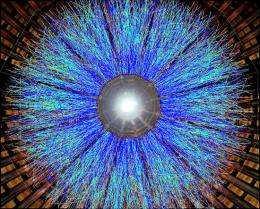
After the quark-gluon plasma filled the universe for a few millionths of a second after the big bang, it was over 13 billion years until experimenters managed to recreate the extraordinarily hot, dense medium on Earth. The JET Collaboration, a team from six universities and three national laboratories led by Berkeley Lab’s Nuclear Science Division, is now developing a new and highly detailed theoretical picture of this unique state of the early universe.
The Department of Energy’s Office of Nuclear Physics recently named Berkeley Lab’s Nuclear Science Division to lead a nine-institution collaboration investigating the “Quantitative Jet and Electromagnetic Tomography of Extreme Phases of Matter in Heavy-Ion Collisions” - JET, for short.
The JET Collaboration is a five-year theoretical effort to understand the properties of the extraordinarily hot and dense state of matter known as the quark-gluon plasma. The quark-gluon plasma filled the Universe a few millionths of a second after the big bang but instantly vanished, condensing into the protons and neutrons and other particles from which the present Universe descended.
Some 13.7 billion years later, experimenters recreated the quark-gluon plasma on Earth, using the Relativistic Heavy Ion Collider (RHIC) at Brookhaven National Laboratory. The first heavy-ion collisions occurred at RHIC in 2000, but confirming the occurence of the quark-gluon plasma in these events took several more years of data collection and analysis.
Freeing the quarks
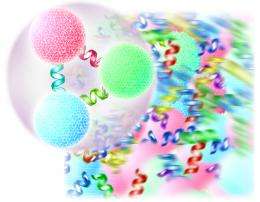
Quarks come in three different “colors,” and it takes three quarks to build a proton or a neutron; as carriers of the color charge, an aspect of the strong nuclear interaction, gluons literally glue the quarks together.
Under ordinary conditions neither quarks nor gluons are ever free. The farther apart they get, the stronger the force between them. Because mass and energy are interchangeable, as described by Einstein’s E=Mc2, eventually the energy that would be needed to separate them goes into creating new bound quarks instead.
RHIC was designed to collide heavy nuclei (as heavy as gold, whose nucleus consists of 79 protons and 118 neutrons) at energies so high that during the near-light-speed collisions, conditions cease to be anything like ordinary. Dense, hot fireballs blossom in the collisions, forming a plasma in which neither quarks nor gluons are bound together; instead they move independently with almost complete freedom.
The RHIC results held some surprises. Unlike more familiar plasmas in which electrically charged particles are separated from one another, the quark-gluon plasma consists of color charges. The quark-gluon plasma produced at RHIC turned out to be more like a liquid than a gas.
“One of the main discoveries at RHIC is that the quark-gluon plasma produced in heavy-ion collisions behaves as a perfect fluid with very small viscosity,” says Xin-Nian Wang, a senior scientist in the Nuclear Theory Group in Berkeley Lab’s Nuclear Science Division (NSD). Wang is the co-spokesperson and project director of the JET Collaboration.
Perfect fluidity arises because the plasma’s constituents are strongly coupled, causing their collective flow. And the quark-gluon plasma flows freely, like low-viscosity motor oil in a hot engine - much more freely, in fact, Wang says, because its specific shear viscosity is “an order of magnitude less than that of water.”
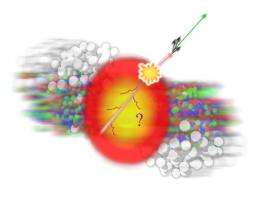
Another RHIC discovery was the predicted but never-before-seen “jet quenching.” When individual particles collide in a vacuum - as when protons collide in CERN’s Large Hadron Collider, for example - the debris often flies out in a pair of jets; particles like pions or kaons detected on one side of the detector are correlated, in terms of total momentum and energy, with particles detected on the opposite side.
“But when heavy ions collide, they produce an incredibly dense medium, 30 to 50 times as dense as an ordinary nucleus,” Wang says. “The farther a jet of particles has to push through this strongly interacting nuclear matter, the more energy it loses. One jet from the back-to-back pair may not escape the fireball at all.”
The energy of the trapped jet has to go somewhere. The energetic particles that are initially produced decay to softer ones which further interact with the medium, producing shock waves in the fluid. As with the sonic boom from a jet plane “breaking the sound barrier” - flying faster than the speed of sound in air - the shock wave from a jet swallowed by the quark-gluon plasma could be used to measure the velocity of sound in the plasma.
The debris from heavy-ion collisions indicates that free quarks and gluons recombine into hadrons (which include pions and kaons made of two quarks and protons and neutrons made of three quarks) while the plasma is cooling; this also affects how the jets propagate.
Probing the plasma
Jets are called “hard probes.” Although by nature strongly interacting, they are moving so fast and with so much energy that their interaction with the surrounding free quarks and gluons in the plasma is actually relatively weak. A jet’s ability to transfer energy and momentum to the medium as it moves through the fireball is known as the jet transport coefficient (JTC), which is related to the plasma’s viscosity: the smaller the viscosity - and the viscosity of the quark-gluon plasma is very small indeed - the larger the JTC.
It’s not just the degree of jet quenching, a figure that emerges in the data from millions of collision events, but the orientation, directionality, and composition of the jets that have much to tell about what’s inside the fireball, and thus about the properties of the quark-gluon plasma.
Another kind of probe, an electromagnetic probe, is so weak there is virtually no interaction with the medium at all. Electromagnetic probes appear when a jet of particles in one direction is balanced not by another jet but by a single, very energetic photon.
The task of the JET Collaboration is to use the existing evidence from the RHIC results to calculate in detail what’s really going on inside the strongly interacting quark-gluon plasma - the kind of three-dimensional picture of an otherwise invisible interior that’s called tomography, as in computed axial tomography, the familiar CAT scan.
Three kinds of phenomena are critical to the completion of the task: collectivity, to determine the viscosity of the medium; jets, to determine the jet transport coefficient; and the excitation of the medium, to determine the velocity of sound within it.
More than one kind of calculation will be required. Different assumptions and different codes must be used to model different kinds of interactions and different properties, and the results don’t always agree. The JET Collaboration includes representatives from major institutions that have made significant contributions to the study of the hot, dense matter in heavy-ion collisions, often approaching the question from different points of view. Working together, a consistent picture of the quark-gluon plasma will emerge.
Once the calculations are complete, having taken into account the entire energy spectrum of particles emerging from millions of evanescent fireballs, the new theoretical picture of this unique state of the early universe will be tested against observations at the newly upgraded RHIC and at the ALICE experiment at the Large Hadron Collider (LHC) at CERN. (The LHC collides protons for most of the year, but for a month each year it will collide heavy ions in the form of lead nuclei.)
The JET Collaboration
In the JET Collaboration, Berkeley Lab will be represented by theorists Wang, Volker Koch, and Feng Yuan. The Lab’s leadership in both the theory of the quark-gluon plasma and in its experimental exploration through the Relativistic Nuclear Collision (RNC) group uniquely positions the Lab to head the Collaboration.
The idea of jet quenching was first proposed for proton-proton collisions in the early 1980s, by James Daniel Bjorken of the Stanford Linear Accelerator Center. The theory linking jet quenching to the quark-gluon plasma in heavy-ion collisions was later developed by Xin-Nian Wang and Miklos Gyulassy; Gyulassy was with Berkeley Lab at the time and is now at Columbia University, where he is a member of the JET Collaboration.
On the experimental side, the heart of the STAR experiment at RHIC is a time projection chamber built at Berkeley Lab and invented here by David Nygren of the Physics Division; STAR is one of many time projection chambers around the world, including the heart of the ALICE experiment at the LHC. The electromagnetic calorimeter, EMCal, which will trigger the recording of interesting jet events in ALICE, is being constructed by an international team led by U.S. members of ALICE, with project management by Berkeley Lab’s Peter Jacobs of NSD and Joseph Rasson of Engineering.
Other DOE labs participating in the JET Collaboration are Lawrence Livermore, represented by Ramona Vogt, and Los Alamos, represented by Ivan Vitev. In addition to Columbia University, represented by Gyulassy, other universities include Duke, represented by Steffen Bass and Berndt Mueller, the JET Collaboration’s co-spokesperson, plus Charles Gale and Sangyong Jeon of McGill, Ulrich Heinz and Abhijit Majumder of Ohio State, Denes Molnar of Purdue, and Rainer Fries and Che-Ming Ko of Texas A&M.
JET is one of three topical collaborations established by DOE’s Office of Nuclear Physics. Over a period of five years, with a budget of $2.5 million, the JET Collaboration will not only develop theory but work closely with experimentalists, train students and postdoctoral fellows, and form associations with a wide range of researchers in the nuclear science community at institutions in the U.S. and abroad.
More information: How heavy ions collide at RHIC to create the quark-gluon plasma
Wikepedia’s article on the quark-gluon plasma
The STAR experiment at RHIC
The ALICE experiment at the LHC
Provided by Lawrence Berkeley National Laboratory


