Making microscopic worms into a more deadly insecticide
January 15, 2010
Making microscopic worms into a more deadly insecticide

Enlarge

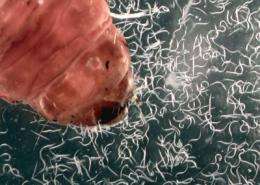
Some species of microscopic nematode worms can be an effective insecticide. In this enlarged image, baby nematodes leave a larva cadaver that their parents killed. A new study identified the genetic changes that make natural-born nematodes better bug-killers than their farm-raised cousins. Credit: Byron Adams/BYU

Microscopic nematode worms can be a potent organic insecticide, killing crop-raiding bugs without harming plants or beneficial insects and without environmental side effects of chemical. The problem is that when the worms are mass-bred for agricultural purposes, they tend to, as Byron Adams says, "wimp out," and are not as deadly as their cousins that grow in the wild.

The Brigham Young University biology professor and his students analyzed the genetic changes in lab-raised worms that make them less deadly to bugs. These results will help preserve the talents of what Adams affectionately calls "natural-born killers." The findings also help us understand how to defeat parasites that harm beneficial plants, animals, and those that cause human disease.

The team reports their results in the new issue of . Graduate student Bishwo Adhikari is the lead author; two coauthors who were undergraduates at the time are now pursuing PhDs at Caltech and the University of Wisconsin.

How the worms protect crops

When the worm, called H. bacteriophora finds an insect in the soil, it crawls inside and, Adams says, "barfs up" special bacteria that had hitched a ride with the worm.

The bacteria quickly kill the insect and spread, and the worm gobbles up the bacteria and reproduces. The bacteria and baby worms eat what's left of the bug, and then head off together in search of another insect host.

Plants and other insects, such as bees, are spared, and the worms are not toxic to humans. The bacteria are only deadly when introduced inside the insect, not when ingested, and can't survive in soil or water. So they are only a threat to the insects targeted by the worm, which include the Japanese beetle, many species of weevils, the Colorado potato beetle, cucumber beetles and many others. These pests can wreak havoc on citrus trees, turfgrass, potatoes, and many other crops.

The worms occur naturally in concentrations too small to be effective at eradicating pests. So farmers can purchase bulk quantities of nematodes mass produced in huge fermentation tanks and spread them through irrigation. Producing deadly nematodes by the barrel is the problem.

Lab-grown worms wimp out

Previous research has shown that the worms are less deadly to insects when grown away from their natural habitat. After a few generations, they don't reproduce or find hosts as well, they have a tougher time tolerating heat, and they aren't as toxic to the bugs they do find.

"We wanted to know the genetic mechanisms that were responsible for these changes, so we did a series of experiments to look at differences in gene expression between the killers and the wimps," said Adams.

The team examined all of the expressed genes of an inbred line (wimps) of worms and their original parental line (killers). They found differences in the expression of 1,185 genes, including those involved with metabolism, virulence and longevity.

"We show that even very small changes in the relative expression of these genes can produce large changes in wimpiness," Adams said.

Now scientists can take steps to improve the quality of worms shipped to farmers. But that's not what has Adams most excited about this work.

Even broader application

"The research also shows that many of the genes involved in the killer/wimp traits in these worms are unique to worms that are nasty parasites of plants, humans and other animal friends," Adams says.

Some of these genes they identified play fundamental roles in host-parasite interactions, such as virulence and the suppression of host defense systems. That means the products of these genes could be promising targets for pharmaceuticals.

Other interventions could prevent disease by disrupting and altering the functions of these genes - taking what was learned about how the bug-killing nematodes evolved to became less deadly and leading harmful parasites down the same road.

Provided by Brigham Young University (news : web)

4.9 /5 (7 votes)  

Rank 4.9 /5 (7 votes)
Related Stories
Relevant PhysicsForums posts
  • Pertubance in a model
    created5 hours ago
  • Cancer drugs and Alzheimer's, Oh my!
    created13 hours ago
  • Squishing cells
    created14 hours ago
  • Any books/articles for evolutionary stable strategy models in humans?
    createdFeb 09, 2012
  • Science behind the bore feeling?
    createdFeb 09, 2012
  • Homo Sapien vs. Chimpanzee - Divergence Timeline
    createdFeb 09, 2012
  • More from Physics Forums - Biology

More news stories

Grass to gas: Researchers' genome map speeds biofuel development

Researchers at the University of Georgia have taken a major step in the ongoing effort to find sources of cleaner, renewable energy by mapping the genomes of two originator cells of Miscanthus x giganteus, a large perenn ...

Biology / Biotechnology

created 19 minutes ago | popularity 5 / 5 (1) | comments 0 | with audio podcast

The power of estrogen -- male snakes attract other males

A new study has shown that boosting the estrogen levels of male garter snakes causes them to secrete the same pheromones that females use to attract suitors, and turned the males into just about the sexiest ...

Biology / Plants & Animals

created 3 hours ago | popularity not rated yet | comments 0 | with audio podcast

Experts reveal how plants don't get sunburn

(PhysOrg.com) -- Experts at the University of Glasgow have discovered how plants survive the harmful rays of the sun.

Biology / Cell & Microbiology

created 3 hours ago | popularity 5 / 5 (2) | comments 0 | with audio podcast

Protein libraries in a snap

(PhysOrg.com) -- A Rice University undergraduate will depart with not only a degree but also a possible patent for his invention of an efficient way to create protein libraries, an important component of biomolecular ...

Biology / Cell & Microbiology

created 6 hours ago | popularity 5 / 5 (2) | comments 0 | with audio podcast

New drugs schedule makes horse racing a sure thing

What do Gai Waterhouse and Anthony Cummings have in common with Queen Elizabeth II?

Biology / Plants & Animals

created 3 hours ago | popularity not rated yet | comments 0


New understanding of DNA repair could eventually lead to cancer therapy

A research group in the Faculty of Medicine & Dentistry at the University of Alberta is hoping its latest discovery could one day be used to develop new therapies that target certain types of cancers.

Hovering not hard if you're top-heavy, researchers find

Top-heavy structures are more likely to maintain their balance while hovering in the air than are those that bear a lower center of gravity, researchers at New York University's Courant Institute of Mathematical Sciences ...

Night, weekend delivery OK for babies with birth defects

Weekday delivery is no better than night or weekend delivery for infants with birth defects, according to a new study presented today at The Pregnancy Meeting, the Society for Maternal-Fetal Medicine's annual conference. ...

Sonic Cradle lands spot in TED exhibition

A Simon Fraser University graduate student project that melds music, meditation and modern technology has landed a rare spot as an exhibit at TEDActive 2012 in Palm Springs, California this month.

Drug halts organ damage in inflammatory genetic disorder

A new study shows that Kineret (anakinra), a medication approved for the treatment of rheumatoid arthritis, is effective in stopping the progression of organ damage in people with neonatal-onset multisystem inflammatory disease ...

Cochlear implants may be safe, effective for organ transplant patients

Cochlear implants may be a safe, effective option for some organ transplant patients who've lost their hearing as an unfortunate consequence of their transplant-related drug regime, researchers report.