Suspension bridge design may not be the best
January 15, 2010 by Lin Edwards
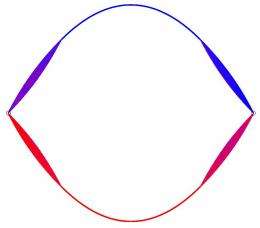
Forms found to be more optimal than a parabola to carry a uniform load between pinned supports (compressive elements shown in blue). Image credit: Matthew Gilbert
(PhysOrg.com) -- A team of structural engineers from the University of Sheffield in the UK say the assumptions originating with 17th century Dutch engineer Christiaan Huygens may need to be re-examined. Huygens assumed the best design for a suspension bridge was based on towers and simple cables hanging between them to support the weight, but the Sheffield group say a more complex design using less material would be more efficient.
The Huygens idea is behind well-known suspension bridges such as the Golden Gate bridge in San Fancisco and the Akashi-Kaikyō Bridge in Japan, which is around 700 meters longer. Basically, the road or railway is suspended from thin hangers dropping from two cables that stretch between the two towers. The cables automatically form a U-shaped curve, or parabola, and this arrangement has been assumed to be the most efficient.
Matthew Gilbert and his colleagues from the Department of Civil and Structural Engineering noted that the calculations assumed the cables could withstand tension but not compression, but in reality both forces are in play. They developed a numerical layout optimization program to check the optimal design and were surprised to find Huygens' parabolic arch rib or cable was not optimal, and the amount of material needed for the cabling could be reduced if the ends were replaced with a network of truss bars known as the "Hencky net". Gilbert said they expected the parabolic design to be confirmed and they tried to work out what was wrong when their software continually nominated the more complex design. "It ended up that the only option was that the current wisdom was wrong," Gilbert said.
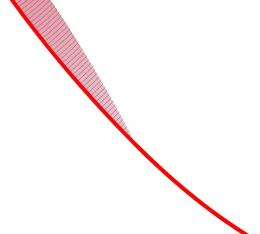
The amount of cable that can be replaced depends on the level of compression the material can withstand. If it can take tension and compression to an equal degree, using a net can reduce the amount of material needed to build the bridge by 0.3%. Other structural engineers have pointed out that this small reduction in material may not provide an economic justification for making a more complicated bridge, since they would undoubtedly be more expensive to manufacture.
The work is published in the January edition of the Structural and Multidisciplinary Optimization journal.
More information: Optimum structure to carry a uniform load between pinned supports, Structural and Multidisciplinary Optimization, http://www.springe … 505v4721655/
© 2010 PhysOrg.com
-
Terrorist-resistant bridge is developed
Jan 26, 2006 |
not rated yet |
0
-
Bridges will rock -- safely -- with new quake design
May 09, 2007 |
not rated yet |
0
-
Strings As Structural Elements? Engineers Devise Mathematics For New Age Structures
Mar 28, 2006 |
not rated yet |
0
-
Modern tests demonstrate soundness of old iron bridge
Dec 21, 2009 |
not rated yet |
0
-
Scientists work to stop bridge corrosion
Dec 08, 2005 |
not rated yet |
0
-
Engineers build first sub-10-nm carbon nanotube transistor
Feb 01, 2012 |
4.9 / 5 (31) |
30
-
Something old, something new: Evolution and the structural divergence of duplicate genes
Jan 31, 2012 |
4.6 / 5 (7) |
1
-
The hidden nanoworld of ice crystals: Revealing the dynamic behavior of quasi-liquid layers
Jan 30, 2012 |
5 / 5 (3) |
1
-
Stock market network reveals investor clustering
Jan 27, 2012 |
3.9 / 5 (23) |
8
-
Of microchemistry and molecules: Electronic microfluidic device synthesizes biocompatible probes
Jan 26, 2012 |
5 / 5 (1) |
0
-
Calling function with no input argument
4 hours ago
-
Force free body diagram problem on gym equipment
5 hours ago
-
Empirical data regarding shower heads and water
13 hours ago
-
feed hold button on CNC lathe
Feb 09, 2012
-
RFAC in Fortran
Feb 09, 2012
-
dynamics 2/32
Feb 08, 2012
- More from Physics Forums - General Engineering
More news stories
New error-correcting codes guarantee the fastest possible rate of data transmission
Error-correcting codes are one of the triumphs of the digital age. Theyre a way of encoding information so that it can be transmitted across a communication channel such as an optical fiber o ...
Technology / Computer Sciences
7 hours ago |
5 / 5 (3) |
4
|
Small modular reactor design could be a 'SUPERSTAR'
(PhysOrg.com) -- Though most of today's nuclear reactors are cooled by water, we've long known that there are alternatives; in fact, the world's first nuclear-powered electricity in 1951 came from a reactor ...
Technology / Energy & Green Tech
7 hours ago |
4.2 / 5 (10) |
16
|
New power source discovered
(PhysOrg.com) -- Researchers at the Massachusetts Institute of Technology (MIT) and RMIT University have made a breakthrough in energy storage and power generation.
Technology / Energy & Green Tech
6 hours ago |
5 / 5 (5) |
2
|
Advanced power-grid model finds low-cost, low-carbon future in West
(PhysOrg.com) -- The least expensive way for the Western U.S. to reduce greenhouse gas emissions enough to help prevent the worst consequences of global warming is to replace coal with renewable and other ...
Technology / Energy & Green Tech
7 hours ago |
5 / 5 (2) |
7
|
Zuckerberg's focus drives Facebook's ascent
When Mark Zuckerberg showed up to rent Judy Fusco's Los Altos, Calif., house in the fall of 2004, soon after he'd arrived in Silicon Valley, the landlord was immediately struck by his confidence.
3 hours ago |
1 / 5 (1) |
0
Human cognitive performance suffers following natural disasters, researchers find
Not surprisingly, victims of a natural disaster can experience stress and anxiety, but a new study indicates that it might also cause them to make more errors - some serious - in their daily lives. In their upcoming Human Fa ...
The power of estrogen -- male snakes attract other males
A new study has shown that boosting the estrogen levels of male garter snakes causes them to secrete the same pheromones that females use to attract suitors, and turned the males into just about the sexiest ...
Putting the squeeze on planets outside our solar system
(PhysOrg.com) -- Using high-powered lasers, scientists at Lawrence Livermore National Laboratory and collaborators discovered that molten magnesium silicate undergoes a phase change in the liquid state, abruptly ...
Both maternal and paternal age linked to autism
Older maternal and paternal age are jointly associated with having a child with autism, according to a recently published study led by researchers at The University of Texas Health Science Center at Houston (UTHealth).
Curry spice component may help slow prostate tumor growth
Curcumin, an active component of the Indian curry spice turmeric, may help slow down tumor growth in castration-resistant prostate cancer patients on androgen deprivation therapy (ADT), a study from researchers ...
Humans may have helped the decline of African rainforests 3000 years ago
(PhysOrg.com) -- Large areas of rainforests in Central Africa mysteriously disappeared over three thousand years ago, to be replaced by savannas. The prevailing theory has been that the cause was a change ...

Jan 15, 2010
Rank: 4.5 / 5 (6)
Occam's Razor time, mayhaps ??
Jan 15, 2010
Rank: 1 / 5 (1)
Jan 15, 2010
Rank: 4.7 / 5 (3)
Huygens 17th Century invention standing up to modern CAD and modelling is impressive.
Jan 15, 2010
Rank: 3.9 / 5 (7)
Jan 15, 2010
Rank: 4.3 / 5 (3)
My first thought, as well. However, these aren't exactly free-hanging cables: there's a roadway suspended underneath, and it's constrained to be [mostly] straight. So that's a different weight load per length of cable for the various sections of the curve, which I can only assume pulls down the sides of the hyperbola, and turns it into a parabola...
Jan 16, 2010
Rank: 4 / 5 (1)
Name for me a cable that can withstand compression and tension to an equal degree, and I will name for you a column.
As an engineer, this article is so far from making sense that I have to hope that the author butchered the original meaning.
Jan 16, 2010
Rank: 4.8 / 5 (4)
I'm an engineer too and have just read the actual paper referred to: http://www.spring...4721655/
Basically the paper isn't about suspension bridges (I don't think these are mentioned once...). What it says is that the least weight (i.e. mathematically most optimal) structure to carry a uniformly distributed load between pinned supports is not a single parabolic element -if the material can withstand both tension and compression. Instead a truss is more optimal. This overturns established wisdom and is an interesting finding. I guess the author of this news article was trying to bring the work to life by referring to suspension bridges (whose cables are approximately parabolic because the approx. uniform deck weight is high in comparison to the weight of the cables). But the new form clearly doesn't look very practical to build
Jan 16, 2010
Rank: 3 / 5 (1)
I suppose an approximation would be to replace part of the 'not quite catenary' with a 'tension tube', either simply-cylindrical or triangular truss...
Snag then is connecting the flexible 'catenary' cable to the rigid portions. IIRC, one advantage of cable staying is that you can 'dissect' a very big cable into a multiple-point anchorage, safely dispersing the load...
Back to Occan's Razor again ??
Jan 18, 2010
Rank: 1 / 5 (1)
Jan 20, 2010
Rank: not rated yet
Also, the analysis assumes no buckling, which is untrue for a real structure and would again mean the Hencky net is not optimum.
Does the research overturn established wisdom? Not really. The press seem to be assuming that there's a belief that the optimum form of structure to carry a uniform load is parabolic. But actually, all that Huygens and others proved was that a member with no bending stiffness subject to a uniform load would naturally take up a parabolic profile, which is not the same thing at all. That particular misconception seems to come from the paper's abstract itself.
Birger - there are railway suspension bridges, one of the largest being the Tsing Ma Bridge in Hong Kong, which carries both road and rail without any problem.