Organized chaos gets robots going (Update)
January 17, 2010
Organized chaos gets robots going (Update)

Enlarge

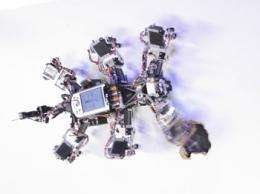
Following the principle of chaos control, the robot produces regular leg movements when walking normally. In addition, it can use the uncontrolled chaotic movement pattern to free itself when its leg is trapped in a hole. Image: Network Dynamics Group, Max Planck Institute for Dynamics and Self-Organization

(PhysOrg.com) -- Even simple insects can generate quite different movement patterns with their six legs. The animal uses various gaits depending on whether it crawls uphill or downhill, slowly or fast. Scientists from Gottingen have now developed a walking robot, which can flexibly and autonomously switch between different gaits. The success of their solution lies in its simplicity: a small and simple network with just a few connections can create very diverse movement patterns. To this end, the robot uses a mechanism for "chaos control."

In humans and animals, periodically recurring movements like walking or breathing are controlled by small neural circuits called "central pattern generators" (CPG). Scientists have been using this principle in the development of walking machines. To date, typically one separate CPG was needed for every gait. The receives information about its environment via several - about whether there is an obstacle in front of it or whether it climbs a slope. Based on this information, it selects the CPG controlling the gait that is appropriate for the respective situation.

This video is not supported by your browser at this time.

Movie: Escaping from danger from behind, orienting and self-protection

The robot developed by the Göttingen scientists now manages the same task with only one CPG that generates entirely different gaits and which can switch between these gaits in a flexible manner. This CPG is a tiny network consisting of two circuit elements. The secret of its functioning lies in the so-called "chaos control". If uncontrolled, the CPG produces a chaotic activity pattern. This activity, however, can very easily be controlled by the sensor inputs into periodic patterns that determine the gait. Depending on the sensory input signal, different patterns - and thus different gaits - are generated.

The connection between sensory properties and CPG can either be preprogrammed or learned by the robot from experience. The scientists use a key example to show how this works: the robot can autonomously learn to walk up a slope with as little energy input as possible. As soon as the robot reaches a slope, a sensor shows that the energy consumption is too high. Thereupon, the connection between the sensor and the control input of the CPG is varied until a gait is found that allows the robot to consume less energy. Once the right connections have been established, the robot has learned the relation between slope and gait. When it tries to climb the hill a second time, it will immediately adopt the appropriate gait.

This video is not supported by your browser at this time.

Movie: Robot exploits chaos for self-untrapping.

In the future, the robot will also be equipped with a memory device which will enable it to complete movements even after the sensory input ceases to exist. In order to walk over an obstacle, for instance, the robot would have to take a large step with each of its six legs. "Currently, the robot would not be able to handle this task - as soon as the obstacle is out of sight, it no longer knows which gait to use," says Marc Timme, scientist at the Max Planck Institute for Dynamics and Self-Organization. "Once the robot is equipped with a motor memory, it will be capable to use foresight and plan its movements".

More information: Silke Steingrube, Marc Timme, Florentin Wörgötter and Poramate Manoonpong, Self-organized adaptation of a simple neural circuit enables complex robot behaviour , Nature Physics, January 17th, 2010 (DOI: 10.1038/NPHYS1508)

Provided by Max-Planck-Gesellschaft (news : web)

4.8 /5 (12 votes)  

Rank 4.8 /5 (12 votes)
Related Stories
Relevant PhysicsForums posts
  • Wind Turbine Power
    created40 minutes ago
  • Steam Table issues
    created2 hours ago
  • electrostatic induction in a conductor should be immpossible
    created6 hours ago
  • Help! Physics Momentum/Impulse problem!
    created9 hours ago
  • Gauss' law cubes, how to prove
    created10 hours ago
  • what is significance of torque
    created12 hours ago
  • More from Physics Forums - General Physics

More news stories

SLAC, Stanford team focuses on high-energy electrons to treat cancer

Accelerator physicists at SLAC and cancer specialists from Stanford are working on a new technology that could dramatically reduce the time needed for cancer radiation treatments. The team ran an initial experiment ...

Physics / General Physics

created 44 minutes ago | popularity not rated yet | comments 0

Measurements from high-energy collisions lead to better understanding of why meson particles disappear

For several years, physicists at the Relativistic Heavy Ion Collider (RHIC) at Brookhaven National Laboratory (BNL), USA, have studied an unusual state of matter called the quark–gluon plasma, which they ...

Physics / General Physics

created 1 hour ago | popularity not rated yet | comments 0

Quantum physicist explains $100K offer for proof scaled-up quantum computing is impossible

(PhysOrg.com) -- MIT researcher Scott Aaronson has certainly riled the physics community with his offer this past Friday, of $100,000 to anyone who can prove that scaled-up quantum computing is impossible. ...

Physics / Quantum Physics

created Feb 08, 2012 | popularity 4.1 / 5 (11) | comments 32 | with audio podcast weblog

Explained: Sigma

It's a question that arises with virtually every major new finding in science or medicine: What makes a result reliable enough to be taken seriously? The answer has to do with statistical significance -- but ...

Physics / General Physics

created Feb 09, 2012 | popularity 5 / 5 (13) | comments 26

Physicists 'record' magnetic breakthrough

An international team of scientists has demonstrated a revolutionary new way of magnetic recording which will allow information to be processed hundreds of times faster than by current hard drive technology.

Physics / General Physics

created Feb 07, 2012 | popularity 4.5 / 5 (39) | comments 14 | with audio podcast


The power of estrogen -- male snakes attract other males

A new study has shown that boosting the estrogen levels of male garter snakes causes them to secrete the same pheromones that females use to attract suitors, and turned the males into just about the sexiest ...

Could Venus be shifting gear?

(PhysOrg.com) -- ESA’s Venus Express spacecraft has discovered that our cloud-covered neighbour spins a little slower than previously measured. Peering through the dense atmosphere in the infrared, the ...

Experts reveal how plants don't get sunburn

(PhysOrg.com) -- Experts at the University of Glasgow have discovered how plants survive the harmful rays of the sun.

Team isolates nerve cells involved in storing long term memory and gene proteins associated with them

(Medical Xpress) -- A research team in Taiwan has succeeded in isolating two nerve cells in fruit fly brains that are believed to be the major players in allowing for the formation of long term memories. Furthermore, ...

Fool's gold may prove an unlikely alternative to overexploited catalytic materials

Catalytic materials, which lower the energy barriers for chemical reactions, are used in everything from the commercial production of chemicals to catalytic converters in car engines. However, with current catalytic materials ...

News of plaque-clearing drug tops week of major advances against Alzheimer's disease

In the last eight days, scientists have delivered a powerful one-two punch in the fight to defeat Alzheimer's disease. At the same time, the White House and members of Congress are proposing increases in Alzheimer's research ...