Tying light in knots
January 17, 2010
Tying light in knots

Enlarge

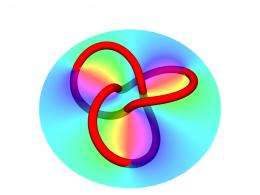
The coloured circle represents the hologram, out of which the knotted optical vortex emerges.

(PhysOrg.com) -- The remarkable feat of tying light in knots has been achieved by a team of physicists working at the universities of Bristol, Glasgow and Southampton, UK, reports a paper in Nature Physics this week.

Understanding how to control in this way has important implications for technology used in wide a range of industries.

Dr Mark Dennis from the University of Bristol and lead author on the paper, explained: "In a light beam, the flow of light through space is similar to water flowing in a river. Although it often flows in a straight line - out of a torch, , etc - light can also flow in whirls and eddies, forming lines in space called 'optical vortices'.

"Along these lines, or optical vortices, the intensity of the light is zero (black). The light all around us is filled with these dark lines, even though we can't see them".

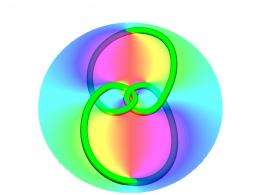
Optical vortices can be created with holograms which direct the flow of light. In this work, the team designed holograms using knot theory - a branch of abstract mathematics inspired by knots that occur in shoelaces and rope. Using these specially designed holograms they were able to create knots in optical vortices.
Tying light in knots
Enlarge

The coloured circle represents the hologram, out of which the knotted optical vortex emerges.

This new research demonstrates a physical application for a branch of mathematics previously considered completely abstract.

Professor Miles Padgett from Glasgow University, who led the experiments, said: "The sophisticated hologram design required for the experimental demonstration of the knotted light shows advanced optical control, which undoubtedly can be used in future laser devices".

"The study of knotted vortices was initiated by Lord Kelvin back in 1867 in his quest for an explanation of atoms", adds Dennis, who began to study knotted optical vortices with Professor Sir Michael Berry at Bristol University in 2000. "This work opens a new chapter in that history."

More information: Isolated optical vortex knots by Mark R. Dennis1, Robert P. King, Barry Jack, Kevin O'Holleran and Miles J. Padgett. Nature Physics, published online 17 January 2010.

Provided by University of Bristol (news : web)

4.8 /5 (38 votes)  

Filter


Move the slider to adjust rank threshold, so that you can hide some of the comments.


Display comments: newest first

Nik_2213
Jan 17, 2010

Rank: 5 / 5 (3)
If you were as surprised as me...
http://en.wikiped...l_vortex
sender
Jan 17, 2010

Rank: not rated yet
I would like to see how these vortices interact with nanocomposite infinite charge carrier ring arrays.
in7x
Jan 18, 2010

Rank: not rated yet
Can we tie any analogies together between light vortices and black holes?

It's curious, this field of study is absolutely exploding on all levels.
Crackpot
Jan 18, 2010

Rank: not rated yet
Tiny knots of light, or at least of electromagnetic waves, are used to explain the elementary particles in this alternative model:

http://classicala...ons.html
Rank 4.8 /5 (38 votes)
Related Stories
Relevant PhysicsForums posts
  • Steam Table issues
    created1 hour ago
  • Problem with the curl of electric field
    created1 hour ago
  • electrostatic induction in a conductor should be immpossible
    created4 hours ago
  • Help! Physics Momentum/Impulse problem!
    created7 hours ago
  • Gauss' law cubes, how to prove
    created9 hours ago
  • what is significance of torque
    created10 hours ago
  • More from Physics Forums - General Physics

More news stories

Physics research suggests new pathways for cancer progression

Observing that certain cancer cells may exhibit greater flexibility than normal cells, some scientists believe that this capability promotes rapid tumor growth. Now computer simulations developed by Boston University Biomedical ...

Physics / General Physics

created 22 hours ago | popularity 5 / 5 (1) | comments 0

Quantum physicist explains $100K offer for proof scaled-up quantum computing is impossible

(PhysOrg.com) -- MIT researcher Scott Aaronson has certainly riled the physics community with his offer this past Friday, of $100,000 to anyone who can prove that scaled-up quantum computing is impossible. ...

Physics / Quantum Physics

created Feb 08, 2012 | popularity 4.1 / 5 (11) | comments 32 | with audio podcast weblog

Explained: Sigma

It's a question that arises with virtually every major new finding in science or medicine: What makes a result reliable enough to be taken seriously? The answer has to do with statistical significance -- but ...

Physics / General Physics

created Feb 09, 2012 | popularity 5 / 5 (13) | comments 32

Physicists 'record' magnetic breakthrough

An international team of scientists has demonstrated a revolutionary new way of magnetic recording which will allow information to be processed hundreds of times faster than by current hard drive technology.

Physics / General Physics

created Feb 07, 2012 | popularity 4.5 / 5 (39) | comments 14 | with audio podcast

Diamond light, brighter than the sun

It’s the size of five football pitches and generates light 10 billion times brighter than the sun. As the Diamond Light Source celebrates its tenth anniversary this year, Penny Bailey visits one of the ...

Physics / General Physics

created Feb 07, 2012 | popularity 4.3 / 5 (7) | comments 15 | with audio podcast


New error-correcting codes guarantee the fastest possible rate of data transmission

Error-correcting codes are one of the triumphs of the digital age. They’re a way of encoding information so that it can be transmitted across a communication channel — such as an optical fiber o ...

A frank discussion of the power law and linking correlation to causation

(PhysOrg.com) -- Michael Stumpf a mathematics professor at Imperial College in London, and Mason Porter a lecturer at Oxford have teamed together to write and publish a perspective piece in Science regarding the in ...

High school students test best with 7 hours' rest

(Medical Xpress) -- Whether or not you know any high school students that actually get nine hours of sleep each night, that’s what federal guidelines currently prescribe.

The question of life in the ancient world

There’s a general feeling that we don’t get the Greeks – ancient or modern. Many, including heads of state like Angela Merkel, visibly shake their head in exasperation, rightly or wrongly, at ...

Soccer -- the link between managers and captains

Soccer managers regard their captains as an extension of themselves, according to new research from Northumbria University, which could explain why Fabio Capello quit as England manager following the FA row ...

Using economic evaluations for drug reimbursement decisions - what have we achieved?

Researchers at the University of York perform evaluations of the clinical and cost-effectiveness of drugs for the National Institute for Health and Clinical Excellence (NICE).