Going Beyond Moore's Law by Using the Third Dimension
January 18, 2010 By Lisa Zyga
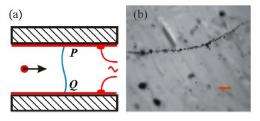
(A) Illustration of a conductive particle attracted to a disclination line that joins two electrodes at points P and Q. (B) Photograph of a horizontal necklace of particles. The red bar is 30 micrometers long. Image copyright: Fleury, et al. (c)2009 APS.
(PhysOrg.com) -- Scientists have demonstrated a new microwire fabrication technique in which microwires self-assemble themselves in a three-dimensional template made of nematic liquid crystals. Amidst concerns about Moore’s law eventually approaching a limit in two dimensions, the new fabrication method could enable researchers to continue to increase the density of transistors on integrated circuits by making use of the third dimension.
The researchers, Jean-Baptiste Fleury, David Pires, and Yves Galerne of the Institute of Physics and Chemistry of Materials of Strasbourg, in Strasbourg, France, have published their research in a recent issue of Physical Review Letters.
As the researchers explain, many different processes have been proposed in the past few years for fabricating high-quality nanowires. Generally, in order to connect nanowires to electrodes, researchers must confine them on a two-dimensional substrate and use the third dimension for manipulating the connections, often using a computer.
In their new study, the scientists show how to manufacture microwires that self-assemble themselves in a three-dimensional template and then connect themselves to electrodes with an accuracy of a few micrometers. First, the researchers took the two substrates to be connected, and filled the space between them with a nematic liquid crystal, which is the same substance used in many kinds of LCDs. Although the molecules in the liquid are free to move, they align themselves parallel to one another, except along threadlike (defect) lines (“nemato” in Greek means “threadlike”).
Next, the scientists created a defect line in the nematic liquid crystal that runs between electrodes in the two substrates. By rubbing the substrates in three different locations at a specific angle, the researchers produced a programmable disclination (i.e., a topological singularity or defect line). In this area, the molecules cannot orient themselves in any direction, creating a disclination that extends between the two substrates.
In addition to their ability to produce programmable disclinations, another property of nematic liquid crystals is that they attract small objects to the disclinations. This attraction occurs due to interference between the distortion from the disclination and the normal threadlike distortion from particles in the nematic liquid crystal. The interference results in a force on silica particles (which are added to the nematic liquid crystal), dragging them toward the disclination line.
Eventually, enough silica particles become trapped onto the line to form a micronecklace in which the particles are in loose contact with each other. To thoroughly join the particles together, the researchers applied a voltage difference between adjacent particles in order to polymerize monomers in the liquid crystal and eventually to stick the particles to one another. After a few hours, polymerization turned the micronecklace into a cohesive microwire.
“As far as I know, there are no other means, at the moment, able to produce microwires self-connected in 3D on designed electrodes,” Galerne told PhysOrg.com.
The researchers predict that this process can be extended to produce a large number of microwires between substrates simultaneously, which could lead to the development of large-scale three-dimensional integrated circuits. Although the microwires need to be separated from each other by a minimum distance, which presents a physical limitation, the method still has the potential to play a significant role in future electronics applications.
“The escape to the third dimension could clearly open possibilities,” Galerne said. “A simple manner could consist in connecting stacks of 2D integrated circuits. For the moment we are working on a method for producing nanowires of better quality (smoother shape, larger strength, and better conductivity).”
More information: Jean-Baptiste Fleury, David Pires, and Yves Galerne. “Self-Connected 3D Architecture of Microwires.” Physical Review Letters 103, 267801 (2009).
Copyright 2010 PhysOrg.com.
All rights reserved. This material may not be published, broadcast, rewritten or redistributed in whole or part without the express written permission of PhysOrg.com.
-
New type of liquid crystal identified; Holds promise of faster, lower priced liquid crystal displays
Jun 17, 2004 |
not rated yet |
0
-
Colluding with colloids: Scientists make liquid crystal discovery
Dec 14, 2006 |
not rated yet |
0
-
Micromuscles: Micrometer-Sized Actuators from Liquid-crystal Elastomers (w/ Video)
Aug 11, 2009 |
not rated yet |
0
-
Chemists get custom-designed microscopic particles to self-assemble in liquid crystal
Nov 25, 2009 |
not rated yet |
0
-
Speedier flexible electronics possible with new fabrication process
Mar 16, 2009 |
not rated yet |
0
-
Engineers build first sub-10-nm carbon nanotube transistor
Feb 01, 2012 |
4.9 / 5 (30) |
30
-
Something old, something new: Evolution and the structural divergence of duplicate genes
Jan 31, 2012 |
4.6 / 5 (7) |
1
-
The hidden nanoworld of ice crystals: Revealing the dynamic behavior of quasi-liquid layers
Jan 30, 2012 |
5 / 5 (3) |
1
-
Stock market network reveals investor clustering
Jan 27, 2012 |
3.9 / 5 (23) |
8
-
Of microchemistry and molecules: Electronic microfluidic device synthesizes biocompatible probes
Jan 26, 2012 |
5 / 5 (1) |
0
-
Light & Sight
1 hour ago
-
Wind Turbine Power
4 hours ago
-
Steam Table issues
6 hours ago
-
electrostatic induction in a conductor should be immpossible
9 hours ago
-
Help! Physics Momentum/Impulse problem!
12 hours ago
-
Gauss' law cubes, how to prove
14 hours ago
- More from Physics Forums - General Physics
More news stories
Hovering not hard if you're top-heavy, researchers find
Top-heavy structures are more likely to maintain their balance while hovering in the air than are those that bear a lower center of gravity, researchers at New York University's Courant Institute of Mathematical Sciences ...
30 minutes ago |
5 / 5 (1) |
1
|
SLAC, Stanford team focuses on high-energy electrons to treat cancer
Accelerator physicists at SLAC and cancer specialists from Stanford are working on a new technology that could dramatically reduce the time needed for cancer radiation treatments. The team ran an initial experiment ...
3 hours ago |
5 / 5 (1) |
0
Measurements from high-energy collisions lead to better understanding of why meson particles disappear
For several years, physicists at the Relativistic Heavy Ion Collider (RHIC) at Brookhaven National Laboratory (BNL), USA, have studied an unusual state of matter called the quarkgluon plasma, which they ...
4 hours ago |
not rated yet |
0
Quantum physicist explains $100K offer for proof scaled-up quantum computing is impossible
(PhysOrg.com) -- MIT researcher Scott Aaronson has certainly riled the physics community with his offer this past Friday, of $100,000 to anyone who can prove that scaled-up quantum computing is impossible. ...
Explained: Sigma
It's a question that arises with virtually every major new finding in science or medicine: What makes a result reliable enough to be taken seriously? The answer has to do with statistical significance -- but ...
Feb 09, 2012 |
5 / 5 (14) |
31
Grass to gas: Researchers' genome map speeds biofuel development
Researchers at the University of Georgia have taken a major step in the ongoing effort to find sources of cleaner, renewable energy by mapping the genomes of two originator cells of Miscanthus x giganteus, a large perenn ...
Drug halts organ damage in inflammatory genetic disorder
A new study shows that Kineret (anakinra), a medication approved for the treatment of rheumatoid arthritis, is effective in stopping the progression of organ damage in people with neonatal-onset multisystem inflammatory disease ...
Cochlear implants may be safe, effective for organ transplant patients
Cochlear implants may be a safe, effective option for some organ transplant patients who've lost their hearing as an unfortunate consequence of their transplant-related drug regime, researchers report.
Researchers develop new method for creating tissue engineering scaffolds
Researchers at Northwestern University have developed a new method for creating scaffolds for tissue engineering applications, providing an alternative that is more flexible and less time-intensive than current technology.
Molecular profiling reveals differences between primary and recurrent ovarian cancers
There is a need to analyze tumor specimens at the time of ovarian cancer recurrence, according to a new study published in Molecular Cancer Therapeutics. Researchers used a diagnostic technology called molecular profiling to examine ...
C-sections linked to breathing problems in preterm infants
Research conducted at Yale School of Medicine shows that a cesarean (C-section) delivery, which was thought to be harmless, is associated with breathing problems in preterm babies who are small for gestational age.
Jan 18, 2010
Rank: not rated yet
Jan 18, 2010
Rank: 5 / 5 (3)
Jan 18, 2010
Rank: 5 / 5 (3)
The Sebeck/Peltier effect would mostly be key to ridding the heat/thermal load, or at least get it out of the chip.
Jan 18, 2010
Rank: 5 / 5 (5)
With a 3D chip, you could cut the frequency and/or voltage, so that each layer performs at 1/4 of "normal" computation output (let's say.) By doing this, however, you'll cut heat dissipation down to 1/16 (dissipated power goes roughly as a square of frequency and/or voltage, provided constant capacitance and/or resistance respectively, IIRC.)
So, you can stack 10 such layers, and you still dissipate 30%+ less energy overall than a high-performance flat chip of the same area, yet you provide 2.5 times more calculation capacity.
Now insert some heat guiding layers (carbon nanotubes maybe, or evaporative cooling channels) and you could drive up voltage or frequency without overheating, or use 100 layers instead of 10.
Then, start using synthetic diamond instead of silicon as a substrate...
Methinks Moore's Law will be with us for a while longer... =)
Jan 18, 2010
Rank: 1 / 5 (1)
Jan 20, 2010
Rank: not rated yet
Jan 22, 2010
Rank: not rated yet