Genetic Analysis Gives Hope That Extinct Tortoise Species May Live Again
January 18, 2010
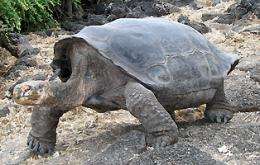
A tortoise in captivity on Galapagos Islands is a genetic relative of extinct species.
(PhysOrg.com) -- Thanks to genetic data gleaned from the bones found in a several museum collections, an international team of researchers led by scientists from Yale believes it may be possible to resurrect a tortoise species hunted to extinction by whalers visiting the Galapagos Islands during the early 19th century, before Charles Darwin made his famous visit.
A genetic analysis of 156 tortoises living in captivity and the DNA taken from remains of specimens of the now-extinct Chelonoidis elephantopus revealed that nine are descendents of the vanished species, which once made its home on Floreana Island in the Galapagos. Over a few generations, a selective breeding program among these tortoises should be able to revive the C. elephantopus species, said Adalgisa Caccone, senior research scientist in the department of ecology and evolutionary biology at Yale and senior author of the piece published this week in the online journal PLoS ONE.
“Theoretically, we can rescue a species that has gone extinct,’’ Caccone said. “Our lab calls it the Lazurus project.”
In 2007, Caccone and others discovered genetic relatives to “Lonesome George” the last known survivor of another species of Galapagos tortoise and an icon of the conservation movement. The team believes that the similar genetic hybrids living in captivity on the Galapagos were descendents of tortoises that were taken by whalers as future meals but then thrown overboard to make room for the more lucrative cargo of whale blubber. These tortoises then swam to nearby islands and mated with natives there. Floreana’s flat topography made it a popular spot for whalers to stop and snatch tortoises for meals, leading to the extinction of C. elephantopus.
The comparison of genetic data from remains in museums to data banks with DNA sequences of living tortoises made it possible to identify relatives of extinct animals, Caccone said. However, it will take at least four generations of selective breeding - about 100 years - to bring a genetically identical member of C. elephantopus “back to life.”
“We won’t be around to see it, but it can be done,” she said.
Other Yale authors of the paper are Edgar Benavides and Jeffrey R. Powell. Researchers from the University of British Columbia Okanagan, University of Crete, State University New York Syracuse and the Galapagos National Park Service contributed to the research.
-
Lonesome George may not be so lonesome after all
May 02, 2007 |
not rated yet |
0
-
Darwin's mockingbirds DNA research may help species recovery
Nov 18, 2009 |
not rated yet |
0
-
Madagascar's tortoises are crawling toward extinction, groups say
Feb 07, 2008 |
not rated yet |
0
-
Global climate change: The impact of El Nino on Galapagos marine iguanas
Dec 12, 2007 |
not rated yet |
0
-
Man versus goats in Galapagos
May 01, 2007 |
not rated yet |
0
-
Engineers build first sub-10-nm carbon nanotube transistor
Feb 01, 2012 |
4.9 / 5 (30) |
30
-
Something old, something new: Evolution and the structural divergence of duplicate genes
Jan 31, 2012 |
4.6 / 5 (7) |
1
-
The hidden nanoworld of ice crystals: Revealing the dynamic behavior of quasi-liquid layers
Jan 30, 2012 |
5 / 5 (3) |
1
-
Stock market network reveals investor clustering
Jan 27, 2012 |
3.9 / 5 (23) |
8
-
Of microchemistry and molecules: Electronic microfluidic device synthesizes biocompatible probes
Jan 26, 2012 |
5 / 5 (1) |
0
-
Cancer drugs and Alzheimer's, Oh my!
6 hours ago
-
Squishing cells
7 hours ago
-
Any books/articles for evolutionary stable strategy models in humans?
18 hours ago
-
Science behind the bore feeling?
Feb 09, 2012
-
Homo Sapien vs. Chimpanzee - Divergence Timeline
Feb 09, 2012
-
a single mRNA strand is attached to sevaral ribosomes?
Feb 08, 2012
- More from Physics Forums - Biology
More news stories
Miami battling invasion of giant African snails
No one knows how they got there. But an invasion of African giant snails has southern Florida in a panic over potential crop damage, disease and general yuckiness surrounding the slimy gastropods.
23 minutes ago |
not rated yet |
0
Fighting crimes against biodiversity: How to catch a killer weed
Invasive species which have the potential to destroy biodiversity and influence global change could be tracked and controlled in the same way as wanted criminals, according to new research from Queen Mary, University of London.
1 hour ago |
not rated yet |
0
Ultraviolet protection molecule in plants yields its secrets
Lying around in the sun all day is hazardous not just for humans but also for plants, which have no means of escape. Ultraviolet (UV) radiation from the sun can damage proteins and DNA inside cells, leading ...
14 hours ago |
5 / 5 (5) |
0
|
Deadly bird parasite evolves at exceptionally fast rate
A new study of a devastating bird disease that spread from poultry to house finches in the mid-1990s reveals that the bacteria responsible for the disease evolves at an exceptionally fast rate. What's more, ...
13 hours ago |
5 / 5 (2) |
0
|
Decoding the molecular machine behind E. coli and cholera
Scientists from Queen Mary, University of London have discovered the workings behind some of the bacteria that kill hundreds of thousands every year, possibly paving the way for new antibiotics that could treat infections ...
13 hours ago |
not rated yet |
0
|
Humans may have helped the decline of African rainforests 3000 years ago
(PhysOrg.com) -- Large areas of rainforests in Central Africa mysteriously disappeared over three thousand years ago, to be replaced by savannas. The prevailing theory has been that the cause was a change ...
Japan scientist makes 'Avatar' robot
A Japanese-developed robot that mimics the movements of its human controller is bringing the Hollywood blockbuster "Avatar" one step closer to reality.
Metastatic breast cancer hitches a free ride from the immune system
Inflammatory breast cancer (IBC) is the most lethal form of breast cancer . It spreads easily through the lymphatic and blood vessels, forming metastasis which can lead to multi-organ failure. New research published in BioMed ...
Sleep breathing machine shows clear benefits in children with sleep apnea
Children and adolescents with obstructive sleep apnea had substantial improvements in attention, anxiety and quality of life after treatment with positive airway pressure (PAP)a nighttime therapy in which a machine ...
Neurologic improvement detected in rats receiving stem cell transplant
In a study to be presented today at the Society for Maternal-Fetal Medicine's annual meeting, The Pregnancy Meeting, in Dallas, Texas, researchers will report that early transplantation of human placenta-derived mesenchymal ...
India's global pharmacy role threatened by EU pact
(AP) -- Efforts by India and the European Union to strengthen trade are threatening India's ability to deliver lifesaving medicines to the world's poorest, analysts say as the two sides push through protracted ...
Jan 18, 2010
Rank: 1 / 5 (1)
Jan 19, 2010
Rank: not rated yet
Why do this? Because we recognize our impact on biodiversity. Conserving nature may be a somewhat selfish goal, but it could be a long-run method for our own survival. We're just as much a part of and influence on nature as extinction after all.
Jan 19, 2010
Rank: 5 / 5 (1)
Edit: It looks like from what is said the species doesn't need help. It survived by mating with other species. Try it for science yes, but to resurrect a species that wasn't fit enough to survive on its own no
Jan 19, 2010
Rank: 3 / 5 (1)
If conditions of a area change the need to apadt ensures that whatever is best at it has the best chance of surviving and spreading its genetic code to its offspring. Giraffes have long necks for a reason ... a long time ago the short necked giraffes died out. By simply bring back species even if man was the cause of the extinction does nothing for those that survived and proved to be capable of changing ever so slightly and find other food and whatever died out stopped eating something that became plentiful and probably feeds something else now... throwing a creature back into a food web thats been patched is the work of a stubborn child.
Jan 20, 2010
Rank: 1 / 5 (1)
Are you sure? I'd suggest that a modern man placed naked (i.e. without any support) into the wild has little chance to survive. Therefore, no, mankind doesn't have any rationale to conserve nature; conserving the nature is purely emotional.
This is the "gutter" section of physorg, of course. Bringing back a forgotten specie may be interesting to some, but hardly hold any promise to redefine the world as we know it. I salute you "protein folding" and "quantum computing" folks.