Robots climb up the wall (w/ Video)

January 19, 2010 by Lin Edwards weblog
Robots climb up the wall

Enlarge

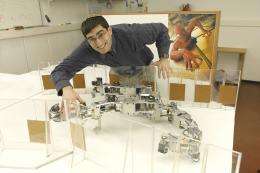
Amir Shapiro and the 3-limbed spider-robot.

(PhysOrg.com) -- A robotics scientist from Ben-Gurion University of the Negev in Beersheeba, Israel, has developed four different kinds of robots that climb up walls.

This video is not supported by your browser at this time.

This video presents four types of wall climbing robots that were developed in Dr. Amir Shapiros lab at the Department of Mechanical Engineering of Ben Gurion University of the Negev, Israel.

The latest projects of Amir Shapiro, head of the robotics laboratory in the Department of Engineering, are wall-climbers, two of which are inspired by animals that climb. One robot, inspired by snails and their trails of mucus, secretes a tiny trail of hot melted glue that allows it to stick to walls as it climbs, while another, inspired by cats and rodents, has four legs with claws made of fish hooks to help it climb rough surfaces.

A third robot in the collection is a wheeled robot with 3M sticky tape on the wheels to enable it to climb up smooth surfaces such as glass or a whiteboard. The fourth is magnetic and can climb smooth metal surfaces, which may make it useful for clambering around the submerged hulls of cargo ships to check for contraband and bombs, and replacing divers who now do this work. Shapiro said that a good scanning algorithm could make the robot very efficient for this purpose.

Shapiro's field is known as biomimetics, which involves using technology to mimic nature, and within that field is a sub-specialty that uses technology specifically to mimic animal location. Several researchers have worked on robots mimicking the undulation motion of snakes, but Shapiro and his team have succeeded in combining vertical and horizontal wave motions to create the trademark slithering motion of snakes. This can slither through small holes and pipes, which could help rescue workers locate and rescue people trapped under collapsed buildings.

Shapiro was asked to design the wall-climbing robots by the Israeli military, who wanted them for intelligence gathering.

More information: http://www.bgu.ac. … l/~ashapiro/

© 2010 PhysOrg.com

4.6 /5 (14 votes)  

Filter


Move the slider to adjust rank threshold, so that you can hide some of the comments.


Display comments: newest first

brant
Jan 19, 2010

Rank: 2 / 5 (1)
You have to shut the magnets off on the first one. I like how the edit that in the video. Hahaha..... He should use electromagnets.

Its not that impressive. He just figured out how to balance stickiness with power to turn the wheels on all his robots..
RayCherry
Jan 21, 2010

Rank: not rated yet
Obedenient, souless suicide bombers. What we invent and supply to our friends can be used by our enemies. Even the magnetic one is useful for release in apparently low risk zones of a vessel, and then it submerges (hence electromagnets were ruled out) and walks to the engine room or propellor and waits to be triggered.

I don't mean to sound Luddite, but why is academia so desperate to perpetuate 'the war machine' when those same machines get implemented in all the wrong ways?
Truth
Jan 22, 2010

Rank: not rated yet
"I don't mean to sound Luddite, but why is academia so desperate to perpetuate the war machine' when those same machines get implemented in all the wrong ways?"
Probably because the other side is hell-bent on doing the same thing. In fact, from recent news headlines, they seem to be better at creating new and stealthier technology to blow our gentle, politically correct butts to smithereens...
Rank 4.6 /5 (14 votes)
Related Stories
Relevant PhysicsForums posts
  • dynamics 2/32
    created2 hours ago
  • dynamics
    created2 hours ago
  • Vibration Absorbtion Problem
    created7 hours ago
  • Does anyone make a small high temperature and high pressure pump?
    created13 hours ago
  • Strange indexing in Fortran Code
    createdFeb 07, 2012
  • Car Port post load calculation
    createdFeb 07, 2012
  • More from Physics Forums - General Engineering

More news stories

Google rumored to have built Heads-Up-Display glasses prototype

(PhysOrg.com) -- 9to5Google is reporting that they have received a tip from someone they believe to be a reliable source saying that Google is working on a Heads-Up-Display (HUD) pair of eye-glasses. The per ...

Electronics / Consumer & Gadgets

created 13 hours ago | popularity 4.3 / 5 (8) | comments 2 | with audio podcast weblog

Review: Soulo converts iPad into karaoke machine

Karaoke lovers typically fall into two categories: Those who enjoy it, and those whose arms have to be twisted to get up and sing in public.

Electronics / Consumer & Gadgets

created 5 hours ago | popularity not rated yet | comments 0

Hitachi ships the industry's first 25-nanometer SLC NAND flash enterprise-class SSDs

Demonstrating its commitment to delivering leading-edge technologies and solutions for enterprise-class servers and storage systems, Hitachi Global Storage Technologies (Hitachi GST) today announced that its ...

Electronics / Hardware

created 13 hours ago | popularity not rated yet | comments 0

New Nokia phone no standout, but worth a look

The first of Nokia's new generation of smartphones isn't flashy and certainly isn't an iPhone killer. But it's a nice device, and at $40 with a two-year contract, a bargain.

Electronics / Consumer & Gadgets

created Feb 03, 2012 | popularity 1 / 5 (2) | comments 4

Intel packs performance and reliability into its latest SSD 520 series

Intel Corporation announced today its fastest, most robust client/consumer solid-state drive (SSD) to date, the Intel Solid-State Drive 520 Series (Intel SSD 520), a 6 gigabit-per-second (gbps) SATA III SSD ...

Electronics / Hardware

created Feb 07, 2012 | popularity 5 / 5 (1) | comments 3


Astronomy team discovers nearby dwarf galaxy

(PhysOrg.com) -- A team led by UCLA research astronomer Michael Rich has used a unique telescope to discover a previously unknown companion to the nearby galaxy NGC 4449, which is some 12.5 million light years ...

Amasia: As next supercontinent forms, Arctic Ocean, Caribbean will vanish first

(PhysOrg.com) -- Geologists at Yale University have proposed a new theory to describe the formation of supercontinents, the epic process by which Earth’s major continental blocks combine into a single ...

Why are there so few fish in the Earth's oceans?

(PhysOrg.com) -- A Stony Brook University researcher has found that, contrary to popular belief, there are not plenty of fish in the sea.

Transparent iron? For the first time, an experiment shows that atomic nuclei can become transparent

At the high-brilliance synchrotron light source PETRA III, a team of DESY scientists headed by Dr. Ralf Röhlsberger has succeeded in making atomic nuclei transparent with the help of X-ray light. At the ...

Physicists build highly efficient 'no-waste' laser

A team of University of California, San Diego researchers has built the smallest room-temperature nanolaser to date, as well as an even more startling device: a highly efficient, "thresholdless" laser that ...

Scientists strengthen memory by stimulating key site in brain

Ever gone to the movies and forgotten where you parked the car? New UCLA research may one day help you improve your memory.