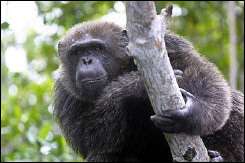
Chimps dance in the face of fire
January 19, 2010 by Lin Edwards
(PhysOrg.com) -- Unusual behaviors have been observed in wild chimpanzees in West Africa in the face of grass fires. The chimps did not panic or flee, and some made ritualistic displays that suggest they understand fire and do not fear it, and they may even be able to control it. Since chimpanzees are the nearest relatives to humans, the observations may shed some light on how our early ancestors harnessed fire.
The chimpanzees faced with a wildfire appeared to monitor the fire, and showed no fear. The alpha male even performed a kind of ritualistic display toward the fire front. Anthropologist Dr Jill Pruetz from Iowa State University made the observations at her Fongoli research site in southeastern Senegal, where hot and fast-moving wildfires are common in the savannah region towards the end of the long dry season.
Dr Pruetz saw the behavior, including "fire dancing" on two occasions in 2006, and said she was surprised at how well the chimps could predict the behavior of the fires, which was better than her own ability. She said in once case there was fire on three sides, and yet the chimps remained calm, even though the flames and smoke were clearly visible. Pruetz said she thought their calmness could represent a key stage in controlling fire since it is necessary to overcome the fear before control becomes a possibility.
The leader of the group, the alpha male, emitted a barking sound unlike the usual warning calls, and then danced in a similar way to the rain dances noted by primatologist Jane Goodall, in which the chimps swayed in slow motion as thunderstorms approached. Male chimps elsewhere have been seen displaying in this way, in a slow-motion dance to show their dominance. The fire dance was a similar exaggerated dance, but directed towards the approaching blaze, and beginning when the fire sounds were quite deafening.
Dr Pruetz is convinced the chimps conceptualize fire, and it is known that captive apes can control fire. She said that if chimpanzees can understand fire, the ape-like, small-brained ancestors of humans who lived in similar habitats around five million years ago could have done the same. This means the control of fire could have occurred at a very early stage in human evolution, and long before the earliest archaeological evidence so far found of burnt remnants associated with human ancestors, which date to less than one million years ago. Dr Pruetz said the main question is why they would try to control it; what is the impetus?
Dr Pruetz is able to get close to the chimpanzees because, although they are wary of humans, they apparently do not view people as predators because people in Senegal do not eat them and consider them close relatives. The Fongoli chimpanzees, living in a habitat that is mostly grassland, are different to forest-dwelling chimps in many ways, including their habits of using caves, soaking in pools of water, and hunting with tools.
The findings are to be published in the American Journal of Physical Anthropology.
More information: Reaction to fire by savanna chimpanzees (Pan troglodytes verus) at Fongoli, Senegal: Conceptualization of fire behavior and the case for a chimpanzee model, American Journal of Physical Anthropology, DOI:10.1002/ajpa.21245
© 2010 PhysOrg.com
-
Wild chimps have near human understanding of fire, study says
Dec 17, 2009 |
not rated yet |
0
-
Gesturing observed in wild chimpanzees
Mar 22, 2006 |
not rated yet |
0
-
Survey: People know much about chimps
Dec 11, 2007 |
not rated yet |
0
-
Study: Chimps don't care about friends
Oct 26, 2005 |
not rated yet |
0
-
Fire out of Africa: A key to the migration of prehistoric man
Oct 27, 2008 |
not rated yet |
0
-
Engineers build first sub-10-nm carbon nanotube transistor
Feb 01, 2012 |
4.9 / 5 (29) |
30
-
Something old, something new: Evolution and the structural divergence of duplicate genes
Jan 31, 2012 |
4.6 / 5 (7) |
1
-
The hidden nanoworld of ice crystals: Revealing the dynamic behavior of quasi-liquid layers
Jan 30, 2012 |
5 / 5 (3) |
1
-
Stock market network reveals investor clustering
Jan 27, 2012 |
3.9 / 5 (23) |
8
-
Of microchemistry and molecules: Electronic microfluidic device synthesizes biocompatible probes
Jan 26, 2012 |
5 / 5 (1) |
0
-
Science behind the bore feeling?
2 hours ago
-
Homo Sapien vs. Chimpanzee - Divergence Timeline
6 hours ago
-
a single mRNA strand is attached to sevaral ribosomes?
Feb 08, 2012
-
Oestrogen and FSH
Feb 07, 2012
-
Linear Blood Vessel Network Examples in Animals or Plants
Feb 07, 2012
-
Neuroscientists: What is a Principal Cell Layer?
Feb 06, 2012
- More from Physics Forums - Biology
More news stories
Life in Antarctic lake? It's everywhere else
If scientists find microbes in a frigid lake two miles beneath the thick ice of Antarctica, it will illustrate once again that somehow life finds a way to survive in the strangest and harshest places.
2 hours ago |
1 / 5 (1) |
0
Fruit flies drawn to the sweet smell of youth
Aging takes its toll on sex appeal and now an international team of researchers led by Baylor College of Medicine and the University of Michigan find that in fruit flies, at least, it even diminishes the come-hither ...
3 hours ago |
not rated yet |
0
|
Amazing skin gives sharks a push
Shark skin has long been known to improve the fish's swimming performance by reducing drag, but now George Lauder and Johannes Oeffner from Harvard University show that in addition, the skin generates thrust, ...
3 hours ago |
4 / 5 (2) |
0
|
How the zebra got its stripes
If there was a 'Just So' story for how the zebra got its stripes, I'm sure that Rudyard Kipling would have come up with an amusing and entertaining camouflage explanation. But would he have come up with the explanation that ...
2 hours ago |
4 / 5 (1) |
0
Judge tosses case seeking rights for orcas
(AP) -- An effort to free whales from SeaWorld by claiming they were enslaved made a splash in the news but flopped in court Wednesday.
2 hours ago |
4 / 5 (1) |
0
Inspired by steel, nanomanufacturing gets wear-resistant carbide tip
(PhysOrg.com) -- Scientists at the University of Pennsylvania, the University of Wisconsin-Madison and IBM Research - Zurich have fabricated an ultrasharp silicon carbide tip possessing such high strength ...
Step towards creating intestine transplant using patient's own cells
(Medical Xpress) -- Doctors at the UCL Institute of Child Health have made progress towards engineering donated intestines, so that they can be implanted without rejection.
Bird populations near Fukushima are more diminished than expected
(PhysOrg.com) -- Low-level radiation in Fukushima Prefecture appears to have had immediate effects on bird populations, and to a greater degree than was expected from a related analysis of Chernobyl, an international ...
Improving fitness, preventing fat gain key in protecting heart
(Medical Xpress) -- Good news for active adults fighting the battle of the bulge. Exercising and getting fit may protect your heart, even if you have a few extra pounds, according to a study published in the Feb. 14 issue ...
Many companies fall short of social responsibility promises
(PhysOrg.com) -- Whether eliminating child labor, creating environmentally friendly technology or working against all forms of corruption, many corporations fail to become socially responsible despite promises to change, ...
Dignity, sense of control keys to quality of life for disabled elderly, study finds
(Medical Xpress) -- Quality of life for disabled elderly people is most closely tied to two factors: a sense of dignity and a sense of control, according to a study by researchers at the San Francisco VA Medical Center (SFVAMC) ...