Turning down the noise in quantum data storage
January 19, 2010
Turning down the noise in quantum data storage

Enlarge

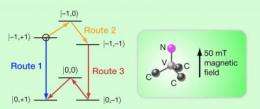
Driving a qubit along a longer quantum path (routes 2 and 3) dramatically improves the signal quality over that achieved by following the shorter path (route 1). The research applies to information stored in qubits that consisted of Nitrogen-based defects in diamond, as schematically shown on the right. Credit: Alan Stonebraker

Researchers who hope to create quantum computers are currently investigating various methods to store data. Nitrogen atoms embedded in diamond show promise for encoding quantum bits (qubits), but the process of reading the information results in an extremely weak signal. Now physicists have demonstrated a roundabout approach for generating a significantly stronger signal from these sorts of qubits. Their experiment is reported in the current issue of Physical Review B and highlighted with a Viewpoint in the January 19 issue of Physics.

In a quantum computer, a single bit of information is encoded into a property of a quantum mechanical system—the spin of an electron, for example. In most arrangements that rely on Nitrogen atoms in diamond to store data, reading the information also resets the qubit, which means there is only one opportunity to measure the state of the qubit.

By developing a technique that involves the spin of the Nitrogen nucleus in the process as well, a team of physicists at the University of Stuttgart in Germany has turned the single step read-out into a multi-step process. Rather than simply resetting the electron-based qubit when the information is read, the researchers discovered that they can force the state of the Nitrogen nucleus to change state twice before the information in the qubit is finally erased.

The state of the Nitrogen nucleus doesn't store any useful information, it simply allows the researchers to add steps to the process of reading the qubit's state. This results in a more convoluted quantum mechanical process that triples the number of events that occur before information is destroyed, which in turn strengthens the signal revealing information stored in the .

The resulting signal is still weak, but by combining other clever methods to the problem researchers might one day be able to use impurities in diamond to read and write at room temperature—which would bring us much closer to creating practical quantum computers.

More information: Universal enhancement of the optical readout fidelity of single electron spins at nitrogen-vacancy centers in diamond, M. Steiner, P. Neumann, J. Beck, F. Jelezko, and J. Wrachtrup, Phys. Rev. B 81, 035205 (2010) - Published January 19, 2010, Download PDF (free)

Provided by American Physical Society

4.8 /5 (5 votes)  

Rank 4.8 /5 (5 votes)
Relevant PhysicsForums posts
  • Non-Integrable Quadratic Hamiltonian
    created2 hours ago
  • Mysteries in Classical Physics
    created4 hours ago
  • (Conceptual) questions about capacitors, circuits
    created4 hours ago
  • a steel rod and an iron rod is placed inside an ac current soleoid
    created5 hours ago
  • Nature of principal strains
    created5 hours ago
  • Magnet in a AC current solenoid
    created6 hours ago
  • More from Physics Forums - Classical Physics

More news stories

Putting the squeeze on planets outside our solar system

(PhysOrg.com) -- Using high-powered lasers, scientists at Lawrence Livermore National Laboratory and collaborators discovered that molten magnesium silicate undergoes a phase change in the liquid state, abruptly ...

Physics / Condensed Matter

created 15 hours ago | popularity 4.3 / 5 (7) | comments 0 | with audio podcast

Hovering not hard if you're top-heavy, researchers find

Top-heavy structures are more likely to maintain their balance while hovering in the air than are those that bear a lower center of gravity, researchers at New York University's Courant Institute of Mathematical Sciences ...

Physics / General Physics

created 16 hours ago | popularity 5 / 5 (2) | comments 1 | with audio podcast

SLAC, Stanford team focuses on high-energy electrons to treat cancer

Accelerator physicists at SLAC and cancer specialists from Stanford are working on a new technology that could dramatically reduce the time needed for cancer radiation treatments. The team ran an initial experiment ...

Physics / General Physics

created 19 hours ago | popularity 5 / 5 (2) | comments 0

Measurements from high-energy collisions lead to better understanding of why meson particles disappear

For several years, physicists at the Relativistic Heavy Ion Collider (RHIC) at Brookhaven National Laboratory (BNL), USA, have studied an unusual state of matter called the quark–gluon plasma, which they ...

Physics / General Physics

created 20 hours ago | popularity 4.5 / 5 (4) | comments 0

Explained: Sigma

It's a question that arises with virtually every major new finding in science or medicine: What makes a result reliable enough to be taken seriously? The answer has to do with statistical significance -- but ...

Physics / General Physics

created Feb 09, 2012 | popularity 5 / 5 (16) | comments 53


Anonymous knocks CIA website offline (Update)

The website of the Central Intelligence Agency was inaccessible on Friday after the hacker group Anonymous claimed to have knocked it offline.

New error-correcting codes guarantee the fastest possible rate of data transmission

Error-correcting codes are one of the triumphs of the digital age. They’re a way of encoding information so that it can be transmitted across a communication channel — such as an optical fiber o ...

Humans may have helped the decline of African rainforests 3000 years ago

(PhysOrg.com) -- Large areas of rainforests in Central Africa mysteriously disappeared over three thousand years ago, to be replaced by savannas. The prevailing theory has been that the cause was a change ...

Small modular reactor design could be a 'SUPERSTAR'

(PhysOrg.com) -- Though most of today's nuclear reactors are cooled by water, we've long known that there are alternatives; in fact, the world's first nuclear-powered electricity in 1951 came from a reactor ...

New power source discovered

(PhysOrg.com) -- Researchers at the Massachusetts Institute of Technology (MIT) and RMIT University have made a breakthrough in energy storage and power generation.

The power of estrogen -- male snakes attract other males

A new study has shown that boosting the estrogen levels of male garter snakes causes them to secrete the same pheromones that females use to attract suitors, and turned the males into just about the sexiest ...