Researchers Detect First Neutrino Events at T2K Facilities in Japan
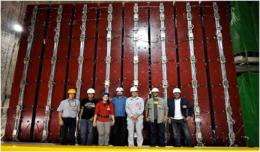
(PhysOrg.com) -- Louisiana State University researchers, including graduate and undergraduate students, have been working for several years on an experiment in Japan called T2K, short for Tokai to Kamioka Long Baseline Neutrino Oscillation Experiment. The project aims to study the most elusive of fundamental subatomic particles - the neutrino. The team recently announced that they have detected the first neutrino events generated by their newly built neutrino beam at the J-PARC accelerator laboratory in Tokai, Japan.
As part of the experiment, high energy protons were directed onto a carbon target, where their collisions produced charged particles called pions. The pions travelled through a helium-filled volume where they decayed to produce a beam of the elusive neutrinos. These neutrinos then flew 200 meters through the earth to a sophisticated detector system capable of making detailed measurements of their energy, direction and type.
“This represents a major milestone and is a tremendous achievement of the collaboration considering the complexity of the machinery, the operation and international nature of the project,” said Thomas Kutter, professor of physics and leader of the T2K project at LSU. “I am excited since this is just the beginning of ground breaking findings from this experiment in the near future.”
The full T2K team includes 474 scientists from 13 nations combining forces to build the complex experiment. The LSU team is one of eight collaborating groups in the United States, each working on a different aspect of the complex instrument. Other groups from the United States include Brookhaven National Laboratory, the University of Colorado, University of Pittsburgh, Colorado State University, University of Rochester, the University of Washington and Stony Brook University. The LSU group’s work is supported by the U.S. Department of Energy.
Neutrinos exist in three types or flavors, each linked to their more familiar charged cousins: the electron, muon and tau lepton. LSU physicists have been part of a number of measurements over the last decade (Super Kamiokande, SNO, KamLAND) that have shown that neutrinos possess the strange property of neutrino oscillations: one flavor of neutrino can transform into another as it travels through space. This is significant because neutrinos were first predicted theoretically in 1930, first actually detected in 1956 and assumed for 50 years to have zero mass. But neutrino oscillations require mass. The neutrino mass is tiny, but no mass was allowed in the original theories. With mysterious linkage between the three types, neutrinos challenge the understanding of the fundamental forces and basic constituents of matter. They may be related to the mystery of why there is more matter than anti-matter in the universe and are the focus of intense study worldwide.
Precision measurements of neutrino oscillations can be made using artificial neutrino beams. This was pioneered in Japan by the K2K neutrino experiment in which neutrinos were produced at the KEK accelerator laboratory near Tokyo and were detected using the Super-Kamiokande neutrino detector, a 50,000 ton tank of ultra-pure water located over half a mile underground in a laboratory 183 miles away near Toyama. T2K is a more powerful and sophisticated version of the K2K experiment, with a more intense neutrino beam derived from the newly-built main ring synchrotron at the J-PARC accelerator laboratory. The beam was built by physicists from KEK in cooperation with other Japanese institutions and with assistance from American, Canadian, UK and French T2K institutes. The beam is aimed once again at Super-Kamiokande, which has been upgraded for this experiment with new electronics and software.
Before the neutrinos leave the J-PARC facility, their properties are determined by a sophisticated “near” detector, partly based on a huge magnet donated from the CERN accelerator laboratory in Geneva. The CERN magnet was earlier used for the UA1 experiment, which won the Nobel Prize for the discovery of the W and Z bosons, which are the basis of neutrino interactions. The LSU team was responsible for building major components of the “near” detector, which recorded the first neutrino events.
The initial neutrino events were detected in a specialized detector called the INGRID, whose purpose is to determine the neutrino beam’s direction and profile before it travels to the “far” detector at Super-Kamiokande. Further tests of the T2K neutrino beam are scheduled for January, and the experiment plans to begin production running in mid-February. The first observation of a neutrino event from the T2K beam in Super-Kamiokande should be observed soon after. Running will continue until the summer, by which time the experiment hopes to have made the most sensitive search for oscillations between all three types of neutrinos at the same time. This will be a critical test of theoretical predictions. Over the next several years, this search will be improved, with the hope that the three-mode oscillation will allow a comparison of the oscillations of neutrinos and anti-neutrinos, probing the asymmetry between matter and anti-matter in the universe.
Provided by Louisiana State University


