Transplanted stem cells form proper brain connections
January 19, 2010
Transplanted stem cells form proper brain connections

Enlarge

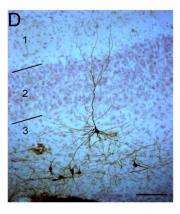
This is a single stem cell-derived neuron that has migrated away from the transplantation site in the cortex and grown into a mature neuron. The blue stain shows the nuclei of the endogenous neural cells in this part of the brain. Credit: Courtesy, with permission: Weimann et al. The Journal of Neuroscience 2010.

Transplanted neurons grown from embryonic stem cells can fully integrate into the brains of young animals, according to new research in the Jan. 20 issue of The Journal of Neuroscience. Healthy brains have stable and precise connections between cells that are necessary for normal behavior. This new finding is the first to show that stem cells can be directed not only to become specific brain cells, but to link correctly.

In this study, a team of neuroscientists led by James Weimann, PhD, of Stanford Medical School focused on cells that transmit information from the brain's cortex, some of which are responsible for muscle control. It is these neurons that are lost or damaged in and amyotrophic lateral sclerosis (ALS). "These stem cell-derived neurons can grow nerve fibers between the brain's and the spinal cord, so this study confirms the use of stem cells for therapeutic goals," Weimann said.

To integrate new cells into a successfully, the researchers first had to condition unspecialized cells to become specific cells in the brain's cortex. Cells that were precursors to cortical neurons were grown in a Petri dish until they displayed many of the same characteristics as mature neurons. The young neurons were then transplanted into the brains of newborn mice -- specifically, into regions of the cortex responsible for vision, touch, and movement.

Until now, making these proper cellular connections has been a fundamental problem in nervous system transplant therapy. In this case, the maturing neurons extended to the appropriate brain structures, and, just as importantly, avoided inappropriate areas. For example, cells transplanted into the reached two deep brain structures called the superior colliculus and the pons, but not to the spinal cord; cells placed into the motor area of the cortex stretched into the spinal cord but avoided the colliculus.

"The authors show that appropriate connectivity for one important class of projection neurons can be obtained in newborn animals," said Mahendra Rao, MD, PhD, an expert in stem cell biology at Life Technology, who was unaffiliated with the study.

The researchers also compared two methods used to grow transplantable cells, only one of which produced the desired results. "The authors provide a protocol for how to get the right kind of neurons to show appropriate connectivity," Rao said. "It's a huge advance in the practical use of these cells."

Researchers will now explore whether the same results can be achieved in adult animals and, ultimately, humans. Weimann and his colleagues also hope to understand how the transplanted cells "knew" to connect in precisely the right way, and whether they can generate the right behaviors, such as vision and movement.

Provided by Society for Neuroscience (news : web)

4.8 /5 (6 votes)  

Rank 4.8 /5 (6 votes)
Relevant PhysicsForums posts
  • Is Everyday Technology Killing Us?
    createdFeb 08, 2012
  • Exercise and weight loss
    createdFeb 08, 2012
  • Why do we have head aches? Our brains can't feel anything.
    createdFeb 07, 2012
  • "The end of diseases" by David Agus, interview from Daily Show with Jon Stewart
    createdFeb 04, 2012
  • Oncolytic adenovirus
    createdFeb 04, 2012
  • Nutrition label stuffs and diets
    createdFeb 02, 2012
  • More from Physics Forums - Medical Sciences

More news stories

FDA-approved drug rapidly clears amyloid from the brain, reverses Alzheimer's symptoms in mice

Neuroscientists at Case Western Reserve University School of Medicine have made a dramatic breakthrough in their efforts to find a cure for Alzheimer's disease. The researchers' findings, published in the journal Science, show t ...

Medicine & Health / Neuroscience

created 11 hours ago | popularity 4.9 / 5 (32) | comments 14 | with audio podcast

Anyone can learn to be more inventive, cognitive researcher says

There will always be a wild and unpredictable quality to creativity and invention, says Anthony McCaffrey, a cognitive psychology researcher at the University of Massachusetts Amherst, because an "Aha moment" is rare and ...

Medicine & Health / Psychology & Psychiatry

created 7 hours ago | popularity 4.8 / 5 (5) | comments 0 | with audio podcast

Cell biologists describes mechanism by which some people may be more susceptible to colon cancer

An international research team led by cell biologists at the University of California, Riverside has uncovered a new insight into colon cancer, the third leading cause of cancer-related deaths in the United ...

Medicine & Health / Cancer

created 8 hours ago | popularity 5 / 5 (2) | comments 0 | with audio podcast

Researchers weigh in on ethics of H5N1 research

(Medical Xpress) -- In a commentary on the biosecurity controversy surrounding publication of bird flu research details, a bioethicist and a vaccine expert at Johns Hopkins reaffirm that "all scientists have an affirmativ ...

Medicine & Health / Other

created 10 hours ago | popularity not rated yet | comments 0 | with audio podcast

To perform with less effort, practice beyond perfection

Whether you are an athlete, a musician or a stroke patient learning to walk again, practice can make perfect, but more practice may make you more efficient, according to a surprising new University of Colorado Boulder study.

Medicine & Health / Neuroscience

created 10 hours ago | popularity 4.6 / 5 (9) | comments 3 | with audio podcast


'Dark plasmons' transmit energy

Microscopic channels of gold nanoparticles have the ability to transmit electromagnetic energy that starts as light and propagates via "dark plasmons," according to researchers at Rice University.

Hydrogen from acidic water: Researchers develop potential low cost alternative to platinum for splitting water

A technique for creating a new molecule that structurally and chemically replicates the active part of the widely used industrial catalyst molybdenite has been developed by researchers with the Lawrence Berkeley ...

Ultraviolet protection molecule in plants yields its secrets

Lying around in the sun all day is hazardous not just for humans but also for plants, which have no means of escape. Ultraviolet (UV) radiation from the sun can damage proteins and DNA inside cells, leading ...

Soraa LED light may dim 50-watt halogen rivals

(PhysOrg.com) -- Soraa, a Fremont, California company founded in 2008, this week launched its first product, a light that uses LEDS (light emitting diodes). The "Soraa LED MR16 lamp" is the "perfect" replacement ...

Flexible paper robots

(PhysOrg.com) -- These inexpensive robots can stretch, bend and twist under control, and lift objects up to 120 times their own weight. Being soft, they can apply gentle and even pressure, and adapt to varied ...

New method makes culture of complex tissue possible in any lab

Scientists at the University of California, San Diego have developed a new method for making scaffolds for culturing tissue in three-dimensional arrangements that mimic those in the body. This advance, published online in ...