Video gamers: Size of brain structures predicts success
January 20, 2010
Video gamers: Size of brain structures predicts success

Enlarge

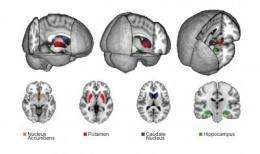
MRI scans reveal the brain structures analyzed in this study: nucleus accumbens (orange), putamen (red), caudate nucleus (blue), and hippocampus (green). Credit: Cerebral Cortex. Rights-protected image. Contact Oxford University Press.

(PhysOrg.com) -- Researchers can predict your performance on a video game simply by measuring the volume of specific structures in your brain, a multi-institutional team reports this week.

The new study, in the journal , found that nearly a quarter of the variability in achievement seen among men and women trained on a new video game could be predicted by measuring the volume of three structures in their brains.

The study adds to the evidence that specific parts of the striatum, a collection of distinctive tissues tucked deep inside the cerebral cortex, profoundly influence a person's ability to refine his or her motor skills, learn new procedures, develop useful strategies and adapt to a quickly changing environment.

"This is the first time that we've been able to take a real world task like a video game and show that the size of specific regions is predictive of performance and learning rates on this video game," said Kirk Erickson, a professor of psychology at the University of Pittsburgh and first author on the study. Ann Graybiel, an Institute Professor at the Massachusetts Institute of Technology and Investigator in the McGovern Institute for Brain Research; and Arthur Kramer, a professor of psychology at the Beckman Institute for Advanced Science and Technology at the University of Illinois, were co-principal investigators on the study. Walter Boot, of Florida State University, also contributed to the research.

The study was conducted at the University of Illinois.

Research has shown that expert video gamers outperform novices on many basic measures of attention and perception, but other studies have found that training novices on video games for 20 or more hours often yields no measurable cognitive benefits.

These contradictory findings suggest that pre-existing individual differences in the brain might predict variability in learning rates, the authors wrote.
Video gamers: Size of brain structures predicts success
Enlarge

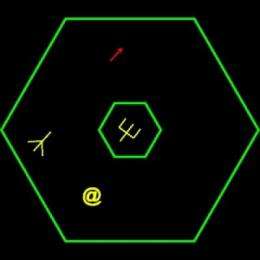
The video game Space Fortress, developed at the University of Illinois, can be manipulated to test various aspects of cognition. Credit: Rensselaer Polytechnic Institute

Animal studies conducted by Graybiel and others led the researchers to focus on three brain structures: the caudate nucleus and the putamen in the dorsal striatum, and the nucleus accumbens in the ventral striatum.

"Our animal work has shown that the striatum is a kind of learning machine - it becomes active during habit formation and skill acquisition," Graybiel said. "So it made a lot of sense to explore whether the striatum might also be related to the ability to learn in humans."

The caudate (CAW-date) nucleus and putamen (pew-TAY-min) are involved in motor learning, but research has shown they are also important to the cognitive flexibility that allows one to quickly shift between tasks. The nucleus accumbens (ah-COME-bins) is known to process emotions associated with reward or punishment.

The researchers began with a basic question about these structures, Kramer said: "Is bigger better?"

They used high-resolution Magnetic Resonance Imaging (MRI) to analyze the size of these brain regions in 39 healthy adults (aged 18-28; 10 of them male) who had spent less than three hours a week playing video games in the previous two years. The volume of each brain structure was compared to that of the brain as a whole.

Participants were then trained on one of two versions of Space Fortress, a video game developed at the University of Illinois that requires players to try to destroy a fortress without losing their own ship to one of several potential hazards.

Half of the study participants were asked to focus on maximizing their overall score in the game while also paying attention to the various components of the game.

The other participants had to periodically shift priorities, improving their skills in one area for a period of time while also maximizing their success at the other tasks.

The latter approach, called "variable priority training" encourages the kind of flexibility in decision-making that is commonly required in daily life, Kramer said. Studies have shown that variable priority training is more likely than other training methods to improve those skills people use every day.

The researchers found that players who had a larger nucleus accumbens did better than their counterparts in the early stages of the training period, regardless of their training group. This makes sense, Erickson said, because the nucleus accumbens is part of the brain's reward center, and a person's motivation for excelling at a includes the pleasure that results from achieving a specific goal. This sense of achievement and the emotional reward that accompanies it is likely highest in the earliest stages of learning, he said.

Players with a larger caudate nucleus and putamen did best on the variable priority training.

"The putamen and the caudate have been implicated in learning procedures, learning new skills, and those nuclei predicted learning throughout the 20-hour period," Kramer said. The players in which those structures were largest "learned more quickly and learned more over the training period," he said.

"This study tells us a lot about how the brain works when it is trying to learn a complex task," Erickson said. "We can use information about the brain to predict who is going to learn certain tasks at a more rapid rate." Such information might be useful in education, where longer training periods may be required for some students, or in treating disability or dementia, where information about the affected by injury or disease could lead to a better understanding of the skills that might also need attention, he said.

More information: The paper, Striatal Volume Predicts Level of Video Game Skill Acquisition, is available online -- doi:10.1093/cercor/bhp293

Provided by University of Illinois at Urbana-Champaign (news : web)

4.2 /5 (10 votes)  

Filter


Move the slider to adjust rank threshold, so that you can hide some of the comments.


Display comments: newest first

Phelankell
Jan 20, 2010

Rank: 1 / 5 (5)
I'm not sure I can buy into this research. This would tend to make one believe that since men have a larger cranial volume that they would have a competitive edge against women with naturally smaller brain structure volumes, and that just is not the case.
SincerelyTwo
Jan 20, 2010

Rank: 4.3 / 5 (6)
Phenlankell,

Statistically speaking, on average, men DO have a competitive edge against women.

What's there to 'buy in to' anyway, results are results, they exist, they can't just not exist because you don't 'like' them. At best the interpretation of the results is open for debate, as usual.
jj2009
Jan 20, 2010

Rank: 1 / 5 (1)
"I'm not sure I can buy into this research. This would tend to make one believe that since men have a larger cranial volume that they would have a competitive edge against women with naturally smaller brain structure volumes, and that just is not the case."

- that's why there are so many women in formula one racing..
Phelankell
Jan 20, 2010

Rank: 1 / 5 (3)
- that's why there are so many women in formula one racing..


That's why there are so many female senators, or female CEOs, or other comments you could make that have absolutely nothing to do with reality.

Statistically speaking, on average, men DO have a competitive edge against women.
Not in problem solving or fine motor control.
fourthrocker
Jan 20, 2010

Rank: not rated yet
I don't know but I'm betting they aren't compensating the female racer(s) with added weight considering they weigh a lot less than most men and weight is important in a light racecar. That alone could provide a woman with a competative edge instead of skill. Jockeys aren't small for nothing.
fourthrocker
Jan 20, 2010

Rank: 5 / 5 (1)
This research isn't complete. I think good gamers brain structures grow bigger from playing games. I think genius is a result of the choices we make in life. I believe we re-wire our brains constantly. When someone dedicates all their thoughts to something it changes their brain. That is what Einstein did when he developed his theories and think it changed his brain structures to deal with the problems he was trying to solve. I think it's the same for a good mathmatician, if they constantly think about math and do math the brain changes to do it better. We are what we think and stupidity is a choice not a genetic difference in most cases.
jimbo92107
Jan 20, 2010

Rank: 4 / 5 (1)
Hey, maybe MRI measurements can replace IQ tests and SAT scores!

That would give me more time to play video games... ;-)
Yellowdart
Jan 20, 2010

Rank: not rated yet
Why not use whats on the market already as well? Why invent your own and only test that? I would think, game genre depending migh tmake a difference as well.
Yellowdart
Jan 20, 2010

Rank: not rated yet
Playing a 2 d shooter is not a "complex task"...try Fifa 10 with the silly amount of complexity in controls.
abhishekbt
Jan 20, 2010

Rank: not rated yet
Such information might be useful in education, where longer training periods may be required for some students


I smell distinction here based on something we can't see, control or do anything about. Imagine schools rejecting applications or grading students based on the size of their hippocampus!
abhishekbt
Jan 20, 2010

Rank: not rated yet
stupidity is a choice not a genetic difference


Sounds very reasonable and looks like a great quote!
StarDust21
Jan 21, 2010

Rank: not rated yet
So according the the premise of these scientifics, the sperm whales are 5 times smarter than humans cause their brains are 5X larger, of course
DaveMart
Jan 21, 2010

Rank: 5 / 5 (2)
I'm not sure what area of the brain is involved in reading skills, butr some of the respondent's seem to be challenged in that area! ;-)
'The volume of each brain structure was compared to that of the brain as a whole.'

So it was relative, not absolute, and the smaller average brain sizes of women would have made no difference, at least under the criteria used in this study.
Dr_Science
Jan 23, 2010

Rank: 2 / 5 (1)
If one thinks in the terms of how evolution
performs, then the answer is quite obvious!

Testosterone and Estrogen each shape a fetuses
brain differently for their biological roles.

"All life is about reproductive advantage".

Do you think nature would favor a woman with risk-taking and strategy skills when caring for
a helpless newborn infant?

Or maybe an overwhelming emotion of heartfelt compassion for the poor mastodon a young male
hunter was about to impale?

I would not be surprised if there are physical
brain differences between men and women.

The bigger question is whether this video game
test could be proven to measure IQ.
Quantum_Conundrum
Jan 24, 2010

Rank: not rated yet
They should have tested 1st and 3rd person player vs player shooter games, and Real Time Strategy games.

By the way, in Real Time Strategy games, there is like one or two females in the top thousand players in the world, so it isn't surprising that males are probably better at video games.

Males are also better at visualization in drafting, as a general rule.
Rank 4.2 /5 (10 votes)
Related Stories
Relevant PhysicsForums posts
  • Is Everyday Technology Killing Us?
    createdFeb 08, 2012
  • Exercise and weight loss
    createdFeb 08, 2012
  • Why do we have head aches? Our brains can't feel anything.
    createdFeb 07, 2012
  • "The end of diseases" by David Agus, interview from Daily Show with Jon Stewart
    createdFeb 04, 2012
  • Oncolytic adenovirus
    createdFeb 04, 2012
  • Nutrition label stuffs and diets
    createdFeb 02, 2012
  • More from Physics Forums - Medical Sciences

More news stories

FDA-approved drug rapidly clears amyloid from the brain, reverses Alzheimer's symptoms in mice

Neuroscientists at Case Western Reserve University School of Medicine have made a dramatic breakthrough in their efforts to find a cure for Alzheimer's disease. The researchers' findings, published in the journal Science, show t ...

Medicine & Health / Neuroscience

created 9 hours ago | popularity 4.9 / 5 (31) | comments 11 | with audio podcast

Anyone can learn to be more inventive, cognitive researcher says

There will always be a wild and unpredictable quality to creativity and invention, says Anthony McCaffrey, a cognitive psychology researcher at the University of Massachusetts Amherst, because an "Aha moment" is rare and ...

Medicine & Health / Psychology & Psychiatry

created 5 hours ago | popularity 4.7 / 5 (3) | comments 0 | with audio podcast

Cell biologists describes mechanism by which some people may be more susceptible to colon cancer

An international research team led by cell biologists at the University of California, Riverside has uncovered a new insight into colon cancer, the third leading cause of cancer-related deaths in the United ...

Medicine & Health / Cancer

created 6 hours ago | popularity 5 / 5 (1) | comments 0 | with audio podcast

Researchers weigh in on ethics of H5N1 research

(Medical Xpress) -- In a commentary on the biosecurity controversy surrounding publication of bird flu research details, a bioethicist and a vaccine expert at Johns Hopkins reaffirm that "all scientists have an affirmativ ...

Medicine & Health / Other

created 8 hours ago | popularity not rated yet | comments 0 | with audio podcast

To perform with less effort, practice beyond perfection

Whether you are an athlete, a musician or a stroke patient learning to walk again, practice can make perfect, but more practice may make you more efficient, according to a surprising new University of Colorado Boulder study.

Medicine & Health / Neuroscience

created 8 hours ago | popularity 4.4 / 5 (7) | comments 3 | with audio podcast


'Dark plasmons' transmit energy

Microscopic channels of gold nanoparticles have the ability to transmit electromagnetic energy that starts as light and propagates via "dark plasmons," according to researchers at Rice University.

Hydrogen from acidic water: Researchers develop potential low cost alternative to platinum for splitting water

A technique for creating a new molecule that structurally and chemically replicates the active part of the widely used industrial catalyst molybdenite has been developed by researchers with the Lawrence Berkeley ...

Ultraviolet protection molecule in plants yields its secrets

Lying around in the sun all day is hazardous not just for humans but also for plants, which have no means of escape. Ultraviolet (UV) radiation from the sun can damage proteins and DNA inside cells, leading ...

Flexible paper robots

(PhysOrg.com) -- These inexpensive robots can stretch, bend and twist under control, and lift objects up to 120 times their own weight. Being soft, they can apply gentle and even pressure, and adapt to varied ...

New method makes culture of complex tissue possible in any lab

Scientists at the University of California, San Diego have developed a new method for making scaffolds for culturing tissue in three-dimensional arrangements that mimic those in the body. This advance, published online in ...

Deadly bird parasite evolves at exceptionally fast rate

A new study of a devastating bird disease that spread from poultry to house finches in the mid-1990s reveals that the bacteria responsible for the disease evolves at an exceptionally fast rate. What's more, ...