An electrifying advance toward tomorrow's power suits
January 20, 2010
An electrifying advance toward tomorrow's power suits

Enlarge

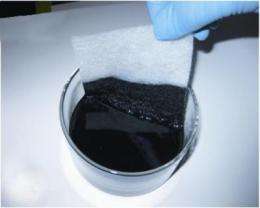
Fabrics treated with this new electrically-conductive ink may power a new generation of futuristic clothing that charges iPods, cell phones and other electronics. Credit: American Chemical Society

Could powering an iPod or cell phone become as easy as plugging it into your tee shirt or jeans, and then recharging the clothing overnight? Scientists in California are reporting an advance in that direction with an easier way of changing ordinary cotton and polyester into "conductive energy textiles" -- e-Textiles that double as a rechargeable battery. Their report on the research appears in ACS' Nano Letters.

"Wearable electronics represent a developing new class of materials with an array of novel functionalities, such as flexibility, stretchability, and lightweight, which allow for many applications and designs previously impossible with traditional electronics technology," Yi Cui and colleagues note. "High-performance sportswear, wearable displays, new classes of portable power, and embedded health monitoring systems are examples of these novel applications."

The report describes a new process for making E-textiles that uses "ink" made from single-walled carbon nanotubes — electrically conductive carbon fibers barely 1/50,000 the width of a human hair. When applied to cotton and polyester fabrics, the ink produced e-Textiles with an excellent ability to store . The fabrics retained flexibility and stretchability of regular cotton and polyester, and kept their new e-properties under conditions that simulated repeated laundering.

More information: "Stretchable, Porous, and Conductive Energy Textiles", http://pubs.acs.or … 21/nl903949m

Provided by American Chemical Society (news : web)

3.8 /5 (10 votes)  

Filter


Move the slider to adjust rank threshold, so that you can hide some of the comments.


Display comments: newest first

Adriab
Jan 21, 2010

Rank: not rated yet
A good next step would be to add a layer that can convert the stretching/moving of the clothing into charge.
ShadowRam
Jan 21, 2010

Rank: 5 / 5 (2)
A good next step would be to add a layer that can convert the stretching/moving of the clothing into charge.


I already have a sweater that does that quite well.
jj2009
Jan 21, 2010

Rank: not rated yet
plugging your ipod into your clothes, and then plugging your clothes in to charge overnight.

hows that any different than just plugging in your ipod to charge overnight
NotAsleep
Jan 22, 2010

Rank: not rated yet
Will the insides be lined with rubber to keep us from getting electrocuted? It seems pretty dangerous to wrap our bodies in a battery... plus, will this lead to a new generation of people that wear the exact same clothes every single day? Reflecting on my time at college, these people should be excluded from society
PinkElephant
Jan 22, 2010

Rank: not rated yet
Forgive me, but aren't carbon nanotubes carcinogenic? They penetrate cell walls easily, they are not quick to decompose. Structurally, they ought to behave A LOT like asbestos fibers. So do we REALLY want to soak clothes in this stuff, and WEAR them: so that the entire surface of skin is exposed by direct, repeated, mechanical contact?

REALLY???
flaredone
Jan 23, 2010

Rank: not rated yet
So do we REALLY want to soak clothes in this stuff, and WEAR them
Of course not, this research is a nonsense with respect to perspective provided.
Rank 3.8 /5 (10 votes)
Relevant PhysicsForums posts
  • polymer nanocomposites
    created15 hours ago
  • Corrosion Tests on Magnesium
    createdFeb 09, 2012
  • polyethylene copper nanocomposite
    createdFeb 09, 2012
  • Output of xrd analysis
    createdFeb 08, 2012
  • Transport phenomena problem based on problems 18.B11 and 19B.6 from Bird, stewart, lw
    createdFeb 06, 2012
  • Help with material selection - Car Piston
    createdFeb 05, 2012
  • More from Physics Forums - Materials & Chemical Engineering

More news stories

'Dark plasmons' transmit energy

Microscopic channels of gold nanoparticles have the ability to transmit electromagnetic energy that starts as light and propagates via "dark plasmons," according to researchers at Rice University.

Nanotechnology / Nanophysics

created 23 hours ago | popularity 5 / 5 (6) | comments 1 | with audio podcast

What lies beneath: Mapping hidden nanostructures

The ability to diagnose and predict the properties of materials is vital, particularly in the expanding field of nanotechnology. Electron and atom-probe microscopy can categorize atoms in thin sheets of material, ...

Nanotechnology / Nanophysics

created 7 hours ago | popularity 5 / 5 (1) | comments 1

New kind of solar cell could capture significantly more energy than current cells

New solar cells could increase the maximum efficiency of solar panels by over 25%, according to scientists from the University of Cambridge.

Nanotechnology / Nanophysics

created Feb 08, 2012 | popularity 4.5 / 5 (12) | comments 14 | with audio podcast

Nanoshell whispering galleries improve thin solar panels

Visitors to Statuary Hall in the U.S. Capitol Building may have experienced a curious acoustic feature that allows a person to whisper softly at one side of the cavernous, half-domed room and for another on ...

Nanotechnology / Nanomaterials

created Feb 07, 2012 | popularity 4.3 / 5 (6) | comments 6 | with audio podcast

Nanotube therapy takes aim at breast cancer stem cells

Wake Forest Baptist Medical Center researchers have again proven that injecting multiwalled carbon nanotubes (MWCNTs) into tumors and heating them with a quick, 30-second laser treatment can kill them.

Nanotechnology / Bio & Medicine

created Feb 09, 2012 | popularity 5 / 5 (1) | comments 0 | with audio podcast


CIA website offline, Anonymous takes credit

The website of the Central Intelligence Agency was unresponsive on Friday after the hacker group Anonymous claimed to have knocked it offline.

Q&A: Obama and the birth control controversy

(AP) -- What birth control debate? A half-century after the introduction of the pill, acceptance of birth control by American women is virtually universal.

Complex wiring of the nervous system may rely on a just a handful of genes and proteins

Researchers at the Salk Institute have discovered a startling feature of early brain development that helps to explain how complex neuron wiring patterns are programmed using just a handful of critical genes. ...

The power of estrogen -- male snakes attract other males

A new study has shown that boosting the estrogen levels of male garter snakes causes them to secrete the same pheromones that females use to attract suitors, and turned the males into just about the sexiest ...

New error-correcting codes guarantee the fastest possible rate of data transmission

Error-correcting codes are one of the triumphs of the digital age. They’re a way of encoding information so that it can be transmitted across a communication channel — such as an optical fiber o ...

Humans may have helped the decline of African rainforests 3000 years ago

(PhysOrg.com) -- Large areas of rainforests in Central Africa mysteriously disappeared over three thousand years ago, to be replaced by savannas. The prevailing theory has been that the cause was a change ...