European space company wants solar power plant in space
January 21, 2010 by Lin Edwards
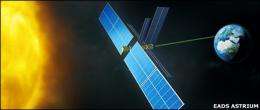
(PhysOrg.com) -- EADS Astrium, Europe's biggest space company, plans to put a solar power satellite in orbit to demonstrate the collection of solar power in space and its transmission via infrared laser to provide electricity on Earth.
Chief executive officer of Astrium, François Auque, said the system is at the testing stage, but that a viable system collecting and transmitting power from space could be within reach soon. Auque said space solar power is an attractive idea because it is an inexhaustible and clean form of energy. Unlike solar plants on Earth, orbital solar collectors can work around the clock, and there is no interference from clouds or atmospheric dusts or gases, which means the energy hitting photovoltaic cells in orbit is much greater than it would be for the same panels on the ground.
Earlier concepts of beaming power to Earth from space were criticized because they relied on microwaves to transmit the power to the ground, which has safety concerns, so Astrium plans to use infrared lasers instead, which means that even if they were misdirected people and objects hit by the laser beams could not be scorched.
The transmission of power via infrared laser has been tested in Astrium’s laboratories, and they are now concentrating on improving the system’s efficiency. Work on developing converters to convert received infrared energy to electricity is proceeding rapidly, and Astrium is collaborating in this work with scientists at the University of Surrey, in the UK. The company is hoping to achieve 80% efficiency in the conversion.
According to Astrium’s chief technology officer, Robert Laine, at present the power handled by the system is limited by the size of the laser that can be built. A demonstration mission would also be necessary to prove the system works, and this should be possible within the present decade.
The concept of harvesting solar power in space has been discussed for at least the last three decades, but the problems of power loss during transmission and the expense and difficulty of assembling large arrays of solar collectors in space have seemed almost insurmountable. However, Astrium is not the only company close to bringing the idea to fruition. Last September Japan announced it is planning to put a small demonstration solar collecting satellite in orbit by 2015. This system will transmit the power to Earth using microwaves.
EADS Astrium is seeking investors and partners such as the EU, national governments, space agencies, or power companies, to fund and contribute in other ways to the development of its operational orbital solar collection and transmission system.
More information: EADS Astrium -- http://www.astrium.eads.net/
© 2010 PhysOrg.com
-
$21 Billion Orbiting Solar Array will Beam Electricity to Earth
Sep 15, 2009 |
not rated yet |
0
-
Desert power: A solar renaissance
Apr 01, 2008 |
not rated yet |
0
-
Japan eyes solar station in space as new energy source
Nov 08, 2009 |
not rated yet |
0
-
Space-Based Solar Power Coming to California in 2016
Apr 15, 2009 |
not rated yet |
0
-
Thai Optical Earth Observation Space System
Jul 05, 2005 |
not rated yet |
0
-
Engineers build first sub-10-nm carbon nanotube transistor
Feb 01, 2012 |
4.9 / 5 (31) |
30
-
Something old, something new: Evolution and the structural divergence of duplicate genes
Jan 31, 2012 |
4.6 / 5 (7) |
1
-
The hidden nanoworld of ice crystals: Revealing the dynamic behavior of quasi-liquid layers
Jan 30, 2012 |
5 / 5 (3) |
1
-
Stock market network reveals investor clustering
Jan 27, 2012 |
3.9 / 5 (23) |
8
-
Of microchemistry and molecules: Electronic microfluidic device synthesizes biocompatible probes
Jan 26, 2012 |
5 / 5 (1) |
0
-
Calling function with no input argument
3 hours ago
-
Force free body diagram problem on gym equipment
4 hours ago
-
Empirical data regarding shower heads and water
12 hours ago
-
feed hold button on CNC lathe
Feb 09, 2012
-
RFAC in Fortran
Feb 09, 2012
-
dynamics 2/32
Feb 08, 2012
- More from Physics Forums - General Engineering
More news stories
Expat French get Internet vote for first time
French citizens will for the first time this year be able to vote in a parliamentary election over the Internet, an experiment that could be extended to other elections if successful.
37 minutes ago |
not rated yet |
0
"Twisted Metal" gamers get shot at real gunplay
Fans of "Twisted Metal" will get to welcome a long-awaited sequel of the car-battle videogame with a real-world bang by blasting an ice cream truck to bits with a machine gun.
26 minutes ago |
not rated yet |
0
New error-correcting codes guarantee the fastest possible rate of data transmission
Error-correcting codes are one of the triumphs of the digital age. Theyre a way of encoding information so that it can be transmitted across a communication channel such as an optical fiber o ...
Technology / Computer Sciences
6 hours ago |
5 / 5 (3) |
3
|
India probes Google over 'forex transactions'
Indian authorities are probing whether online giant Google broke domestic foreign-exchange transactions rules while shifting funds abroad, the Press Trust of India reported on Friday.
1 hour ago |
not rated yet |
0
Small modular reactor design could be a 'SUPERSTAR'
(PhysOrg.com) -- Though most of today's nuclear reactors are cooled by water, we've long known that there are alternatives; in fact, the world's first nuclear-powered electricity in 1951 came from a reactor ...
Technology / Energy & Green Tech
6 hours ago |
4.2 / 5 (10) |
14
|
Putting the squeeze on planets outside our solar system
(PhysOrg.com) -- Using high-powered lasers, scientists at Lawrence Livermore National Laboratory and collaborators discovered that molten magnesium silicate undergoes a phase change in the liquid state, abruptly ...
Employers feel no love for unscrupulous practice of 'service sweethearting'
A new study led by two Florida State University marketing professors finds that some frontline service employees who are rewarded for hikes in customer loyalty and satisfaction also may engage in "service ...
US issues guidelines to avoid heparin contamination
Four years after US drug-maker Baxter International's blood thinner heparin was contaminated in China, causing dozens of deaths, US regulators on Friday issued draft guidelines for safe production.
The power of estrogen -- male snakes attract other males
A new study has shown that boosting the estrogen levels of male garter snakes causes them to secrete the same pheromones that females use to attract suitors, and turned the males into just about the sexiest ...
Curry spice component may help slow prostate tumor growth
Curcumin, an active component of the Indian curry spice turmeric, may help slow down tumor growth in castration-resistant prostate cancer patients on androgen deprivation therapy (ADT), a study from researchers ...
Grass to gas: Researchers' genome map speeds biofuel development
Researchers at the University of Georgia have taken a major step in the ongoing effort to find sources of cleaner, renewable energy by mapping the genomes of two originator cells of Miscanthus x giganteus, a large perenn ...
Jan 21, 2010
Rank: 1 / 5 (1)
Jan 21, 2010
Rank: 1.8 / 5 (4)
Jan 21, 2010
Rank: 2.3 / 5 (3)
Jan 21, 2010
Rank: 5 / 5 (4)
As well, who knows what the environment will do to something so massive over extended duration, likely there will be a tremendous learning curve. I have a terrible feeling we'll waste a lot of money on this and still find nuclear power is far cheaper and practical and efficient.
Jan 21, 2010
Rank: 4.8 / 5 (4)
The ozone-killing properties of rocket fuel would destroy the ENTIRE ozone layer 20 times over for getting enough of these panels into space to power even one country (let alone the world).
Jan 21, 2010
Rank: 1 / 5 (2)
The most effeicient use would be microwave radiation to transmit energy -- at sufficient frequency there is VERY LITTLE loss due to the amount of water vapor in the atmosphere - meaning you can transmit power through clouds, reaching effeciencies of 95+% which lets face it is awesome.
I have not seen the numbers on infrared transmission effeciency but my gut and not science tells me that increases in dust or clouds in the atmosphere will likely block this form totally.
@LKD -- Solar cells almost never need to replaced and in this scenerio you would not replace but simply add on to generate more power. There are plans to make a 2GW solar power station such as this with very few launches.
Jan 21, 2010
Rank: 3 / 5 (2)
Jan 21, 2010
Rank: 5 / 5 (2)
Jan 21, 2010
Rank: 1 / 5 (2)
What a minute...then why would they need the satellite...isn't the sun a fantastic source of infrared light? And if they reach that 80% level on the receiver end, wouldn't that make up for any losses that power storage (used during the nighttime) would introduce?
Jan 21, 2010
Rank: 1 / 5 (1)
I would imagine if its in geosynchronous orbit you would either at least 3 so there is always LOS between the sun and "a" satellite, and then bewteen that satellite and the one that's doing the "beaming down" activities.
Jan 21, 2010
Rank: 1 / 5 (2)
This is unecessary. You would not use 3 satelites either... the waste transmitting and recieving would be prohibitive. Low-orbiting satellites, as proposed for Palau, would pass over once
every 90 minutes or so, transmitting power to a rectenna for perhaps
five minutes, requiring long-term battery storage or immediate use -
for example, in recharging electric automobiles via built-in
rectennas.
One NASA study visualized
solar-panel arrays 3 by 6 miles in size, transmitting power to
similarly sized rectennas on Earth.
Each such mega-orbiter might produce 5 gigawatts of power, more than
twice the output of a Hoover Dam.
Jan 21, 2010
Rank: 5 / 5 (3)
Jan 21, 2010
Rank: 1 / 5 (2)
Gee, what happens when a plane flies through a radio transmission?
Jan 21, 2010
Rank: 2.8 / 5 (4)
Why build in orbit?
1. The sun is only available for part of the day on the surface.
2. The planet's atmosphere attenuates solar energy.
3. There are no terrorists in synchronous Earth orbit.
4. There are no environmental impact statements needed for orbital operations.
5. Because it's way cool.
How to fix?
Astronauts.
Jan 21, 2010
Rank: 2.8 / 5 (4)
Jan 21, 2010
Rank: 3 / 5 (2)
1. For the same cost you can build 10 such installations on earth, giving you more 'time in the sun per square meter' than for the space based installation
2. True, but see above: that will make up for more than that easily
3. It's hard to sabotage a solar field 3 miles wide (that would be like trying to sabotage a corn field)
4. Read about pollution from rocket fuel. That is MAJOR for such a big installation. Also: not much environemntal impact in deserts.
Robots aren't good if you don't know whht is broken or for 'untidy' breakdowns (like debris hitting the intallation and warping structs). We're not at the stage where robotsa are good for anything but following a script.
Jan 21, 2010
Rank: 1 / 5 (1)
you have satellite tv or net 24/7, right?
Or, place ones on the poles (no umbras there) that passes it on to other satellites like a network, then geosync.
Jan 21, 2010
Rank: 1 / 5 (2)
Jan 22, 2010
Rank: 4 / 5 (2)
Could make a great space-based orbital weapon, though.
Jan 22, 2010
Rank: not rated yet
Umbra is not a problem since that is fairly small at GEO. Even if you pass through it the time spent there is minimal.
Hoarding the energy and beaming it down once every revolution is not feasible. You'd need to ad huge battery systems to the station (which would exacerbate the weight issue immensely)
All in all a very ill thought-out proposition.
Jan 22, 2010
Rank: not rated yet
Jan 22, 2010
Rank: not rated yet
Jan 22, 2010
Rank: 5 / 5 (1)
Why? If the planet has little atmosphere then a ground based system will always be much cheaper (if it has a dense atmosphere then there will be transmission problems).
If the planet is far away from the sun (e.g. Mars) then the size needed is impractical.
Jan 22, 2010
Rank: not rated yet
The problem with this system is that the cost is impractical. We can over come dealing with beaming the energy down, being accurate, and such, but we are still in the stone age when it comes to getting things into space.
I would rather that they spend this money on other projects, but at least someone is trying to do something to bring the future to us in my lifetime. So I applaud the effort and hope it succeeds, because we all benefit from the experience.
Jan 23, 2010
Rank: not rated yet
Jan 23, 2010
Rank: not rated yet
Jan 23, 2010
Rank: 1 / 5 (1)
Jan 23, 2010
Rank: not rated yet
misuse
n [ˌmɪsˈjuːs] also misusage
1. erroneous, improper, or unorthodox use misuse of words
2. cruel or inhumane treatment
vb [ˌmɪsˈjuːz] (tr)
1. to use wrongly
2. to treat badly or harshly
Jan 24, 2010
Rank: not rated yet
Jan 24, 2010
Rank: not rated yet
Before commercial viable megascale space-eploration can taKE off I think money is better spend in researching and building cheaper launchmethods first (X-prize), after that space would be our oyster, not only in the mind of engineers gone wild.
Jan 24, 2010
Rank: 3.7 / 5 (3)
Jan 24, 2010
Rank: 2.5 / 5 (2)
With high enough robotics technology, constructing orbital solar arrays and Dyson Swarms WILL be possible, with a minimum of launches from earth.
Once robitic technology peaks in a few decades to a century, they will be able to send up a single robot which will construct these things by the thousands from material in the solar system.
In the mean time, I think panels and wind turbines on the ground and roofs until everyone has them is the best option for now...
However, the mere fact that the European Space agency and Japan are even taking this seriusly proves I was right in a debate with certain others recently...
mrlewish:
You are correct. Nobody has any real intention of selling solar or wind power plants commercially, because they can't brainwash/control you as easily if they do...
Jan 24, 2010
Rank: not rated yet
It seems inappropriate to say "duh" in response to a post in a well meaning discussion, but seriously this post merits it. Do you expect it will be visible, or even in exactly the same location at all times? Once the technology becomes feasible, imagine a world with dozens or more of these "invisible towers of death". Perhaps a glib response isn't better than no response at all.
Jan 25, 2010
Rank: not rated yet
I would certainly agree that the technology is not here today, but the fact remains that if a collector placed close to the sun could capitalize on the extraordinary bombardment of radiation (ie. without getting fried or wasting it all to protect itself), it would be no small gain.
Jan 25, 2010
Rank: 5 / 5 (2)
1) When you put collectors close to the sun then you are putting them farther away from earth (how do you plan on getting the energy back here? Laser beams widen.)...besides you will have different periods of revolution and all that jazz. (Unless you put them all at L1 - which isn't all that much closer to the sun)
2) The closer you get to the sun the higher the problem of degradation. Solar cell arrays don't stay operable forever. You need to continually replace the degradation losses. I remember doing the calculations for boosting solar cells into orbit recently and if I wasn't far off then simply the act of replacing losses would cost around a third of the worlds GDP - every year (assuming we wanted enough solar cells up there to supply all earth's needs).
Oh, and it would take a few thousand shuttle launches a year, too.
Jan 25, 2010
Rank: not rated yet
Jan 26, 2010
Rank: not rated yet
Jan 26, 2010
Rank: not rated yet
Jan 26, 2010
Rank: not rated yet
...depending on where you manufacture them of course. If you manufacture them on Earth and shoot them to Mars then orbital deployment would be easier.
The further out you go the more reason there is to not use solar energy.
In Earth orbit the solar constant is about 1350W/m^2
On the surface (with clear skies) it's about 1000W/m^s (albeit only for 50% of the time as compared to the space based system)
Seem like not enough difference to merit all the trouble of sattelites, launch costs and transmission losses to me.
Jan 28, 2010
Rank: not rated yet
Jan 28, 2010
Rank: not rated yet
But I think for Mars nuclear reactors would prove to be a far superior source of energy. Since there is no fresh air, life bearing soil, or water to contaminate that would make underground fission (or fusion if we ever get it working) generators the best choice.
Jan 29, 2010
Rank: not rated yet
Feb 01, 2010
Rank: not rated yet
Feb 03, 2010
Rank: not rated yet
http://www.hyperi...ion.com/