Spirit Rover Switches to Backward Drives
January 22, 2010
Spirit Rover Switches to Backward Drives

Enlarge

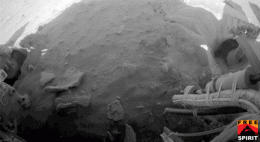
This two-frame animation aids evaluation of NASA's Mars Exploration Rover Spirit during a drive on the rover's 2,147th Martian day, or sol (Jan. 16, 2010). Click "Enlarge" for animation.

(PhysOrg.com) -- The rover team has begun driving Spirit backward as next technique for attempting to extricate the rover from the sand trap where it is embedded. The first two backward drives produced about 6.5 centimeters (2.6 inches) of horizontal motion and lifted the rover slightly.

Spirit performed the first backwards drive (toward the south) on Sol 2045 (Jan. 14, 2010). Until then, all drives since extrication attempts began two months earlier had been with forward driving, with Spirit facing northward.

The rover first entered its present location driving backward in April 2009. The backward driving in recent days includes the additional technique of steering the wheels side-to-side before performing each step. The hypothesis for the wheel steering is two-fold. The process clears out material in front of the wheel and allows material to slough off the face of the wheel trench and provide traction under the wheel.

Also, the flat surface of the wheel's side "kicks" against loose material, like a swimmer's frog kick or breast stroke, to provide some push. This Sol 2045 drive included enough wheel rotations to move the rover backward about 30 meters (98 feet) in six steps of 5 meters (16 feet) each, if the rover were in a situation with good traction. However, as Spirit is in a sand trap, the drive moved the rover backward a total of just over 3 centimeters (1.2 inches) and raised it in altitude just over 1 centimeter (0.4 inch). This is the first time the rover has climbed since extrication attempts began.

Northerly tilt also improved by just over a degree. The explanation here is that the rover's rear wheels are climbing, raising the back of the rover. Images from the rear hazard avoidance camera confirm this. A tilt toward the north would be favorable for energy production in the coming Martian winter, as it would gain more sunshine on the .

A second backward drive was commanded on Sol 2047 (Jan. 16, 2010). It was also six steps of 5 meters backward with the steering "frog kicks." The rover moved about 3.5 centimeters (1.4 inches) backward and climbed 0.3 centimeters (0.1 inch). However, this time the northerly tilt deteriorated by over a degree, undoing the prior drive's improvement. The explanation here is that the rover yawed counterclockwise, swinging the angled solar arrays away from north. But the rear wheels continued to climb, suggesting that the middle wheels are gaining traction. The rover is now about 3.5 centimeters (1.4 inches) south of the point where it started extrication two months ago, meaning the backward driving has already covered all of the distance achieved with forward driving and then some. Spirit is still down about 3 centimeters (1.2 inches) in altitude since extrication started. It is important to remember that the right-rear wheel is still non-functional, along with the right-front wheel.

On Sol 2050 (Jan. 19, 2010), Spirit was commanded to drive further backwards. Partway through the drive, the rover's left middle wheel stalled. Activities planned for coming sols include getting more diagnostic information about that wheel stall. Even with four working wheels, Spirit would have a very difficult path to extrication. And the rover needs a much better northerly tilt to assure winter survival.

As for other techniques to consider for extrication, the rover team has examined the two options that would use the robotic arm: pushing with it and re-sculpting the terrain by the left-front wheel. The assessment of pushing with the arm reveals that only about 30 newtons of lateral force could be achieved, while a minimum of several hundreds of newtons would be needed to move the rover. Further, such a technique risks damaging the arm and preventing its use for high-priority science from a stationary rover. The other technique of re-sculpting the terrain and perhaps pushing a rock in front of or behind the left-front wheel is also assessed to be of little to no help and, again, risks the arm. There is also a large risk of accidentally pushing the rock into the open wheel and jamming.

Provided by JPL/NASA (news : web)

Filter


Move the slider to adjust rank threshold, so that you can hide some of the comments.


Display comments: newest first

Adriab
Jan 22, 2010

Rank: 5 / 5 (1)
The trouble with these intrepid rovers serves to underline the fact that we need new missions to Mars to continue the exploration. Hopefully NASA keeps enough funding for MSL.
Temple
Jan 22, 2010

Rank: 5 / 5 (3)
I would strike "trouble with" from your statement and replace it with "absolutely unexpected and impressive performance and wondrous accomplishments of".
RoboticExplorer
Jan 23, 2010

Rank: not rated yet
I would strike "trouble with" from your statement and replace it with "absolutely unexpected and impressive performance and wondrous accomplishments of".


Agreed, these little martian explorers have done so much to further our understanding of another world NASA should be ashamed they have not, already, duplicated the effort for the the other high interest science targets in our solar system.

But no, they decided to spend on an antiquated "Rocket Ship" that will most likely never make it to the launch pad...http://www.popula...800.html
Rank 5 /5 (4 votes)
Related Stories
Relevant PhysicsForums posts
  • Titan's lack of impact craters
    created22 hours ago
  • Real pictures of black hole eating a star?
    createdFeb 08, 2012
  • Hypothetical way to travel faster than light, but not technically exceed lightspeed
    createdFeb 06, 2012
  • How do scientists monitor the Sun's activity?
    createdFeb 05, 2012
  • Search patterns in observational studies
    createdFeb 05, 2012
  • Derivation of Pogson's law
    createdFeb 03, 2012
  • More from Physics Forums - General Astronomy

More news stories

Could Venus be shifting gear?

(PhysOrg.com) -- ESA’s Venus Express spacecraft has discovered that our cloud-covered neighbour spins a little slower than previously measured. Peering through the dense atmosphere in the infrared, the ...

Space & Earth / Space Exploration

created 46 minutes ago | popularity 5 / 5 (1) | comments 0 | with audio podcast

What does a nebula sound like?

What do things sound like out in the cosmos? Of course, sound waves can’t travel through the vacuum of space; however, electromagnetic waves can. These electromagnetic waves can be recorded by devices called spectrographs ...

Space & Earth / Space Exploration

created 53 minutes ago | popularity 5 / 5 (1) | comments 0

Two new moons for Jupiter

Advances in technology have lead to the discovery of new planets outside of our Solar System, and now even new moons in our own backyard.

Space & Earth / Space Exploration

created 51 minutes ago | popularity not rated yet | comments 2

Sandy streets over the Atlantic

Thick dust from the Sahara blowing over the ocean off the western coast of Africa encounters the islands of Cape Verde, forming a wake of swirling “vortex streets” visible by satellite.

Space & Earth / Earth Sciences

created 18 minutes ago | popularity not rated yet | comments 0

Humans may have helped the decline of African rainforests 3000 years ago

(PhysOrg.com) -- Large areas of rainforests in Central Africa mysteriously disappeared over three thousand years ago, to be replaced by savannas. The prevailing theory has been that the cause was a change ...

Space & Earth / Environment

created 4 hours ago | popularity 5 / 5 (2) | comments 1 | with audio podcast report


The power of estrogen -- male snakes attract other males

A new study has shown that boosting the estrogen levels of male garter snakes causes them to secrete the same pheromones that females use to attract suitors, and turned the males into just about the sexiest ...

Experts reveal how plants don't get sunburn

(PhysOrg.com) -- Experts at the University of Glasgow have discovered how plants survive the harmful rays of the sun.

Team isolates nerve cells involved in storing long term memory and gene proteins associated with them

(Medical Xpress) -- A research team in Taiwan has succeeded in isolating two nerve cells in fruit fly brains that are believed to be the major players in allowing for the formation of long term memories. Furthermore, ...

Measurements from high-energy collisions lead to better understanding of why meson particles disappear

For several years, physicists at the Relativistic Heavy Ion Collider (RHIC) at Brookhaven National Laboratory (BNL), USA, have studied an unusual state of matter called the quark–gluon plasma, which they ...

SLAC, Stanford team focuses on high-energy electrons to treat cancer

Accelerator physicists at SLAC and cancer specialists from Stanford are working on a new technology that could dramatically reduce the time needed for cancer radiation treatments. The team ran an initial experiment ...

News of plaque-clearing drug tops week of major advances against Alzheimer's disease

In the last eight days, scientists have delivered a powerful one-two punch in the fight to defeat Alzheimer's disease. At the same time, the White House and members of Congress are proposing increases in Alzheimer's research ...