Acoustic levitation could be used on Mars
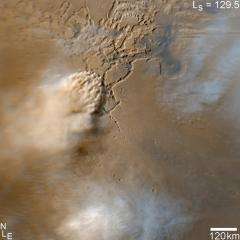
January 25, 2010 by Lin Edwards Dust storm on Mars

Enlarge

Dust storm on Mars. Image credit: NASA/JPL

(PhysOrg.com) -- The presence of fine dust on the Moon and Mars may present problems for explorers, such as coating solar panels, penetrating seals and interfering with machinery. Human explorers would also be endangered if there was a possibility of inhaling the extremely fine dust particles. Now scientists at the University of Vermont are considering a novel solution: acoustic levitation.

Finding ways of dealing with the fine dust is a high priority because the problems it can cause could drastically affect any long-term exploration. The thin atmosphere on Mars means are not as rounded as they would be on Earth and can remain quite sharp and abrasive, and they have a high electrostatic charge, which means the fine dust clings to everything and can penetrate space suit air locks, and make inoperable.

The researchers from the Department of Physics and Materials Science Program carried out a feasibility study to develop an acoustic dust removing system for use in space stations or habitations on the or Mars. They found a high-pitched (13.8 kHz, 128 dB) standing wave of sound emitted from a 3 cm aperture tweeter and focused on a reflector 9 cm away was strong enough to dislodge and move extremely fine (<2 µm diameter) dust particles on the reflector surface. The sound waves overcome the van der Waals adhesive force that binds dust particles to the surface, and creates enough pressure to levitate the dust, which is then blown away.

The team tested the system on a solar panel coated with mock lunar and Martian dust. The output of the clean panel was 4 volts, but when coated with dust it produced only 0.4 volts. After four minutes of acoustic levitation treatment the output returned to 98.4% of the maximum.

Study co-author Junrun Wu said acoustic levitation is not new, but this is the first time it has been considered for applications away from Earth. The technology is cheap and uses readily found parts, but there is one enormous problem: it will only work when it is sealed inside a space station or other habitation. It will not work where there is no atmosphere (such as the moon) or where the atmosphere is low pressure and thin (such as ) because sound is a pressure wave that travels through the air. This limits its usefulness because inside an enclosed space station there would be relatively little dust, and probably other readily-available means of removing it without resorting to acoustic levitation.

The paper is published in the Journal of the Acoustical Society of America in January.

You need Flash installed to watch this ideo

Acoustic Levitation Lifting. A piece of Styrofoam is levitated then dropped and picked up again using only sound waves. Video: Queen's University.


More information: Dislodgement and removal of dust-particles from a surface by a technique combining acoustic standing wave and airflow. J. Acoust. Soc. Am. Volume 127, Issue 1, pp. 45-50 (January 2010) http://dx.doi.org/10.1121/1.3268507

© 2010 PhysOrg.com


Rate this story - 4.1 /5 (12 votes)

Rank Filter

Move the slider to adjust rank threshold, so that you can hide some of the comments.


Display comments: newest first

  • Nik_2213 - Jan 25, 2010
    • Rank: 2.5 / 5 (2)
    13k8 Hz ? 128 dB ?? That's like the loitering-youth scarers at mall entrances. Only kids, dogs and the few older folk who have retained their high-end hearing notice...

    "Hey, Joe, one of your signs is screaming: Better get the neon transformer checked ASAP..."
    "Uh, Nik, it is supposed to be too high-pitched for you to hear..."

    Hilarity aside, they may do better using ionisers to knock down Martian / Lunar dust *before* it becomes a nuisance...
  • danman5000 - Jan 25, 2010
    • Rank: 5 / 5 (3)
    It will not work where there is no atmosphere (such as the moon) or where the atmosphere is low pressure and thin (such as Mars) because sound is a pressure wave that travels through the air. This limits its usefulness because inside an enclosed space station there would be relatively little dust, and probably other readily-available means of removing it without resorting to acoustic levitation.

    So what? What about inside airlocks? Surely they didn't think they were going to blow the dust off spacesuits while the astronauts were still outside? Take them into the airlock, pressurize it, blow the dust off, and suck it back outside.
  • yyz - Jan 25, 2010
    • Rank: not rated yet
    @danman5000,

    I was also curious about the inside airlock option. Besides dusting off the astronauts, they would need a pressurized area to take equipment/solar panels for cleaning. Seems obvious.
  • LeadDreamer - Jan 25, 2010
    • Rank: 5 / 5 (1)
    The point, folks, was once the task was carried out *inside*, whether station or airlock, then other (more simple) techniques could be used... such as a brush...

    The idea was to use the technique for locations where basic approaches were not practical. The technique described is "cute", but as pointed out, fails at it's most basic requirement: utility in the environment specified, namely Mars atmosphere.

    (BTW - pressurize airlock, and "suck it back outside"? Tad wasteful of not-so-readily-available air, wouldn't you think?)
  • danman5000 - Jan 25, 2010
    • Rank: not rated yet
    Heh, that's true. I suppose I'd rather be dusty than not able to breathe.
  • GaryB - Jan 25, 2010
    • Rank: not rated yet
    These sound waves will travel just fine in low or no atmosphere -- just send them through the metal itself.
  • Caliban - Jan 25, 2010
    • Rank: 4 / 5 (1)
    I thought of that, too, Gary- but it probably wouldn't work, due to different alloys and other materials interfering or altering the frequency and power of the wave propagation.
  • Walid - Feb 11, 2010
    • Rank: not rated yet
    @LeadDreamer
    The point, folks, was once the task was carried out *inside*, whether station or airlock, then other (more simple) techniques could be used... such as a brush...

    The idea was to use the technique for locations where basic approaches were not practical. The technique described is "cute", but as pointed out, fails at it's most basic requirement: utility in the environment specified, namely Mars atmosphere.

    (BTW - pressurize airlock, and "suck it back outside"? Tad wasteful of not-so-readily-available air, wouldn't you think?)


    You make sense if you were on the Moon, but this is truly viable on Mars. Martian air could be used instead and then pumped out. This will also suck out most of the dust that might get airborne in the dusting process.

January 25, 2010 all stories

Comments: 8

4.1 /5 (12 votes)


  • hide
  • Related Stories

  • Solution To Clean Space Dust From Mars Exploration Vehicles
    created Sep 01, 2005 | popularity not rated yet | comments 0
  • Mars Dust Devil Has Colorful Effect in Image Series
    created Jul 14, 2009 | popularity not rated yet | comments 0
  • Tracing ultra-fine dust
    created Oct 05, 2009 | popularity not rated yet | comments 0
  • Dust Devils Whip By Spirit
    created Apr 13, 2007 | popularity not rated yet | comments 0
  • Controllers Cheer as Data Arrive from NASA's Spirit Rover
    created Nov 13, 2008 | popularity not rated yet | comments 0


  • hide
  • Relevant PhysicsForums posts

Other News

Ultra-powerful Laser Makes Silicon Pump Liquid Uphill with No Added Energy

Physics / Optics & Photonics

created 16 hours ago | popularity 4.3 / 5 (6) | comments 4 | with audio podcast

(PhysOrg.com) -- Researchers at the University of Rochester's Institute of Optics have discovered a way to make liquid flow vertically upward along a silicon surface, overcoming the pull of gravity, without pumps or other ...


Quantum Sensor Developed by LSU Researcher Breaks New Limits

Physics / Quantum Physics

created 9 hours ago | popularity 5 / 5 (7) | comments 5 | with audio podcast

(PhysOrg.com) -- Researchers at Louisiana State University have invented an optical sensor that surpasses a quantum limit to sensitivity previously believed to be unbeatable. The breakthrough has a broad array of applications, ...


Metallic Glass Yields Secrets Under Pressure

Metallic Glass Yields Secrets Under Pressure

Physics / Condensed Matter

created 14 hours ago | popularity 5 / 5 (4) | comments 0 | with audio podcast

(PhysOrg.com) -- Metallic glasses are emerging as potentially useful materials at the frontier of materials science research. They combine the advantages and avoid many of the problems of normal metals and ...


Molding the Future of Plastic Electronic Production

Molding the Future of Plastic Electronic Production

Physics / Condensed Matter

created 8 hours ago | popularity not rated yet | comments 0 | with audio podcast

(PhysOrg.com) -- E-readers that can be bent and folded, "smart" bandages that signal when they need changing based on oxygen levels, and biodegradable radio frequency identification tags that help companies ...


Borexino experiment detects geo-neutrinos

Borexino experiment detects geo-neutrinos

Physics / General Physics

created 19 hours ago | popularity 4.6 / 5 (11) | comments 3 | with audio podcast report

(PhysOrg.com) -- The Borexino collaboration of about 80 scientists from six countries, who have been working with a detector buried 1.5 km beneath the Gran Sasso mountain near l'Aquila in Italy have detected ...