Researchers of microraptor shed light on ancient origin of bird flight
A joint team from the University of Kansas and Northeastern University in China says that it has settled the long-standing question of how bird flight began.
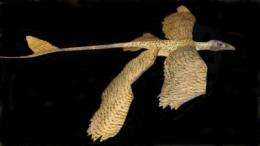
In the Jan. 25 issue of Proceedings of the National Academy of Sciences, the KU-China researchers push their research into the origins of bird flight and the early evolution of birds with decisive flight tests of a model of the four-winged gliding raptor, called microraptor.
The team is led by David Alexander, KU assistant professor of biology and an expert on modern animal flight. Alexander is joined by KU colleagues Larry Martin, David Burnham and Amanda Falk, along with Enpu Gong from Northeastern University in China, who are engaged in a comprehensive study of the functional morphology and ecology of early birds from China.
"We've done the scientific work and flight tests to show that microraptor was a very successful glider," said Burnham. "In 2003, they found one that was so well-preserved that you could count the feathers on its wings."
A debate involving the KU scientists, recently documented by the PBS program "NOVA," had flared over the question of whether evidence supported the theory that animals developed flight as ground dwellers, as a majority of paleontologists had asserted. But Martin and Burnham argue that flight originated above, in the trees. Such animals would have been gliders. The researchers say that fossils of the hawk-sized microraptor shore up their theory.
"The controversy was that these animals couldn't spread their hind-wings to glide," said Burnham. "But we've been able to articulate the bones in their hip socket to show that they could fly."
The new flight model created by Martin and Burnham comes directly from a skeleton composed of casts of the original bones of a microraptor and the preserved impressions of feathers from specimens in Chinese museums.
These astonishingly preserved fossils give a detailed image of the plumage in the gliding raptor and make possible the construction of an accurate model.
The fossils also show that an essentially sprawling posture was a plausible hind-limb wing position to provide stable flight with gliding parameters better than those of modern "flying lemurs."
The competing "biplane posture" advanced by other researchers suggested that an upright stance provided for successful glides. But the KU-China team argues that this stance required an impossibly heavy head to maintain a proper center of gravity. Furthermore, the presence of seven-inch-long flight feathers on the feet would prohibit any extended stay on the ground. Thus, microraptor must have been completely arboreal.
"We decided that we would take the skeleton we had, put wings on it from the feather pattern and show that it could fly," said Burnham. "If others think that it was a terrestrial runner, they should make a model and put it on a treadmill and show that it could run with those long feathers on its hind legs."
Successful flight tests were conducted in the open air and under more controlled conditions in the Anschutz Sports Pavilion at KU. A video of some of the tests is available at www.features.ku.edu/microraptors.
Indeed, the KU-China team's work provides such strong support for the trees-down model for the origin of avian flight that the alternative terrestrial (ground up) origin now may be abandoned.
Researchers Martin, Burnham and Falk, along with Gong, recently made headlines for their discovery of a venom-delivery system in sinornithosaurus, a cousin of microraptor. A paper detailing that finding was published in PNAS last month.
Provided by University of Kansas


