Advanced engine-control system reduces biodiesel fuel consumption and emissions
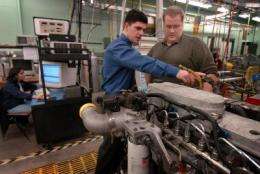
Researchers from Purdue University and Cummins Inc. have developed an advanced "closed-loop control" approach for preventing diesel engines from emitting greater amounts of smog-causing nitrogen oxides when running on biodiesel fuels.
Operating truck engines on a blend of biodiesel and ordinary diesel fuel dramatically reduces the emission of particulate matter, or soot. However, the most modern and efficient diesel engines burning biodiesel emit up to 40 percent more nitrogen oxides at some operating conditions, and fuel economy declines by as much as 20 percent.
Unlike conventional diesel, biodiesel contains oxygen, and the researchers have shown that this presence of oxygen is responsible for the majority of the higher emission of nitrogen oxides, said Gregory Shaver, an assistant professor of mechanical engineering.
Another key factor is a recent innovation called exhaust gas recirculation, which reroutes exhaust back into the engine cylinders to reduce emissions. The researchers found that nitrogen oxide emissions rise by a higher percentage in engines equipped with this exhaust-recirculation technology compared with older engines that do not. However, the newer engines still emit less nitrogen oxides than the older engines.
The research addresses the need to reduce nitrogen oxide emissions and fuel consumption. Researchers at Purdue's Ray W. Herrick Laboratories used a Cummins 6.7-liter, six-cylinder diesel engine, a popular power plant found in Dodge Ram pickup trucks.
"We were able to improve the fuel economy with a biodiesel blend while reducing nitrogen oxides to where they were with conventional diesel," Shaver said. "At the same time, we were able to maintain the customary biodiesel reductions in particulate matter emissions compared to ordinary diesel fuel while not increasing noise emissions."
Fuel economy still is problematic, however, because biodiesel has 10 percent to 12 percent lower "energy density," or the amount of energy liberated during combustion, compared to regular diesel fuel, he said.
"This means you get lower mileage for biodiesel compared to ordinary diesel fuel," Shaver said. "We improved the combustion efficiency and were able to get better mileage than before, but still not as good as conventional diesel fuel."
Findings are detailed in a research paper that has been posted online and that will appear in an upcoming issue of the American Chemical Society journal Energy & Fuels. Researchers from Purdue and Cummins also authored a related paper regarding soy biodiesel blends that appeared online in October in the same journal.
The researchers developed a physics-based, closed-loop control technique - which means the system uses advanced models to self-adjust engine settings based on feedback from sensors. Software algorithms use data from the sensors to determine the fuel blend being combusted. If the fuel is changed, the system identifies the new fuel and makes critical adjustments to fuel-injection timing, the air-to-fuel ratio and how much exhaust is rerouted into the cylinders.
"You need to be able to estimate what the blend ratio is so you know what's going on in the engine," Shaver said. "Is it 20 percent biodiesel fuel mixed with 80 percent regular fuel? Then we can do something to reduce the nitrogen oxides to levels consistent with a conventional fuel that didn't have oxygen in it."
Most late-model cars and trucks already are equipped with both oxygen sensors in their exhaust systems and sophisticated electronic control modules, making the technique applicable for both current and future vehicles, Shaver said.
"It just adds another wrinkle or two of extra intelligence to an engine's electronic control module," Shaver said.
The researchers extensively tested and simulated four blend ratios of biodiesel, focusing on soy-based fuel, which is the most commonly used biodiesel in the United States. The approach also could be used for other types of fuels and engines, including advanced lean-burn gasoline engines running on ethanol-gasoline blends.
More information: Both papers are available at http://pubs.acs.org/doi/abs/10.1021/ef9006609 and http://pubs.acs.org/doi/abs/10.1021/ef9011033
Provided by Purdue University


