How to shoot the messenger
January 26, 2010
How to shoot the messenger

Enlarge

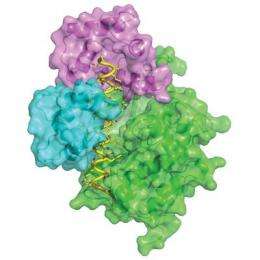
This image shows the three-dimensional structure of death-associated protein kinase (green and yellow) when bound to calmodulin (violet and blue). It was obtained by X-ray crystallography. Credit: Mathias Wilmanns/EMBL

Cells rely on a range of signaling systems to communicate with each other and to control their own internal workings. Scientists from the European Molecular Biology Laboratory (EMBL) in Hamburg, Germany, have now found a way to hack into a vital communications system, raising the possibility of developing new drugs to tackle disorders like neurodegeneration, cancer and cardiovascular disease. In a study published today in Science Signaling, they have pieced together the first snapshot of what two of the system's components look like while interacting.

One way these signalling systems work is by triggering a flood of inside the cell. These get picked up by a receiver, a protein called calmodulin which turns this calcium signal into action by switching various parts of the cell's machinery on or off. Calmodulin regulates a set of proteins called kinases, each of which controls the activity of specific parts of the cell, thus altering the cell's behaviour.

Using high-energy X-rays produced by the (ESRF) in Grenoble, France, and by the German Synchrotron Radiation Centre (DESY), in Hamburg, Germany, Matthias Wilmanns' team at EMBL revealed the molecular structure of one of these kinases, a protein called Death-Associated DAPK, when bound to calmodulin. The structure showed how calmodulin binds to a particular section of DAPK, switching the kinase on so that it can go and change the function of its targets. The team then worked out which of DAPK's building blocks, or , were crucial for calmodulin to bind.

"Faulty versions of DAPK are involved in the development of some cancers," says Wilmanns, "so we want to know more about how this functions to allow its better exploitation as an anti-cancer target."

What's more, DAPK has physical similarities to many of the other kinases controlled by calmodulin, meaning many of them are likely to interact with calmodulin in the same, or similar ways. Being able to see the three-dimensional structures of these proteins, how they clip together and alter each other's behaviour means researchers can devise ways to manipulate this interaction with drugs.

"That will provide a platform to get into drug discovery," says Wilmanns, adding, "obviously, this is the beginning of the story." He is planning to do so in an ongoing collaboration with Adi Kimchi's team at the Weizmann Institute in Israel and other groups from EMBL.

Provided by European Molecular Biology Laboratory (news : web)

Filter


Move the slider to adjust rank threshold, so that you can hide some of the comments.


Display comments: newest first

stealthc
Jan 26, 2010

Rank: not rated yet
protein folding is only just getting understood and is probably a system not only worthwhile examining for new drugs, it is a system worthwhile looking at because of the scale at which it operates it holds further clues to quantum phenomena.
Rank 5 /5 (1 vote)
Related Stories
Relevant PhysicsForums posts
  • Stoichiometry
    created3 hours ago
  • Boiling and melting point of impure substances
    created4 hours ago
  • Safe nitrogen compound to decompose a 500 deg C in a furnace?
    created11 hours ago
  • [ask]electron inside drinking water
    createdFeb 08, 2012
  • How to avoid formation of Lithium Chromate ???
    createdFeb 08, 2012
  • how to choose a reduced or oxidated form in a redox
    createdFeb 08, 2012
  • More from Physics Forums - Chemistry

More news stories

Hydrogen from acidic water: Researchers develop potential low cost alternative to platinum for splitting water

A technique for creating a new molecule that structurally and chemically replicates the active part of the widely used industrial catalyst molybdenite has been developed by researchers with the Lawrence Berkeley ...

Chemistry / Materials Science

created 14 hours ago | popularity 5 / 5 (10) | comments 11 | with audio podcast

Engineers find inspiration for new materials in Piranha-proof armor

(PhysOrg.com) -- It’s a matchup worthy of a late-night cable movie: put a school of starving piranha and a 300-pound fish together, and who comes out the winner?

Chemistry / Materials Science

created 20 hours ago | popularity 4.5 / 5 (4) | comments 2 | with audio podcast

Flexible paper robots

(PhysOrg.com) -- These inexpensive robots can stretch, bend and twist under control, and lift objects up to 120 times their own weight. Being soft, they can apply gentle and even pressure, and adapt to varied ...

Chemistry / Materials Science

created 12 hours ago | popularity 5 / 5 (5) | comments 2 | with audio podcast

New method makes culture of complex tissue possible in any lab

Scientists at the University of California, San Diego have developed a new method for making scaffolds for culturing tissue in three-dimensional arrangements that mimic those in the body. This advance, published online in ...

Chemistry / Biochemistry

created 11 hours ago | popularity 5 / 5 (4) | comments 0 | with audio podcast

Chemists harvest light to create 'green' tool for pharmaceuticals

(PhysOrg.com) -- A team of University of Arkansas researchers, including an Honors College undergraduate student, has created a new, "green" method for developing medicines. The researchers used energy from ...

Chemistry / Biochemistry

created 20 hours ago | popularity 5 / 5 (3) | comments 0 | with audio podcast


FDA-approved drug rapidly clears amyloid from the brain, reverses Alzheimer's symptoms in mice

Neuroscientists at Case Western Reserve University School of Medicine have made a dramatic breakthrough in their efforts to find a cure for Alzheimer's disease. The researchers' findings, published in the journal Science, show t ...

'Dark plasmons' transmit energy

Microscopic channels of gold nanoparticles have the ability to transmit electromagnetic energy that starts as light and propagates via "dark plasmons," according to researchers at Rice University.

Ultraviolet protection molecule in plants yields its secrets

Lying around in the sun all day is hazardous not just for humans but also for plants, which have no means of escape. Ultraviolet (UV) radiation from the sun can damage proteins and DNA inside cells, leading ...

Soraa LED light may dim 50-watt halogen rivals

(PhysOrg.com) -- Soraa, a Fremont, California company founded in 2008, this week launched its first product, a light that uses LEDS (light emitting diodes). The "Soraa LED MR16 lamp" is the "perfect" replacement ...

Anyone can learn to be more inventive, cognitive researcher says

There will always be a wild and unpredictable quality to creativity and invention, says Anthony McCaffrey, a cognitive psychology researcher at the University of Massachusetts Amherst, because an "Aha moment" is rare and ...

Explained: Sigma

It's a question that arises with virtually every major new finding in science or medicine: What makes a result reliable enough to be taken seriously? The answer has to do with statistical significance -- but ...