The sea level has been rising and falling over the last 2,500 years
January 26, 2010
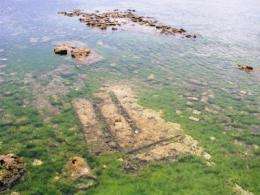
Rising and falling sea levels over relatively short periods do not indicate long-term trends. An assessment of hundreds and thousands of years shows that what seems an irregular phenomenon today is in fact nothing new," explains Dr. Dorit Sivan, who supervised the research. The Templar palace in Acre, seen here, is one of the sites where this study was carried out. Credit: Amir Yurman, Director of the Leon Recanati Institute for Maritime Studies Maritime Workshop at the University of Haifa; Courtesy of the University of Haifa
"Rising and falling sea levels over relatively short periods do not indicate long-term trends. An assessment of hundreds and thousands of years shows that what seems an irregular phenomenon today is in fact nothing new," explains Dr. Dorit Sivan, who supervised the research.
The sea level in Israel has been rising and falling over the past 2,500 years, with a one-meter difference between the highest and lowest levels, most of the time below the present-day level. This has been shown in a new study supervised by Dr. Dorit Sivan, Head of the Department of Maritime Civilizations at the University of Haifa. "Rises and falls in sea level over relatively short periods do not testify to a long-term trend. It is early yet to conclude from the short-term increases in sea level that this is a set course that will not take a change in direction," explains Dr. Sivan.
The rising sea level is one of the phenomena that have most influence on humankind: the rising sea not only floods the littoral regions but also causes underground water salinization, flooded effluents, accelerated coastal destruction, and other damage.
According to Dr. Sivan, the changing sea level can be attributed to three main causes: the global cause - the volume of water in the ocean, which mirrors the mass of ice sheets and is related to global warming or cooling; the regional cause - vertical movement of the earth's surface, which is usually related to the pressure placed on the surface by the ice; and the local cause - vertical tectonic activity. Seeing as Israel is not close to former ice caps and the tectonic activity along the Mediterranean coast is negligible over these periods, it can be concluded that drastic changes in Israel's sea levels are mainly related to changes in the volume of water.
In the present study, in light of earlier studies, research student Ayelet Toker and Dr. Sivan, set out to examine Israel's sea level over the past 2,500 years, based on data deduced from many coastal archaeological findings. They made a careful selection of findings that have been reliably and accurately dated, and first focused on findings that were excavated by the Antiquities Authority in Acre of the Crusader period. These revealed that the sea level during the Crusader period - just 800 years ago - was some 50-90 centimeters lower than the present sea level. Findings from the same period at Caesarea and Atlit reinforced this conclusion. When additional sites were examined from periods before and after the Crusader period, it was revealed that there have been significant fluctuations in sea level: During the Hellenistic period, the sea level was about 1.6 meters lower than its present level; during the Roman era the level was almost similar to today's; the level began to drop again during the ancient Muslim period, and continued dropping to reach the same level as it was during the Crusader period; but within about 500 years it rose again, and reached some 25 centimeters lower than today's level at the beginning of the 18th century.
"Over the past century, we have witnessed the sea level in Israel fluctuating with almost 19 centimeters between the highest and lowest levels. Over the past 50 years Israel's mean sea level rise is 5.5 centimeters, but there have also been periods when it rose by 10 centimeters over 10 years. That said, even acute ups and downs over short periods do not testify to long-term trends. An observation of the sea levels over hundreds and thousands of years shows that what seems a phenomenon today is as a matter of fact "nothing new under the sun", Dr. Sivan concludes.
-
NASA now better able to measure sea level
Jul 13, 2005 |
not rated yet |
0
-
Scientists look at global sea level rise
Oct 12, 2005 |
not rated yet |
0
-
Rising Sea Greater Danger to Louisiana than Sinking Land
Nov 27, 2006 |
not rated yet |
0
-
Sea level rise of 1 meter within 100 years
Jan 08, 2009 |
not rated yet |
0
-
Sea level is rising along US Atlantic coast, say environmental scientists
Dec 10, 2009 |
not rated yet |
0
-
Engineers build first sub-10-nm carbon nanotube transistor
Feb 01, 2012 |
4.9 / 5 (30) |
30
-
Something old, something new: Evolution and the structural divergence of duplicate genes
Jan 31, 2012 |
4.6 / 5 (7) |
1
-
The hidden nanoworld of ice crystals: Revealing the dynamic behavior of quasi-liquid layers
Jan 30, 2012 |
5 / 5 (3) |
1
-
Stock market network reveals investor clustering
Jan 27, 2012 |
3.9 / 5 (23) |
8
-
Of microchemistry and molecules: Electronic microfluidic device synthesizes biocompatible probes
Jan 26, 2012 |
5 / 5 (1) |
0
-
Discrepancy between oxygen and carbon-dioxide levels
6 hours ago
-
where gems are found in the world
10 hours ago
-
Wind Waves in Reservoir ~ Wind run-up and Wind set-up
Feb 08, 2012
-
Balance of oxygen in the atmosphere
Feb 01, 2012
-
The case for a methanol-based economy
Jan 30, 2012
-
Weather in a rotating cylinder
Jan 25, 2012
- More from Physics Forums - Earth
More news stories
New views show old NASA Mars landers
(PhysOrg.com) -- The High Resolution Imaging Science Experiment (HiRISE) camera on NASA's Mars Reconnaissance Orbiter recorded a scene on Jan. 29, 2012, that includes the first color image from orbit showing ...
Space & Earth / Space Exploration
20 hours ago |
4.9 / 5 (7) |
8
|
Deconstructing a mystery: What caused Snowmaggedon?
In the quiet after the storms, streets and cars had all but disappeared under piles of snow. The U.S. Postal Service suspended service for the first time in 30 years. Snow plows struggled to push the evidence ...
Space & Earth / Earth Sciences
12 hours ago |
4.7 / 5 (3) |
1
|
Black holes and star formation
(PhysOrg.com) -- It has long been recognized that galaxy mergers or even close interactions can play a vital role in shaping the morphology of galaxies. One way they can do so, it is thought, is by triggering ...
19 hours ago |
4.1 / 5 (7) |
5
|
Ocean microbe communities changing, but long-term environmental impact is unclear
As oceans warm due to climate change, water layers will mix less and affect the microbes and plankton that pump carbon out of the atmosphere but researchers say it's still unclear whether these processes ...
Space & Earth / Earth Sciences
14 hours ago |
5 / 5 (2) |
2
|
Researchers create 3-D laser maps that show how earthquake changes landscape
Geologists have a new tool to study how earthquakes change the landscape down to a few inches, and it's giving them insight into how earthquake faults behave. In the Feb. 10 issue of the journal Science, a team ...
Space & Earth / Earth Sciences
14 hours ago |
5 / 5 (4) |
0
|
'Dark plasmons' transmit energy
Microscopic channels of gold nanoparticles have the ability to transmit electromagnetic energy that starts as light and propagates via "dark plasmons," according to researchers at Rice University.
FDA-approved drug rapidly clears amyloid from the brain, reverses Alzheimer's symptoms in mice
Neuroscientists at Case Western Reserve University School of Medicine have made a dramatic breakthrough in their efforts to find a cure for Alzheimer's disease. The researchers' findings, published in the journal Science, show t ...
Hydrogen from acidic water: Researchers develop potential low cost alternative to platinum for splitting water
A technique for creating a new molecule that structurally and chemically replicates the active part of the widely used industrial catalyst molybdenite has been developed by researchers with the Lawrence Berkeley ...
Ultraviolet protection molecule in plants yields its secrets
Lying around in the sun all day is hazardous not just for humans but also for plants, which have no means of escape. Ultraviolet (UV) radiation from the sun can damage proteins and DNA inside cells, leading ...
Soraa LED light may dim 50-watt halogen rivals
(PhysOrg.com) -- Soraa, a Fremont, California company founded in 2008, this week launched its first product, a light that uses LEDS (light emitting diodes). The "Soraa LED MR16 lamp" is the "perfect" replacement ...
Anyone can learn to be more inventive, cognitive researcher says
There will always be a wild and unpredictable quality to creativity and invention, says Anthony McCaffrey, a cognitive psychology researcher at the University of Massachusetts Amherst, because an "Aha moment" is rare and ...
Jan 26, 2010
Rank: 3.3 / 5 (19)
The system is more complex than we're assuming, and certainly not as fragile as currently expected. More research is needed as this research could be partial conjecture.
Jan 26, 2010
Rank: 3.5 / 5 (11)
Hmmm.. Another piece of evidence to suggest the MWP may not have been global.
Jan 26, 2010
Rank: 2.5 / 5 (12)
Jan 26, 2010
Rank: 2.5 / 5 (12)
Jan 26, 2010
Rank: 2.5 / 5 (13)
Nowhere in this brief article does it indicate whether or not the researcher actually bothered to validate any of the work done in the "carefully selected" research of others.
Jan 26, 2010
Rank: 2.2 / 5 (13)
I stumbled over that as well and eventually concluded that he believes that if the MWP was a global event then that would have had to mean that the ice caps and glaciers would have been melting which in turn would have raised water levels instead of lowering them. Not that I agree with his comment, just passing along the thought process. IMHO, such a short term elevation of the temperature would not necessarily have lasted long enough to provide significant ice melt.
This makes me think that if the AGWers had been around then that they would have been spewing a lot of the same rhetoric that is currently being published as fact, when IMHO no one really knows.
Jan 26, 2010
Rank: 2 / 5 (10)
Jan 26, 2010
Rank: 4 / 5 (2)
Jan 26, 2010
Rank: 1.7 / 5 (3)
Another couple of good questions . . .
How does the putative additional mass of water (from melting ice) affect subsidence (the lowering, or compression, of the Ocean floor due to the (assumed) additional mass above))?
As the ocean floor is compressed by the additional mass, I would assume the ocean level drops . . .
How does the putative additional mass of water affect the amount of water injected into the crust/mantle at plate boundaries?
As the water disappears into the lower crust/upper mantle, I assume, sea levels drop as water is removed from the ocean system.
Jan 26, 2010
Rank: 4.3 / 5 (3)
Another aspect is that the Med's surface salinity is sensitive to the inflow from several great rivers. Long-term climate variations that affect their catchments may alter the Med's level...
Jan 26, 2010
Rank: 1.7 / 5 (12)
GISP2 can be fit into Vostok data for the same time period, too.
Lining up both GISP2 and Vostok is a pretty good indicator of a global climate situation, especially when proxies can be lined up together for comparison from other parts of the world.
MWP was real, its signal can be seen in a considerable set of data these days, and these data show that this period was not confined to the Northern Hemisphere as commonly was thought in years past.
This is exactly why Mann had to do something with the data he was seeing and smoothed out the signal for the MWP, creating and publishing the infamous hockey-stick.
As to the above article and the sea levels, it is exactly right. Changes in sea levels happen all the time.
Jan 26, 2010
Rank: 3 / 5 (4)
Jan 26, 2010
Rank: 2.8 / 5 (5)
Jan 26, 2010
Rank: 1.7 / 5 (6)
Can't resist this one - there is no science behind it! Sorry, that was very tongue in cheek, but had to be done!
@tenkam - you're on the right track in that the orbit is not absolutely precise. Read up on perihelion and aphelion for more info. It's a likely factor, seeing as the temperature changes have been naturally occurring for countless years, and human beings have only been hardcore polluting the air for essentially the past 100 years. It's something the Global Warming fanatics should have read up on in any case.
Jan 26, 2010
Rank: 3.4 / 5 (10)
How sad that Dr. Sivan is so unfamiliar with other research in this field that he is unaware that atmospheric pressure and wind velocity also affect local sea level height.
Jan 27, 2010
Rank: 1.3 / 5 (8)
That sea is an interesting case because of its situation. In this case it is the increase of volume of water that appears to be the main driver of sea level rise in the Mediterranean, according to Dr. Sivan. The other factors are believed to be so negligible an influence on the Mediterranean as not needing mention. It has nothing to do with what Dr. Sivan appears to know or not to know about the other factors in sea level rise, so I would not make such assumptions as to what he does or doesn't know.
The other factors simply are not believed to be pertinent in this region of the Mediterranean, which have been affected in the past by the 3 main drivers of sea level change in the Mediterranean. These do not mean anything in the global schema of things.
Jan 27, 2010
Rank: 3 / 5 (2)
;)
Jan 27, 2010
Rank: 1 / 5 (1)
Jan 27, 2010
Rank: 5 / 5 (1)
Tectonic activity is massive around the Mediterranean. Look at the volcanos for instance. Etna, Vesuvius, etc and the massive eruption of Santorini in about 1500BC. Massive earthquakes in Turkish area. High land in Greece in slipping into the sea along old massive fault lines.
More homework required!
Jan 27, 2010
Rank: not rated yet
Jan 27, 2010
Rank: 5 / 5 (5)
...and you believe that because Greenland and western Europe were warmer then the whole globe was...hmmm. Still curious how you dismiss proxy data on the one hand then use it when you want. You know that the same proxy data you dismiss shows that the MWP coincided not only with a particularly strong PDO and AMO but also, and pay attention here this is important, with the lowest Nino3 in the last 1,500 years.The LIA is marked by particularly low PDO and AMO temperatures and a near average Nino3. Article is here http://www.scienc...957/1256
Like you say, you can't just use one area for 'proof' of a particular theory, but you can use each as "evidence" in a particular theory. Notice my wording , nest time read properly ;-)
Jan 27, 2010
Rank: 1.6 / 5 (7)
For example: http://www.spring...0215w15/
Jan 27, 2010
Rank: 1.5 / 5 (8)
That is quite cogent advice that I hope you one day will take and put to use in future. I mentioned several types of proxy data from many parts of the world that all interrelate and display the same signal of the MWP. You appear to have missed it and driven your foot into your mouth...again. Sigh...
Jan 27, 2010
Rank: 1.8 / 5 (10)
Got something else of more scientific value? Anything from CRU and Michael Mann is suspect these days due to ClimateGate--until facts and figures can be completely rechecked.
Jan 28, 2010
Rank: 4.2 / 5 (5)
Oh, the emails again...blah blah blah. Perhaps you would link to an email that proves a grand global conspiracy..you know...from the emails you say you have but haven't read yet...again.
Jan 28, 2010
Rank: 1 / 5 (7)
Not sure who this is directed to but I read the paper. Mann's data is suspect as it has been shown that his methods of analysis and his preferred "peers" aren't quite what they should be in concern to the guidelines for peer review. It's an interesting paper, but without corrolary data and published works, it cannot be taken as pure fact based on your assertions.
Jan 28, 2010
Rank: 1 / 5 (7)
His fault in processing data in a manner to rid himself of the MWP is known well enough to call anything he writes on the subject of the MWP into question until the results can be replicated by other scientists. Period.
You can take his facts and figures at face value if you want but I am not willing to do so--especially when I have seen proxy data from all over the globe (both hemispheres) that has a comparative signal of the MWP showing glaringly through when lain side by side and when Mann has smoothed away the MWP via his statistical methodology before.
Jan 28, 2010
Rank: 1 / 5 (6)
You keep asking me to provide a link to specific emails. It would be a fun exercise for me to do so. Elsewhere, in a now hidden post, I have asked you to link us with a working link to a site of your choosing that contains the texts of the emails. You still have not done so. Any chance that will happen any time soon?
And, you continue to misread and misstate what I have written. I have read the emails and skimmed through the rest of the material. It is the rest of the data ASIDE FROM the emails that I have not finished studying in-depth. Big difference.
Jan 29, 2010
Rank: 1 / 5 (6)
I will here state that I have not yet gone through the entire collection of code. But, as I was skimming through some of it the following caught my eye:
The use of HADCRU3V data initially gives me pause for concern. I need not repeat the reason why as I have made that abundantly clear elsewhere. The charts in the paper have the same or very similar characteristic smoothing in Mann's infamous hockey-stick graph. This could be problematic. I will be searching through the files for raw data, however.
I will need to study this all out before offering a final opinion. I do not have time to go through all the data at the moment but hope to have time shortly, so my opinion could change after going through it all. We'll see.
Feb 01, 2010
Rank: 1 / 5 (4)
Here is one problem, however. Cook himself is on record as stating that these data support a global MWP.
(Cook et al., 2002, Evidence for a ‘Medieval Warm Period’ in a 1,100 year tree-ring reconstruction of past austral summer temperatures in New Zealand)
That said, I plan to go through and study the material more closely as I may have missed something but as I have gone thus far I have found several issues.
Feb 05, 2010
Rank: 3 / 5 (2)