Channeling your inner alien? Maybe, scientists say (Update)
January 26, 2010
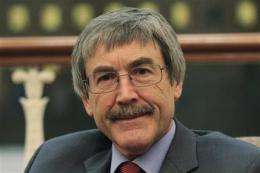
Paul Davies of Arizona State University poses for the Associated Press prior to his lecture in the Royal Society in central London, Tuesday Jan. 26, 2010. For the past 50 years, scientists have been scouring the skies for radio signals from beyond our planet, hoping for some sign of extraterrestrial life. But one physicist says there's no reason alien life couldn't already be lurking among us or maybe even in us. Davies had told the conference held on the society on the hunt for alien life and that life may have developped on earth not once but several times. Davies said the variant life forms -- most likely tiny microbes could still be hanging around "right under or noses or even in our noses." (AP Photo/Lefteris Pitarakis)
(AP) -- For decades, scientists have scanned the heavens in search of extraterrestrial life. Perhaps they should have looked closer to home. Variant life forms - most likely tiny microbes - could still be hanging around "right under or noses - or even in our noses," Paul Davies, an award-winning Arizona State University physicist, told a group of scientists Tuesday.
"How do we know all life on earth descended from a single origin?" he said, speaking at London's Royal Society, which serves as Britain's academy of sciences. "We've just scratched the surface of the microbial world."
The idea that alien micro-organisms could be hiding on Earth has been discussed for a while, according to Jill Tarter, the director of Search for Extraterrestrial Intelligence, a U.S. project that listens for signals from civilizations based around distant stars.
She said several of the scientists involved in the project were interested in pursuing the notion, which Davies laid out in a 2007 Scientific American article, "Are Aliens Among Us?"
So far, there's no answer. And finding one would be fraught with difficulties, as Davies himself acknowledged.
Unusual organisms abound - including chemical-eating bacteria which dwell deep in the ocean and organisms that thrive in boiling-hot springs - but that doesn't mean they're different life forms entirely.
"How weird do they have to be to suggest a second genesis as opposed to just an obscure branch of the family tree?" he said. Davies suggested that the only way to prove an organism wasn't "life as we know it" was if it were built using exotic elements which no other form of life had.
Such organisms have yet to be found. Bruce Jakosky, an astrobiologist at the University of Colorado at Boulder, said the notion of alien life on Earth was "an interesting theoretical idea" but one that would be impossible to put odds on because "we have no idea what we're looking for."
Jakosky added that, if such life forms existed, humans would probably have little to fear, as their different biochemistry would tend to mitigate against infection or disease.
Davies agreed that the idea needed verification, telling the conference that "the scientist in me screams out for caution."
Still, he noted that less than 1 percent of all the world's bacteria had been comprehensively studied - leaving plenty of room for scientists to find surprises in Earth's nooks and crannies.
Davies' call for alien-hunting scientists to look to their own backyards came as a pioneer in the search for extraterrestrial life in outer space told the conference the job appears to be more difficult than previously thought.
Frank Drake, who conducted the first organized search for alien radio signals in 1960, said that the Earth - which used to pump out a loud tangle of radio waves, television signals and other radiation - has been steadily getting quieter as its communications technology improves.
Drake cited the switch from analogue to digital television - which uses a far weaker signal - and the fact that much more communications traffic is now relayed by satellites and fiber optic cables, limiting its leakage into outer space.
"Very soon we will become very undetectable," he said. If similar changes are taking place in other technologically advanced societies, then the search for them "will be much more difficult than we imagined."
But Drake said scientists at SETI were excited by the possibility of using lasers to send super-bright flashes of light into space for a tiny fraction of a second. The flashes could theoretically be seen by an advanced civilization up to 1,000 light years away, and infrared versions of the devices could possibly send beams even further.
But Drake noted that the interstellar equivalent to turning a flashlight on and off only works if a prospective alien civilization wants to get in touch to begin with.
"There has to be altruism in the universe," he said.
More information: Royal Society: http://royalsociety.org/
SETI Institute: http://www.seti.org/
©2010 The Associated Press. All rights reserved. This material may not be published, broadcast, rewritten or redistributed.
-
Cosmologist Paul Davies explores notion of 'alien' life on Earth
Feb 15, 2009 |
not rated yet |
0
-
11,000 alien species invade Europe
Nov 20, 2008 |
not rated yet |
0
-
Astrobiologist helps IMAX director film
Jan 16, 2005 |
not rated yet |
0
-
Queen's marine biologist investigates aliens beneath the waves
Jun 16, 2008 |
not rated yet |
0
-
Vatican searches for extra-terrestrial life
Nov 10, 2009 |
not rated yet |
0
-
Engineers build first sub-10-nm carbon nanotube transistor
Feb 01, 2012 |
4.9 / 5 (30) |
30
-
Something old, something new: Evolution and the structural divergence of duplicate genes
Jan 31, 2012 |
4.6 / 5 (7) |
1
-
The hidden nanoworld of ice crystals: Revealing the dynamic behavior of quasi-liquid layers
Jan 30, 2012 |
5 / 5 (3) |
1
-
Stock market network reveals investor clustering
Jan 27, 2012 |
3.9 / 5 (23) |
8
-
Of microchemistry and molecules: Electronic microfluidic device synthesizes biocompatible probes
Jan 26, 2012 |
5 / 5 (1) |
0
-
Titan's lack of impact craters
Feb 09, 2012
-
Real pictures of black hole eating a star?
Feb 08, 2012
-
Hypothetical way to travel faster than light, but not technically exceed lightspeed
Feb 06, 2012
-
How do scientists monitor the Sun's activity?
Feb 05, 2012
-
Search patterns in observational studies
Feb 05, 2012
-
Derivation of Pogson's law
Feb 03, 2012
- More from Physics Forums - General Astronomy
More news stories
Could Venus be shifting gear?
(PhysOrg.com) -- ESAs Venus Express spacecraft has discovered that our cloud-covered neighbour spins a little slower than previously measured. Peering through the dense atmosphere in the infrared, the ...
Space & Earth / Space Exploration
3 hours ago |
5 / 5 (4) |
4
|
Humans may have helped the decline of African rainforests 3000 years ago
(PhysOrg.com) -- Large areas of rainforests in Central Africa mysteriously disappeared over three thousand years ago, to be replaced by savannas. The prevailing theory has been that the cause was a change ...
Clam fields found at deep, low-temperature Mariana vents
(PhysOrg.com) -- Scientists have marveled at the unusual life forms thriving at high temperature hydrothermal vents of the deep ocean.
Space & Earth / Earth Sciences
3 hours ago |
not rated yet |
0
|
Mars Science Laboratory computer issue resolved
(PhysOrg.com) -- Engineers have found the root cause of a computer reset that occurred two months ago on NASA's Mars Science Laboratory and have determined how to correct it.
Space & Earth / Space Exploration
4 hours ago |
5 / 5 (5) |
2
|
Two new moons for Jupiter
Advances in technology have lead to the discovery of new planets outside of our Solar System, and now even new moons in our own backyard.
Space & Earth / Space Exploration
3 hours ago |
not rated yet |
2
New understanding of DNA repair could eventually lead to cancer therapy
A research group in the Faculty of Medicine & Dentistry at the University of Alberta is hoping its latest discovery could one day be used to develop new therapies that target certain types of cancers.
Zuckerberg's focus drives Facebook's ascent
When Mark Zuckerberg showed up to rent Judy Fusco's Los Altos, Calif., house in the fall of 2004, soon after he'd arrived in Silicon Valley, the landlord was immediately struck by his confidence.
Both maternal and paternal age linked to autism
Older maternal and paternal age are jointly associated with having a child with autism, according to a recently published study led by researchers at The University of Texas Health Science Center at Houston (UTHealth).
Night, weekend delivery OK for babies with birth defects
Weekday delivery is no better than night or weekend delivery for infants with birth defects, according to a new study presented today at The Pregnancy Meeting, the Society for Maternal-Fetal Medicine's annual conference. ...
Sonic Cradle lands spot in TED exhibition
A Simon Fraser University graduate student project that melds music, meditation and modern technology has landed a rare spot as an exhibit at TEDActive 2012 in Palm Springs, California this month.
From virginity to Viagra
Americans will spend more than $17 billion on Valentine's Day, but far less on programs like sex education for adolescents. The editors of the new book, Sex for Life, From Virginity to Viagra, How Sexuality Changes Throughout ...