'TomTom' for human body: TLEMsafe to assist surgeons with reconstructive surgery
January 26, 2010
'TomTom' for human body: TLEMsafe to assist surgeons with reconstructive surgery

Enlarge

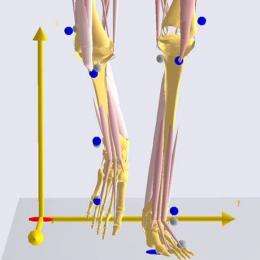
Dutch researchers from the University of Twente's MIRA research institute, UMC St Radboud and various other institutions have developed a highly detailed computer model of the musculoskeletal system of the lower half of the human body. Surgeons can use this model to enhance their preparations for surgery, and even to "practice" these procedures in advance, using Virtual Reality. The model can be personalized for individual patients. The researchers recently received a European grant of 3 million euros for the development work.

Hip prosthesis revision surgery and operations to remove tumours can involve the loss of parts of bones or muscles. In such cases, muscles are sometimes repositioned to enhance the patient's functional abilities. When deciding exactly where to connect these muscles, surgeons usually rely on their intuition and experience. There are currently no suitable models capable of accurately predicting how the will function following surgery or rehabilitation. In many cases, it is unclear whether the patient will still be able to walk normally after surgery.

Researchers from the University of Twente and various other institutions are currently developing a model that can accurately calculate the best place to connect the muscle and the best way in which to do so. MRI scans are used to personalize the model, creating a unique model for each specific patient. By using these personalized models in a , surgeons are better able to plan surgical procedures in advance. The system can autonomously select the optimum site for muscle connection. It can also predict the consequences of specific choices. If so required, surgeons can even simulate entire operations in advance using a environment.

The is linked to an automated navigation system that is used during surgery. This ensures that the site selected by the system as the optimal location for muscle attachment can actually be used in the patient in question. The researchers compare this system to a satnav system. The system shows the surgeon exactly how certain muscles should be relocated in order to optimize the patient's musculoskeletal system.

According to the researchers, this system could benefit several hundred patients undergoing relatively major surgery in the Netherlands each year.

According to Prof. Nico Verdonschot and Prof. Bart Koopman, who are both members of the research team, the strength of the underlying musculoskeletal model lies in its accuracy, which is approximately five times greater than that of existing models. Uniquely, the system is based on a single, consistent dataset. This means that the body of a single individual is used as a basis (while existing models are composed of parts of different bodies). The fine detail of this individual's muscles, bones, tendons and attachments is mapped and digitized. As stated, the model is based on a consistent data set. However, an is used to personalize the model for each patient, creating a model that is unique to the individual in question.

Provided by University of Twente (news : web)


Rank not rated yet
Relevant PhysicsForums posts

More news stories

Human cognitive performance suffers following natural disasters, researchers find

Not surprisingly, victims of a natural disaster can experience stress and anxiety, but a new study indicates that it might also cause them to make more errors - some serious - in their daily lives. In their upcoming Human Fa ...

Medicine & Health / Psychology & Psychiatry

created 30 minutes ago | popularity not rated yet | comments 0

Both maternal and paternal age linked to autism

Older maternal and paternal age are jointly associated with having a child with autism, according to a recently published study led by researchers at The University of Texas Health Science Center at Houston (UTHealth).

Medicine & Health / Psychology & Psychiatry

created 3 hours ago | popularity not rated yet | comments 0 | with audio podcast

Curry spice component may help slow prostate tumor growth

Curcumin, an active component of the Indian curry spice turmeric, may help slow down tumor growth in castration-resistant prostate cancer patients on androgen deprivation therapy (ADT), a study from researchers ...

Medicine & Health / Cancer

created 4 hours ago | popularity 5 / 5 (3) | comments 0 | with audio podcast

Team isolates nerve cells involved in storing long term memory and gene proteins associated with them

(Medical Xpress) -- A research team in Taiwan has succeeded in isolating two nerve cells in fruit fly brains that are believed to be the major players in allowing for the formation of long term memories. Furthermore, ...

Medicine & Health / Neuroscience

created 5 hours ago | popularity 5 / 5 (4) | comments 1 | with audio podcast report

Seeing colors in music, tasting flavors in shapes may happen in life's early months

Famed violinist Itzhak Perlman sees a deep forest green whenever he plays a B-flat on his Stradivarius' G string. The A on the E string is red.

Medicine & Health / Psychology & Psychiatry

created 6 hours ago | popularity 4.5 / 5 (2) | comments 0 | with audio podcast


The power of estrogen -- male snakes attract other males

A new study has shown that boosting the estrogen levels of male garter snakes causes them to secrete the same pheromones that females use to attract suitors, and turned the males into just about the sexiest ...

Putting the squeeze on planets outside our solar system

(PhysOrg.com) -- Using high-powered lasers, scientists at Lawrence Livermore National Laboratory and collaborators discovered that molten magnesium silicate undergoes a phase change in the liquid state, abruptly ...

New error-correcting codes guarantee the fastest possible rate of data transmission

Error-correcting codes are one of the triumphs of the digital age. They’re a way of encoding information so that it can be transmitted across a communication channel — such as an optical fiber o ...

Humans may have helped the decline of African rainforests 3000 years ago

(PhysOrg.com) -- Large areas of rainforests in Central Africa mysteriously disappeared over three thousand years ago, to be replaced by savannas. The prevailing theory has been that the cause was a change ...

Fool's gold may prove an unlikely alternative to overexploited catalytic materials

Catalytic materials, which lower the energy barriers for chemical reactions, are used in everything from the commercial production of chemicals to catalytic converters in car engines. However, with current catalytic materials ...

Could Venus be shifting gear?

(PhysOrg.com) -- ESA’s Venus Express spacecraft has discovered that our cloud-covered neighbour spins a little slower than previously measured. Peering through the dense atmosphere in the infrared, the ...