Engineered metamaterials enable remarkably small antennas
January 26, 2010
Engineered metamaterials enable remarkably small antennas

Enlarge

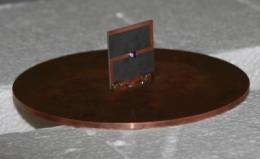
This Z antenna tested at the National Institute of Standards and Technology is smaller than a standard antenna with comparable properties. Its high efficiency is derived from the "Z element" inside the square that acts as a metamaterial, greatly boosting the signal sent over the air. The square is 30 millimeters on a side. Credit: C. Holloway/NIST

In an advance that might interest Q-Branch, the gadget makers for James Bond, the National Institute of Standards and Technology and partners from industry and academia have designed and tested experimental antennas that are highly efficient and yet a fraction of the size of standard antenna systems with comparable properties. The novel antennas may be useful in ever-shrinking and proliferating wireless systems such as emergency communications devices, micro-sensors and portable ground-penetrating radars to search for tunnels, caverns and other geophysical features.

NIST engineers are working with scientists from the University of Arizona (Tucson) and Research & Technology (Seattle, Wash.) to design antennas incorporating metamaterials—materials engineered with novel, often microscopic, structures to produce unusual properties. The new antennas radiate as much as 95 percent of an input radio signal and yet defy normal design parameters. Standard antennas need to be at least half the size of the signal wavelength to operate efficiently; at 300 MHz, for instance, an would need to be half a meter long. The experimental antennas are as small as one-fiftieth of a wavelength and could shrink further.

In their latest prototype device, the research team used a metal wire antenna printed on a small square of copper measuring less than 65 millimeters on a side. The antenna is wired to a signal source. Mounted on the back of the square is a "Z element" that acts as a metamaterial—a Z-shaped strip of copper with an inductor (a device that stores energy magnetically) in the center (see photo).

"The purpose of an antenna is to launch energy into free space," explains NIST engineer Christopher Holloway, "But the problem with antennas that are very small compared to the wavelength is that most of the signal just gets reflected back to the source. The metamaterial makes the antenna behave as if it were much larger than it really is, because the antenna structure stores energy and re-radiates it." Conventional antenna designs, Holloway says, achieve a similar effect by adding bulky "matching network" components to boost efficiency, but the metamaterial system can be made much smaller. Even more intriguing, Holloway says, "these metamaterials are much more 'frequency agile.' It's possible we could tune them to work at any frequency we want, on the fly," to a degree not possible with conventional designs.

The Z antennas were designed at the University of Arizona and fabricated and partially measured at Boeing Research & Technology. The power efficiency measurements were carried out at NIST laboratories in Boulder, Colo. The ongoing research is sponsored by the Defense Advanced Research Projects Agency.

More information: R.W. Ziolkowski, P. Jin, J.A. Nielsen, M.H. Tanielian and C.L. Holloway. Design and experimental verification of Z antennas at UHF frequencies. IEEE Antennas Wireless Propag. Lett., 2009 vol. 8, pp. 1329-1332

Provided by National Institute of Standards and Technology (NIST)

Filter


Move the slider to adjust rank threshold, so that you can hide some of the comments.


Display comments: newest first

TJ_alberta
Jan 26, 2010

Rank: not rated yet
so how does this differ in principle from a physically shortened antenna with a loading coil?
NeuroPulse
Jan 27, 2010

Rank: not rated yet
The plural of "antenna" is "antennae"
jimbo92107
Jan 27, 2010

Rank: 5 / 5 (2)
Latin plural forms are no longer the fashion in English. Antennas, stadiums, octopuses, etc. are now the preferred form. Shame, I kinda liked buffalae...;-)
asiwel
Jan 28, 2010

Rank: not rated yet
This is interesting. I wonder how directional and focused these antennas can be? Also wonder if the effect is useful for reception as well as transmission. Also be interesting to know how much power can be sent through such an antenna.
Rank 5 /5 (12 votes)
Relevant PhysicsForums posts
  • Calling function with no input argument
    created15 hours ago
  • Force free body diagram problem on gym equipment
    created16 hours ago
  • Empirical data regarding shower heads and water
    createdFeb 10, 2012
  • feed hold button on CNC lathe
    createdFeb 09, 2012
  • RFAC in Fortran
    createdFeb 09, 2012
  • dynamics 2/32
    createdFeb 08, 2012
  • More from Physics Forums - General Engineering

More news stories

Anonymous knocks CIA website offline (Update)

The website of the Central Intelligence Agency was inaccessible on Friday after the hacker group Anonymous claimed to have knocked it offline.

Technology / Internet

created 9 hours ago | popularity 5 / 5 (9) | comments 16

Google users warned of threat to smartphone wallets

Users of Google smartphone wallets were being warned on Friday that there is a way to crack pass codes intended to thwart thieves from going on illicit shopping sprees.

Technology / Internet

created 8 hours ago | popularity 5 / 5 (2) | comments 0

New error-correcting codes guarantee the fastest possible rate of data transmission

Error-correcting codes are one of the triumphs of the digital age. They’re a way of encoding information so that it can be transmitted across a communication channel — such as an optical fiber o ...

Technology / Computer Sciences

created 18 hours ago | popularity 4.9 / 5 (8) | comments 6 | with audio podcast

New power source discovered

(PhysOrg.com) -- Researchers at the Massachusetts Institute of Technology (MIT) and RMIT University have made a breakthrough in energy storage and power generation.

Technology / Energy & Green Tech

created 17 hours ago | popularity 4.8 / 5 (29) | comments 8 | with audio podcast

Small modular reactor design could be a 'SUPERSTAR'

(PhysOrg.com) -- Though most of today's nuclear reactors are cooled by water, we've long known that there are alternatives; in fact, the world's first nuclear-powered electricity in 1951 came from a reactor ...

Technology / Energy & Green Tech

created 17 hours ago | popularity 4.4 / 5 (13) | comments 23 | with audio podcast


Humans may have helped the decline of African rainforests 3000 years ago

(PhysOrg.com) -- Large areas of rainforests in Central Africa mysteriously disappeared over three thousand years ago, to be replaced by savannas. The prevailing theory has been that the cause was a change ...

The power of estrogen -- male snakes attract other males

A new study has shown that boosting the estrogen levels of male garter snakes causes them to secrete the same pheromones that females use to attract suitors, and turned the males into just about the sexiest ...

Complex wiring of the nervous system may rely on a just a handful of genes and proteins

Researchers at the Salk Institute have discovered a startling feature of early brain development that helps to explain how complex neuron wiring patterns are programmed using just a handful of critical genes. ...

Could Venus be shifting gear?

(PhysOrg.com) -- ESA’s Venus Express spacecraft has discovered that our cloud-covered neighbour spins a little slower than previously measured. Peering through the dense atmosphere in the infrared, the ...

Advanced power-grid model finds low-cost, low-carbon future in West

(PhysOrg.com) -- The least expensive way for the Western U.S. to reduce greenhouse gas emissions enough to help prevent the worst consequences of global warming is to replace coal with renewable and other ...

Fool's gold may prove an unlikely alternative to overexploited catalytic materials

Catalytic materials, which lower the energy barriers for chemical reactions, are used in everything from the commercial production of chemicals to catalytic converters in car engines. However, with current catalytic materials ...