Astronomers Find Rare Beast by New Means
January 27, 2010
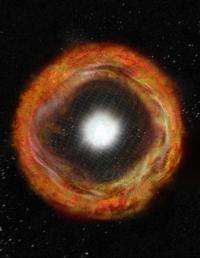
Core-collapse supernova explosion expelling nearly-spherical debris shell. CREDIT: Bill Saxton, NRAO/AUI/NSF
(PhysOrg.com) -- For the first time, astronomers have found a supernova explosion with properties similiar to a gamma-ray burst, but without seeing any gamma rays from it. The discovery, using the National Science Foundation's Very Large Array (VLA) radio telescope, promises, the scientists say, to point the way toward locating many more examples of these mysterious explosions.
"We think that radio observations will soon be a more powerful tool for finding this kind of supernova in the nearby Universe than gamma-ray satellites," said Alicia Soderberg, of the Harvard-Smithsonian Center for Astrophysics.
The telltale clue came when the radio observations showed material expelled from the supernova explosion, dubbed SN2009bb, at speeds approaching that of light. This characterized the supernova, first seen last March, as the type thought to produce one kind of gamma-ray burst.
"It is remarkable that very low-energy radiation, radio waves, can signal a very high-energy event," said Roger Chevalier of the University of Virginia.
When the nuclear fusion reactions at the cores of very massive stars no longer can provide the energy needed to hold the core up against the weight of the rest of the star, the core collapses catastrophically into a superdense neutron star or black hole. The rest of the star's material is blasted into space in a supernova explosion. For the past decade or so, astronomers have identified one particular type of such a "core-collapse supernova" as the cause of one kind of gamma-ray burst.
Not all supernovae of this type, however, produce gamma-ray bursts. "Only about one out of a hundred do this," according to Soderberg.
In the more-common type of such a supernova, the explosion blasts the star's material outward in a roughly-spherical pattern at speeds that, while fast, are only about 3 percent of the speed of light. In the supernovae that produce gamma-ray bursts, some, but not all, of the ejected material is accelerated to nearly the speed of light.
The superfast speeds in these rare blasts, astronomers say, are caused by an "engine" in the center of the supernova explosion that resembles a scaled-down version of a quasar. Material falling toward the core enters a swirling disk surrounding the new neutron star or black hole. This accretion disk produces jets of material boosted at tremendous speeds from the poles of the disk.
"This is the only way we know that a supernova explosion could accelerate material to such speeds," Soderberg said.
Until now, no such "engine-driven" supernova had been found any way other than by detecting gamma rays emitted by it.
"Discovering such a supernova by observing its radio emission, rather than through gamma rays, is a breakthrough. With the new capabilities of the Expanded VLA coming soon, we believe we'll find more in the future through radio observations than with gamma-ray satellites," Soderberg said.
Why didn't anyone see gamma rays from this explosion? "We know that the gamma-ray emission is beamed in such blasts, and this one may have been pointed away from Earth and thus not seen," Soderberg said. In that case, finding such blasts through radio observations will allow scientists to discover a much larger percentage of them in the future.
"Another possibility," Soderberg adds, "is that the gamma rays were 'smothered' as they tried to escape the star. This is perhaps the more exciting possibility since it implies that we can find and identify engine-driven supernovae that lack detectable gamma rays and thus go unseen by gamma-ray satellites."
One important question the scientists hope to answer is just what causes the difference between the "ordinary" and the "engine-driven" core-collapse supernovae. "There must be some rare physical property that separates the stars that produce the 'engine-driven' blasts from their more-normal cousins," Soderberg said. "We'd like to find out what that property is."
One popular idea is that such stars have an unusually low concentration of elements heavier than hydrogen. However, Soderberg points out, that does not seem to be the case for this supernova.
Provided by National Radio Astronomy Observatory (news : web)
-
New Type of Cosmic Explosion More Powerful Than Supernovae
Aug 05, 2004 |
not rated yet |
0
-
Very High Energy Gamma Rays
Sep 25, 2009 |
not rated yet |
0
-
The Oddball Hosts of Gamma-ray Bursts
Oct 22, 2008 |
not rated yet |
0
-
Fermi Telescope reveals a population of radio-quiet gamma-ray pulsars
Jul 02, 2009 |
not rated yet |
0
-
On the Scent of a Pre-Historic Particle Accelerator?
Feb 09, 2006 |
not rated yet |
0
-
Engineers build first sub-10-nm carbon nanotube transistor
Feb 01, 2012 |
4.9 / 5 (30) |
30
-
Something old, something new: Evolution and the structural divergence of duplicate genes
Jan 31, 2012 |
4.6 / 5 (7) |
1
-
The hidden nanoworld of ice crystals: Revealing the dynamic behavior of quasi-liquid layers
Jan 30, 2012 |
5 / 5 (3) |
1
-
Stock market network reveals investor clustering
Jan 27, 2012 |
3.9 / 5 (23) |
8
-
Of microchemistry and molecules: Electronic microfluidic device synthesizes biocompatible probes
Jan 26, 2012 |
5 / 5 (1) |
0
-
Titan's lack of impact craters
Feb 09, 2012
-
Real pictures of black hole eating a star?
Feb 08, 2012
-
Hypothetical way to travel faster than light, but not technically exceed lightspeed
Feb 06, 2012
-
How do scientists monitor the Sun's activity?
Feb 05, 2012
-
Search patterns in observational studies
Feb 05, 2012
-
Derivation of Pogson's law
Feb 03, 2012
- More from Physics Forums - General Astronomy
More news stories
Could Venus be shifting gear?
(PhysOrg.com) -- ESAs Venus Express spacecraft has discovered that our cloud-covered neighbour spins a little slower than previously measured. Peering through the dense atmosphere in the infrared, the ...
Space & Earth / Space Exploration
2 hours ago |
5 / 5 (3) |
4
|
Clam fields found at deep, low-temperature Mariana vents
(PhysOrg.com) -- Scientists have marveled at the unusual life forms thriving at high temperature hydrothermal vents of the deep ocean.
Space & Earth / Earth Sciences
3 hours ago |
not rated yet |
0
|
Mars Science Laboratory computer issue resolved
(PhysOrg.com) -- Engineers have found the root cause of a computer reset that occurred two months ago on NASA's Mars Science Laboratory and have determined how to correct it.
Space & Earth / Space Exploration
3 hours ago |
5 / 5 (4) |
2
|
Humans may have helped the decline of African rainforests 3000 years ago
(PhysOrg.com) -- Large areas of rainforests in Central Africa mysteriously disappeared over three thousand years ago, to be replaced by savannas. The prevailing theory has been that the cause was a change ...
Two new moons for Jupiter
Advances in technology have lead to the discovery of new planets outside of our Solar System, and now even new moons in our own backyard.
Space & Earth / Space Exploration
2 hours ago |
not rated yet |
2
Zuckerberg's focus drives Facebook's ascent
When Mark Zuckerberg showed up to rent Judy Fusco's Los Altos, Calif., house in the fall of 2004, soon after he'd arrived in Silicon Valley, the landlord was immediately struck by his confidence.
Antidepressants and pregnancy: Women must consider the impact of drugs on baby, and of depression on baby, themselves
Upon learning they are pregnant, most women dutifully nix the alcohol, sushi and caffeine. But what about antidepressants?
Both maternal and paternal age linked to autism
Older maternal and paternal age are jointly associated with having a child with autism, according to a recently published study led by researchers at The University of Texas Health Science Center at Houston (UTHealth).
Curry spice component may help slow prostate tumor growth
Curcumin, an active component of the Indian curry spice turmeric, may help slow down tumor growth in castration-resistant prostate cancer patients on androgen deprivation therapy (ADT), a study from researchers ...
The power of estrogen -- male snakes attract other males
A new study has shown that boosting the estrogen levels of male garter snakes causes them to secrete the same pheromones that females use to attract suitors, and turned the males into just about the sexiest ...
Netflix light on flicks as viewers soak up TV shows
Like most fresh faces that arrive in Hollywood, Netflix wanted to be a movie star. But now it's learning what many in Tinseltown have known for decades: Movies are sexy, but the real money is in television.
Jan 27, 2010
Rank: not rated yet
Jan 27, 2010
Rank: not rated yet
Jan 29, 2010
Rank: not rated yet
Related paper out today re SN 2007gr: http://arxiv.org/...5060.pdf
Jan 30, 2010
Rank: 1 / 5 (1)
Jan 30, 2010
Rank: 1 / 5 (1)
Jan 30, 2010
Rank: not rated yet
Jan 30, 2010
Rank: not rated yet
This is a quote from a portion of the above article. The LHC will smash protons, the LHC is supposed to be the experiment to produce.... conditions which mimic the condition moments after the big bang.
Jan 30, 2010
Rank: 5 / 5 (1)
Your concept of multiverses sounds like a flavor of 'eternal inflation' that's been kicking around for some time (bubble universe model). Check out the wiki: http://en.wikiped...n_theory .
Feb 01, 2010
Rank: 1 / 5 (1)
VLA Rocks and I apologize in advance for not adding to the scientific discussion with my SciFi flights of fancy but there is a whole lot we don't know about GRB.