Study finds barefoot runners have less foot stress than shod ones (w/ Video)
January 27, 2010 By Rebecca Hersher
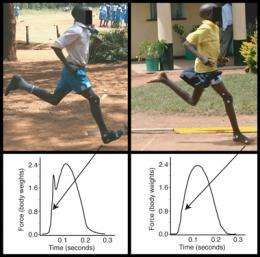
On the left, a habitually shod Kenyan who is heel-striking; on the right, a Kenyan who has never worn shoes and who is forefoot striking in the way most barefoot runners land. Below are representative force traces (in units of body weight) showing how the two styles of running differ in the force generated when the foot collides with the ground. The barefoot runner lands with no collisional force. Image: Daniel E. Lieberman
(PhysOrg.com) -- New research is casting doubt on the old adage, "All you need to run is a pair of shoes."
Scientists have found that those who run barefoot, or in minimal footwear, tend to avoid "heel-striking," and instead land on the ball of the foot or the middle of the foot. In so doing, these runners use the architecture of the foot and leg and some clever Newtonian physics to avoid hurtful and potentially damaging impacts, equivalent to two to three times body weight, that shod heel-strikers repeatedly experience.
"People who don't wear shoes when they run have an astonishingly different strike," says Daniel E. Lieberman, professor of human evolutionary biology at Harvard University and co-author of a paper appearing this week in the journal Nature. "By landing on the middle or front of the foot, barefoot runners have almost no impact collision, much less than most shod runners generate when they heel-strike. Most people today think barefoot running is dangerous and hurts, but actually you can run barefoot on the world's hardest surfaces without the slightest discomfort and pain. All you need is a few calluses to avoid roughing up the skin of the foot. Further, it might be less injurious than the way some people run in shoes."
Working with populations of runners in the United States and Kenya, Lieberman and his colleagues at Harvard, the University of Glasgow, and Moi University looked at the running gaits of three groups: those who had always run barefoot, those who had always worn shoes, and those who had converted to barefoot running from shod running. The researchers found a striking pattern.
Most shod runners -- more than 75 percent of Americans -- heel-strike, experiencing a very large and sudden collision force about 1,000 times per mile run. People who run barefoot, however, tend to land with a springy step towards the middle or front of the foot.
"Heel-striking is painful when barefoot or in minimal shoes because it causes a large collisional force each time a foot lands on the ground," says co-author Madhusudhan Venkadesan, a postdoctoral researcher in applied mathematics and human evolutionary biology at Harvard. "Barefoot runners point their toes more at landing, avoiding this collision by decreasing the effective mass of the foot that comes to a sudden stop when you land, and by having a more compliant, or springy, leg."
The differences between shod and unshod running have evolutionary underpinnings. For example, says Lieberman, our early Australopith ancestors had less developed arches in their feet. Homo sapiens, by contrast, has evolved a strong, large arch that we use as a spring when running.
This video is not supported by your browser at this time.
Heel Strike when Barefoot
This video is not supported by your browser at this time.
Heel Strike in Running Shoes
"Our feet were made in part for running," Lieberman says. But as he and his co-authors write in Nature: "Humans have engaged in endurance running for millions of years, but the modern running shoe was not invented until the 1970s. For most of human evolutionary history, runners were either barefoot or wore minimal footwear such as sandals or moccasins with smaller heels and little cushioning."For modern humans who have grown up wearing shoes, barefoot or minimal shoe running is something to be eased into, warns Lieberman. Modern running shoes are designed to make heel-striking easy and comfortable. The padded heel cushions the force of the impact, making heel-striking less punishing.
"Running barefoot or in minimal shoes is fun but uses different muscles," says Lieberman. "If you've been a heel-striker all your life you have to transition slowly to build strength in your calf and foot muscles."
In the future, he hopes, the kind of work done in this paper can not only investigate barefoot running, but can provide insight into how to better prevent the repetitive stress injuries that afflict a high percentage of runners today.
"Our hope is that an evolutionary medicine approach to running and sports injury can help people run better for longer and feel better while they do it," says Lieberman, who has created a web site, www.barefootrunning.fas.harvard.edu, to educate runners about the respective merits of shod and barefoot running.
-
Running shoes may cause damage to knees, hips and ankles
Jan 04, 2010 |
not rated yet |
0
-
Probing Question: Is it better to run barefoot?
Dec 07, 2006 |
not rated yet |
0
-
Expensive trainers are a waste of money
Oct 11, 2007 |
not rated yet |
0
-
Flips-flops are bad for your sole
Jun 18, 2009 |
not rated yet |
0
-
Supportive shoes date to 40,000 years
Aug 24, 2005 |
not rated yet |
0
-
Engineers build first sub-10-nm carbon nanotube transistor
Feb 01, 2012 |
4.9 / 5 (31) |
30
-
Something old, something new: Evolution and the structural divergence of duplicate genes
Jan 31, 2012 |
4.6 / 5 (7) |
1
-
The hidden nanoworld of ice crystals: Revealing the dynamic behavior of quasi-liquid layers
Jan 30, 2012 |
5 / 5 (3) |
1
-
Stock market network reveals investor clustering
Jan 27, 2012 |
3.9 / 5 (23) |
8
-
Of microchemistry and molecules: Electronic microfluidic device synthesizes biocompatible probes
Jan 26, 2012 |
5 / 5 (1) |
0
-
Classical and Quantum Mechanics via Lie algebras
Apr 15, 2011
- More from Physics Forums - Independent Research
More news stories
Complex wiring of the nervous system may rely on a just a handful of genes and proteins
Researchers at the Salk Institute have discovered a startling feature of early brain development that helps to explain how complex neuron wiring patterns are programmed using just a handful of critical genes. ...
3 hours ago |
5 / 5 (5) |
0
|
Both maternal and paternal age linked to autism
Older maternal and paternal age are jointly associated with having a child with autism, according to a recently published study led by researchers at The University of Texas Health Science Center at Houston (UTHealth).
Medicine & Health / Psychology & Psychiatry
8 hours ago |
5 / 5 (1) |
0
|
New understanding of DNA repair could eventually lead to cancer therapy
A research group in the Faculty of Medicine & Dentistry at the University of Alberta is hoping its latest discovery could one day be used to develop new therapies that target certain types of cancers.
7 hours ago |
4.8 / 5 (4) |
0
|
Human cognitive performance suffers following natural disasters, researchers find
Not surprisingly, victims of a natural disaster can experience stress and anxiety, but a new study indicates that it might also cause them to make more errors - some serious - in their daily lives. In their upcoming Human Fa ...
Medicine & Health / Psychology & Psychiatry
5 hours ago |
4 / 5 (1) |
0
Curry spice component may help slow prostate tumor growth
Curcumin, an active component of the Indian curry spice turmeric, may help slow down tumor growth in castration-resistant prostate cancer patients on androgen deprivation therapy (ADT), a study from researchers ...
9 hours ago |
4.6 / 5 (5) |
0
|
Google users warned of threat to smartphone wallets
Users of Google smartphone wallets were being warned on Friday that there is a way to crack pass codes intended to thwart thieves from going on illicit shopping sprees.
Anonymous knocks CIA website offline (Update)
The website of the Central Intelligence Agency was inaccessible on Friday after the hacker group Anonymous claimed to have knocked it offline.
NASA sees wide-eyed cyclone Jasmine
Cyclone Jasmine's eye has opened wider on NASA satellite imagery, as it moves through the Southern Pacific Ocean.
NASA sees Giovanna reach cyclone strength, threaten Madagascar
Tropical Storm 12S built up steam and became a cyclone on February 10, 2012 as NASA's Terra satellite passed overhead. Residents of east-central Madagascar should prepare for this cyclone to make landfall ...
Putting the squeeze on planets outside our solar system
(PhysOrg.com) -- Using high-powered lasers, scientists at Lawrence Livermore National Laboratory and collaborators discovered that molten magnesium silicate undergoes a phase change in the liquid state, abruptly ...
The power of estrogen -- male snakes attract other males
A new study has shown that boosting the estrogen levels of male garter snakes causes them to secrete the same pheromones that females use to attract suitors, and turned the males into just about the sexiest ...
Jan 27, 2010
Rank: not rated yet
Jan 27, 2010
Rank: not rated yet
Jan 27, 2010
Rank: not rated yet
Jan 27, 2010
Rank: 4 / 5 (2)
Jan 28, 2010
Rank: not rated yet
Food for thought!
Jan 28, 2010
Rank: not rated yet
Jan 28, 2010
Rank: not rated yet
Jan 28, 2010
Rank: not rated yet
Jan 28, 2010
Rank: not rated yet
http://www.youtub...ULFLHUO0
Jan 28, 2010
Rank: not rated yet
Jan 28, 2010
Rank: not rated yet
Google Fail
Feb 01, 2010
Rank: not rated yet