Arctic 'Melt Season' Is Growing Longer, New Research Demonstrates
January 27, 2010 by Kathryn Hansen
Arctic 'Melt Season' Is Growing Longer, New Research Demonstrates

Enlarge

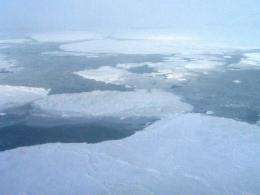
Arctic sea ice has been facing longer melt seasons, according to a new study. Credit: NASA/Thorsten Markus

New NASA-led research shows that the melt season for Arctic sea ice has lengthened by an average of 20 days over the span of 28 years, or 6.4 days per decade. The finding stems from scientists' work to compile the first comprehensive record of melt onset and freeze-up dates -- the "melt season" -- for the entire Arctic.

The melt season begins each April when the sunless winter gives way to sunrise and spring, and water and air temperatures rise. By September, the sea ice shrinks to a minimum and begins refreezing, bringing the annual melt season to an end.

The longer melt season, described by Thorsten Markus of NASA's Goddard Space Flight Center in Greenbelt, Md., in the -- Oceans, has implications for the future of . Open water that appears earlier in the season absorbs more heat from the sun throughout summer, further warming the water and promoting more melting.

"This feedback process has always been present, yet with more extensive open water this feedback becomes even stronger and further boosts ice loss," Markus said. "Melt is starting earlier, but the trend towards a later freeze-up is even stronger because of this feedback effect."
Arctic 'Melt Season' Is Growing Longer, New Research Demonstrates
Enlarge

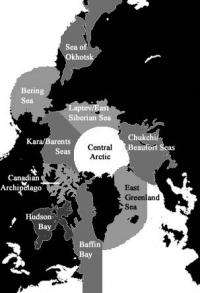
Researchers analyzed satellite data for 10 different Arctic regions and found trends in melt and freeze onset days as well as trends in melt season length. Credit: NASA/Thorsten Markus

To examine melt season length, Markus and colleagues used data from satellite passive microwave sensors, which can "see" indications of melt. The result is an accurate account of the melt seasons from 1979 to 2007.

"Given that the ocean is nearly twice the size of the continental United States, it would be impossible to track change like this without long-term satellite records," said Thomas Wagner, NASA's cryosphere program scientist at NASA Headquarters, Washington.

Analyzing melt-season trends for 10 different Arctic regions, the research team discovered that melt season lengthened the most -- more than 10 days per decade -- in Hudson Bay, the East Greenland Sea, the Laptev and East Siberian Seas, and the Chukchi and Beaufort Seas. Some of that change is due to melt onset occurring about three days earlier per decade in some areas. Earlier melt means more heat can be absorbed by the , promoting more melting and later freeze-up dates -- more than eight days per decade later in some areas. Only the Sea of Okhotsk turned up a shorter melt season. The reasons for the regional differences are currently being investigated.

"The onset of melting and melt season length are important variables for understanding the Arctic climate system," Markus added. "Given the recent large losses of the Arctic summer ice cover, it has become critical to investigate the causes of the decline and the consequences of its continued decline."

The lengthened melt season could impact more than just the Arctic ice and ocean. According to Markus, "marine ecosystems are very sensitive to changes in melt onset and freeze-up dates."

"Changes in the ice cover may have profound effects on North America’s climate," said Wagner. "Studies like this one show us how ice responds to variations in the ocean and atmosphere and improve the predictive models that will help us plan for climate change."

Provided by NASA's Goddard Space Flight Center (news : web)

Filter


Move the slider to adjust rank threshold, so that you can hide some of the comments.


Display comments: newest first

TegiriNenashi
Jan 27, 2010

Rank: 2.8 / 5 (11)
Yet another "environmentally-challenged" article? Why should anyone believe what these junk scientists say instead of doublechecking the data themselves?
http://www.ijis.i...tent.htm
I don't witness alleged melting, let alone seasonable changes there, do you?
Caliban
Jan 27, 2010

Rank: 3.3 / 5 (12)
You might consider looking at the Journal article, instead of pulling numbers from the Japan Aerospace Exploration Agency. That might help.
GrayMouser
Jan 28, 2010

Rank: 2.6 / 5 (10)
You might consider looking at the Journal article, instead of pulling numbers from the Japan Aerospace Exploration Agency. That might help.

The polar ice coverage maps indicate no significant long term changes in sea ice. There was a period a few years ago when there was what probably was a 50 year low (but not a 100 year low) caused by shifting warm currents but they shifted back and the ice sheet has been recovering nicely.
I expect what we are seeing is due to normal variation and axial precession shifting when the seasons start and stop. Remember that there used to be agriculture in Greenland. I expect the polar ice sheet was MUCH smaller then.
_Sheikh_Yamani_
Jan 29, 2010

Rank: 2 / 5 (12)
You are right GrayMouser, our studies have shown that polar ice caps were indeed much smaller, here in Saudia Arabia we had much more rain then!
It is good to see some people have not been conned by the AGW scam and are prepared to take the time to speak their mind.
mary_hinge
Jan 30, 2010

Rank: 4.7 / 5 (3)
, our studies have shown that polar ice caps were indeed much smaller,


References? There is agriculture in Greenland now.http://www.greenl...uth.htm.
"The winter climate is relatively mild, and summer temperatures reaching 16-18°C are not uncommon. Because of these conditions, the economic life of this area is also very different from the rest of Greenland, with sheep farming and agriculture playing an important part."

Regarding other comments the IJIS graph is very useful as a recent guide, since 2002/3, but the research is based on the last 28 years. This is a more relevant link
http://www.eea.eu...900-2100
mary_hinge
Jan 30, 2010

Rank: not rated yet
Sorry about format above, just learning how this blog works..WUWT is much easier.
mary_hinge
Jan 30, 2010

Rank: 5 / 5 (3)
NASA posted this yesterday re. this subject. The Graph and graphics give a better understanding that the above article. http://earthobser...id=42456
GrayMouser
Feb 02, 2010

Rank: 2 / 5 (1)
NASA posted this yesterday re. this subject. The Graph and graphics give a better understanding that the above article. http://earthobser...id=42456

I find this chart of Arctic Sea Ice Extent, it shows no significant trends in coverage from June 2002 through February 2010:
http://www.ijis.i...tent.htm
Skeptic_Heretic
Feb 04, 2010

Rank: 1 / 5 (1)
NASA posted this yesterday re. this subject. The Graph and graphics give a better understanding that the above article. http://earthobser...id=42456
That graph is a tad misleading, it doesn't really show a reasonable trend in either direction with how wildly the data points scatter.

One can also question their use of coloration on the maps. It seems a little leading, but the data is there and up for interpretation by people more well versed than I.

Now the graph provided by the JAEA appears to be more clear, I also liek the fact they included the data as readily available on the page directly under the graph.
Rank 3 /5 (17 votes)
Relevant PhysicsForums posts
  • Discrepancy between oxygen and carbon-dioxide levels
    created12 hours ago
  • where gems are found in the world
    created16 hours ago
  • Wind Waves in Reservoir ~ Wind run-up and Wind set-up
    createdFeb 08, 2012
  • Balance of oxygen in the atmosphere
    createdFeb 01, 2012
  • The case for a methanol-based economy
    createdJan 30, 2012
  • Weather in a rotating cylinder
    createdJan 25, 2012
  • More from Physics Forums - Earth

More news stories

Domestic consumption main contributor to Africa's growing e-waste

West Africa faces a rising tide of e-waste generated by domestic consumption of new and used electrical and electronic equipment, according to a new United Nations report. Domestic consumption makes up the majority (up to ...

Space & Earth / Environment

created 50 minutes ago | popularity not rated yet | comments 0

Humans may have helped the decline of African rainforests 3000 years ago

(PhysOrg.com) -- Large areas of rainforests in Central Africa mysteriously disappeared over three thousand years ago, to be replaced by savannas. The prevailing theory has been that the cause was a change ...

Space & Earth / Environment

created 5 hours ago | popularity 5 / 5 (3) | comments 4 | with audio podcast report

Could Venus be shifting gear?

(PhysOrg.com) -- ESA’s Venus Express spacecraft has discovered that our cloud-covered neighbour spins a little slower than previously measured. Peering through the dense atmosphere in the infrared, the ...

Space & Earth / Space Exploration

created 1 hour ago | popularity 5 / 5 (3) | comments 4 | with audio podcast

Clam fields found at deep, low-temperature Mariana vents

(PhysOrg.com) -- Scientists have marveled at the unusual life forms thriving at high temperature hydrothermal vents of the deep ocean.

Space & Earth / Earth Sciences

created 2 hours ago | popularity not rated yet | comments 0 | with audio podcast

Mars Science Laboratory computer issue resolved

(PhysOrg.com) -- Engineers have found the root cause of a computer reset that occurred two months ago on NASA's Mars Science Laboratory and have determined how to correct it.

Space & Earth / Space Exploration

created 2 hours ago | popularity 5 / 5 (4) | comments 2 | with audio podcast


Fool's gold may prove an unlikely alternative to overexploited catalytic materials

Catalytic materials, which lower the energy barriers for chemical reactions, are used in everything from the commercial production of chemicals to catalytic converters in car engines. However, with current catalytic materials ...

Curry spice component may help slow prostate tumor growth

Curcumin, an active component of the Indian curry spice turmeric, may help slow down tumor growth in castration-resistant prostate cancer patients on androgen deprivation therapy (ADT), a study from researchers ...

What lies beneath: Mapping hidden nanostructures

The ability to diagnose and predict the properties of materials is vital, particularly in the expanding field of nanotechnology. Electron and atom-probe microscopy can categorize atoms in thin sheets of material, ...

Netflix light on flicks as viewers soak up TV shows

Like most fresh faces that arrive in Hollywood, Netflix wanted to be a movie star. But now it's learning what many in Tinseltown have known for decades: Movies are sexy, but the real money is in television.

To avoid early labor and delivery, weight and diet changes not the answer

One of the strongest known risk factors for spontaneous or unexpected preterm birth – any birth that occurs before the 37th week of pregnancy, most often without a known cause – is already having had one. For women ...

Arthritic knees, but not hips, have robust repair response

Researchers at Duke University Medical Center used new tools they developed to analyze knees and hips and discovered that osteoarthritic knee joints are in a constant state of repair, while hip joints are not.