The Moon may have formed in a nuclear explosion
January 28, 2010 by Lin Edwards
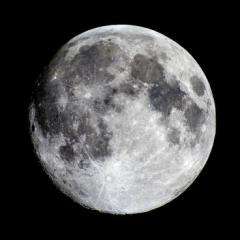
The Moon. Image: NASA
(PhysOrg.com) -- A new theory suggests the Moon was formed after a natural nuclear explosion in the Earth's mantle rather than after the impact of a massive object with the Earth, as previously thought.
The problem with the impact hypothesis is that simulations calculate the Moon should be composed of 80% impactor and 20% Earth, whereas in fact the isotope ratios of light and heavy elements found in Moon rocks so far examined are virtually identical to those on Earth.
The fission hypothesis is an alternative explanation for the formation of the moon, and it predicts similar isotope ratios in the Moon and Earth. The hypothesis (credited to Charles Darwin’s son George in 1879) is that the Earth and Moon began as a mass of molten rock spinning rapidly enough that gravity was just barely greater than the centrifugal forces. Even a slight kick could dislodge part of the mass into orbit, where it would become the Moon. The hypothesis has been around for 130 years, but was rejected because no one could explain a source of the energy required to kick a moon-sized blob of molten rock into orbit.
Dutch scientists Rob de Meijer (University of the Western Cape) and Wim van Westrenen (Amsterdam’s VU University) think they know the answer. Their hypothesis is that the centrifugal forces would have concentrated heavy elements like thorium and uranium on the equatorial plane and at the Earth core-mantle boundary. If the concentrations of these radioactive elements were high enough, this could have led to a nuclear chain reaction that became supercritical, causing a nuclear explosion.
De Meijer and van Westrenen calculate the concentration of radioactive elements could have been high enough for a supercritical nuclear reaction to take place. After it became supercritical the Earth basically became a natural nuclear georeactor that exploded and ejected into orbit the lunar-sized blob that became the Moon.
The researchers suggest the hypothesis explains the identical isotopic composition of light and heavy elements, and further propose it could be tested, since the explosion would leave evidence such as xenon-136 and helium-3, which would have been produced in abundance in the georeactor. Confirmation will be complicated by the fact that solar wind deposits these isotopes onto the moon in vast quantities, and that would have to be compensated for.
Georeactors are known to have existed on Earth, such as that at Oklo in the Republic of Gabon in Western Africa, which was operating between 2.0 and 1.5 billion years ago.
More information: http://arxiv.org/abs/1001.4243
© 2010 PhysOrg.com
-
Partial lunar eclipse will take place on 31st December
Dec 03, 2009 |
not rated yet |
0
-
SMART-1 on the trail of the Moon's beginnings
Aug 18, 2006 |
not rated yet |
0
-
Pluto-Charon origin may mirror that of Earth and its Moon
Feb 02, 2005 |
not rated yet |
0
-
SMART-1 views Middle East and Mediterranean
Jul 27, 2004 |
not rated yet |
0
-
NASA's new moon probe sends back moon shots
Jun 24, 2009 |
not rated yet |
0
-
Engineers build first sub-10-nm carbon nanotube transistor
Feb 01, 2012 |
4.9 / 5 (31) |
30
-
Something old, something new: Evolution and the structural divergence of duplicate genes
Jan 31, 2012 |
4.6 / 5 (7) |
1
-
The hidden nanoworld of ice crystals: Revealing the dynamic behavior of quasi-liquid layers
Jan 30, 2012 |
5 / 5 (3) |
1
-
Stock market network reveals investor clustering
Jan 27, 2012 |
3.9 / 5 (23) |
8
-
Of microchemistry and molecules: Electronic microfluidic device synthesizes biocompatible probes
Jan 26, 2012 |
5 / 5 (1) |
0
-
Scale of the Universe
2 hours ago
-
Titan's lack of impact craters
Feb 09, 2012
-
Real pictures of black hole eating a star?
Feb 08, 2012
-
Hypothetical way to travel faster than light, but not technically exceed lightspeed
Feb 06, 2012
-
How do scientists monitor the Sun's activity?
Feb 05, 2012
-
Search patterns in observational studies
Feb 05, 2012
- More from Physics Forums - General Astronomy
More news stories
NASA sees wide-eyed cyclone Jasmine
Cyclone Jasmine's eye has opened wider on NASA satellite imagery, as it moves through the Southern Pacific Ocean.
Space & Earth / Earth Sciences
1 hour ago |
not rated yet |
0
NASA sees Giovanna reach cyclone strength, threaten Madagascar
Tropical Storm 12S built up steam and became a cyclone on February 10, 2012 as NASA's Terra satellite passed overhead. Residents of east-central Madagascar should prepare for this cyclone to make landfall ...
Space & Earth / Earth Sciences
1 hour ago |
not rated yet |
0
Humans may have helped the decline of African rainforests 3000 years ago
(PhysOrg.com) -- Large areas of rainforests in Central Africa mysteriously disappeared over three thousand years ago, to be replaced by savannas. The prevailing theory has been that the cause was a change ...
Could Venus be shifting gear?
(PhysOrg.com) -- ESAs Venus Express spacecraft has discovered that our cloud-covered neighbour spins a little slower than previously measured. Peering through the dense atmosphere in the infrared, the ...
Space & Earth / Space Exploration
9 hours ago |
5 / 5 (7) |
7
|
Mars Science Laboratory computer issue resolved
(PhysOrg.com) -- Engineers have found the root cause of a computer reset that occurred two months ago on NASA's Mars Science Laboratory and have determined how to correct it.
Space & Earth / Space Exploration
10 hours ago |
4.7 / 5 (6) |
3
|
Google users warned of threat to smartphone wallets
Users of Google smartphone wallets were being warned on Friday that there is a way to crack pass codes intended to thwart thieves from going on illicit shopping sprees.
Anonymous knocks CIA website offline (Update)
The website of the Central Intelligence Agency was inaccessible on Friday after the hacker group Anonymous claimed to have knocked it offline.
Complex wiring of the nervous system may rely on a just a handful of genes and proteins
Researchers at the Salk Institute have discovered a startling feature of early brain development that helps to explain how complex neuron wiring patterns are programmed using just a handful of critical genes. ...
Putting the squeeze on planets outside our solar system
(PhysOrg.com) -- Using high-powered lasers, scientists at Lawrence Livermore National Laboratory and collaborators discovered that molten magnesium silicate undergoes a phase change in the liquid state, abruptly ...
The power of estrogen -- male snakes attract other males
A new study has shown that boosting the estrogen levels of male garter snakes causes them to secrete the same pheromones that females use to attract suitors, and turned the males into just about the sexiest ...
New error-correcting codes guarantee the fastest possible rate of data transmission
Error-correcting codes are one of the triumphs of the digital age. Theyre a way of encoding information so that it can be transmitted across a communication channel such as an optical fiber o ...
Jan 28, 2010
Rank: 2 / 5 (4)
A thermal fission reactor, 'geo' or not, is supercritical on delayed neutrons to increase power. If it is even critical on prompt neutrons then it disassembles messily due to the slower energy transfer out of the power producing region.
Jan 28, 2010
Rank: 2 / 5 (3)
Jan 28, 2010
Rank: 3.6 / 5 (5)
Jan 28, 2010
Rank: 2 / 5 (7)
This thought process has been soundly disproven as the end all be all. To be clear, it is very possible that you're correct, but being in the same orbital plane doesn't guarantee similar composition, especially if the bodies are uneven in size. As an aside, I still subscribe to the impact hypothesis.
The explosion hypothesis is interesting, however there are other ways to impart great amounts of energy during the protoplanet life cycle.
Jan 28, 2010
Rank: 2.2 / 5 (6)
Jan 28, 2010
Rank: 3.5 / 5 (2)
Jan 28, 2010
Rank: 1.6 / 5 (5)
If core is thermo nuclear then what evidence would we see. Would the many miles of iron and mantel act as a radiation shield. Uranium is a very dense metal and would naturally centrifuge to the center of the core. This we see in the iron outer core.
The only thing I can think of to detect is more neutrinos radiating from the core than from the sides. EM and other ionizing radiation would be aborbed by the outer core, mantel and crust.
Jan 28, 2010
Rank: 1.3 / 5 (4)
Good luck with that.
Jan 28, 2010
Rank: 3.5 / 5 (2)
I think the magnitude of nuclear explosion they are hypothesizing is much much larger than anything man made. Your talking about millions of tonnes of fissile material instead of kilos.
My own view is that the rate of rotation to counter gravity would have to be enormous in order to bring the dense Uranium and other nuclear fuel out from the center of the core.
Jan 28, 2010
Rank: 3.9 / 5 (8)
Jan 28, 2010
Rank: 3.5 / 5 (2)
Just hypothesizing here: If the rate of rotation is so large that the fissile material is far out and just marginally too thin to form a critical mass then a slowing of the rotation (by whatever means) would mean that the material starts to fall inward and thereby all of it reaches fission density at the same time (well, the part away from the sun would probably reach critical mass a tad earlier than the other side so the explosion would be slightly asymmetric.)
Jan 28, 2010
Rank: 3.4 / 5 (7)
Jan 28, 2010
Rank: 4 / 5 (4)
Jan 28, 2010
Rank: 3 / 5 (2)
Jan 28, 2010
Rank: 3.3 / 5 (4)
Jan 29, 2010
Rank: 1.7 / 5 (6)
However, that said, I still adhere to the 'Impactor Hypothesis' until more evidence is available to the contrary.
Jan 29, 2010
Rank: 3.4 / 5 (5)
Uranium and thorium are actually quite common in the crust today. Its not inconceivable that a large number of smaller explosions put considerable molten rock into orbit, where it combined to form the moon. It really didn't have to be ejected all at once.
Jan 29, 2010
Rank: 2 / 5 (8)
I'm fairly sure they sneak more than one in daily.
Jan 29, 2010
Rank: 5 / 5 (1)
Granted it could be an periodic ejection of material. However why wouldn't you see a similar behavior with Venus? It is ~82% of the mass of the Earth and presumably made from very similar material. If radioactives are collecting near the crust in proto-planets about the mass of the Earth then something similar should have occurred there as well.
Jan 29, 2010
Rank: not rated yet
Jan 29, 2010
Rank: 3.5 / 5 (2)
Jan 29, 2010
Rank: 1 / 5 (4)
Jan 29, 2010
Rank: 1 / 5 (1)
Assume for a minute that the pure radium crystals and chunks of aluminum-124 and such, on the proto-Earth, were not yet at critical mass but were brought to super-critically by the impact of the putative Theia and its own trove of fissionables?
Perhaps throw in quanities of D2 and T3?
Heat, pressure, density, BOOM!
Jan 29, 2010
Rank: 5 / 5 (2)
Thats not even a theory. Pure hypothesis. My theory(hypothesis) is the the moon was built by aliens as rest stop on the way to Andromeda. Just as valid.
Why elevate something like this to such a status in the eyes of the uninformed??
Jan 30, 2010
Rank: 5 / 5 (2)
From the article, "Physicists Investigate Possibility of an 'Unhiggs'"
"[UnHiggs unparticles] do not have a well defined mass; in fact, an unparticle can be thought of as a superposition of an infinite number of particles with different masses."
Infinite number, eh? So the UnHiggs must be REALLY BIG (infinity being the largish number that it is..)
Perhaps even the size of an iron-poor planetismal?
Also note this same article includes a diagram which clearly shows the moon rising over the ocean.
Conclusion: Luna is the UnHiggs.
Recommendation: California should name the LHC as a state historical resource.
Jan 30, 2010
Rank: not rated yet
Also, even if the Moon is 80% impactor, the impact was supposed to strip mostly crustal material from the proto-Earth. This material being lighter than the core of either planetoid, would still be found at the surfaces of both. I don't even understand why the isotopic similarity is somehow an unsolved puzzle; I'd have thought it would actually be the expected outcome!
Jan 30, 2010
Rank: 1 / 5 (2)
Jan 31, 2010
Rank: not rated yet
Jan 31, 2010
Rank: 5 / 5 (2)
This sound like an idea concocted in an Amsterdam coffee shop after sampling too much Blueberry or Northern Lights.
Jan 31, 2010
Rank: 1 / 5 (2)
Jan 31, 2010
Rank: 1 / 5 (1)
Sorry, i'm not very intelligent as some of you here or as the ppl behind this new theory.
I also have a theory to this theory:
Why don't we travel to the time of these events ( "moon formation" )and look with our own eyes who/how/why/...when...? :) hummm
And what about that?
Time travel.
Holly Wood.
Since time is an Illusion and we as humans like magic tricks... I would love to see it happen.
Like i would love to see life in other planets, or how dinosaurs lived in their time, or how plants developed as animals, or how some can live in their own space time universe without never need to manifest in our own.
Well... I'm always lacking on money to buy a new space time ship to travel around. :)
I wonder how they get the idea of explaining the event as "NATURAL". :)
Jan 31, 2010
Rank: not rated yet
un-close-captured? until liberated terrestrial matter acriets around it ? ?
@shootist ?Al-124?
Feb 01, 2010
Rank: not rated yet
Here's a thought: Let's say we're still at the stage where the earth hasn't solidified and is a 'nebulous ball of matter' gradually collapsing. If this is spinning then you'd get a pretty good separation of elements from high to low mass from the outside in in concentric shells (or the inside out if the spin is slow).
Now if just one part of the 'uranium shell' reaches critical mass then you produce a shockwave. Since all parts are close to critical mass this may be enough to push close by regions that bit more together and you have a chain reaction that could go on for some time.
This would create a moon almost with the same composition as the earth _only_ if the spin rate was _slow_ (not fast as inidcated in the artcle). For fast rotation only heavier elements than uranium would be pushed outwards.
Feb 01, 2010
Rank: 1 / 5 (2)
That one caught my eye, too. I know about isotopes 21-41 but 124 seemed really out of place. But, then on thinking about it I concluded that he probably did what I have done at times and fat-fingered the 2-key and hit the 1-key at the same time by mistake.
Speculation of course but that is the way I see it.
Feb 01, 2010
Rank: 5 / 5 (1)
Feb 02, 2010
Rank: not rated yet
Neat idea, but no. Three big problems - first, the uranium density in that "shell" would have to be high enough to go supercritical - you're talking about a single cohesive layer,or band, planetwide, all simultaneously approaching a very specific value. It's just not credible.
The second issue is with shockwaves - the shockwaves from even a tremendously large explosion wouldn't shift the minerals planetwide, nor in a specific way to cause a propogating fission reaction.
Lastly, a hundred thousand individual big explosions across a landscape and over time does not equal one horrendous explosion all at once at a specific point (which is what you want, I think, to blow the moon into orbit?)
Feb 02, 2010
Rank: not rated yet
If you think of the example of a ring of uranium close to critical mass then an explosion at point A would cause a series of explosions all around the ring (part A's shockwave causing part B right next to it to become more dense/critical and blow, which in turn causes part C to become dense enough to blow etc., etc. )
What you'd get is some matter thrown outward which itself would then coalesce into an object - much like some parts of Saturn's rings formed moons.
Although the matter would _not_ be of the same makeup as the earth since it would only contain material that is either heavier or lighter than uranium (depending on initial rotation speed) - that's where it all falls down, of course.
Feb 02, 2010
Rank: not rated yet
Feb 02, 2010
Rank: not rated yet
Feb 02, 2010
Rank: not rated yet
But say it DID compress it - you'd have multiple other areas "fizz" and produce their own shockwaves, creating not a single explosion, but a diffration pattern over the molten surface.
A slowly propogating diffration pattern. It may take hours to propogate across an area the size of north america. So you don't have, again, one giant explosion. You have tens of thousands of "little" (Mount Saint Helens?) sized explosions. In some places you'd get material into low earth orbit... but nothing Man or Nature has made since - including supervolcanos and fusion warheads - has lofted material into the Moon's orbit, nor a Moon's amount of material.
You'd need.. billions? trillions? of tons of U235 to loft as much material as made the moon. All fizzing at once. Good luck.
Feb 02, 2010
Rank: not rated yet
The Moon: 7.36x10^22 kilograms
Acceleration: 6 km/s (total guess - about 1/2 escape velocity)
Energy required: 1.32 x10^28 joules
Megaton of TNT has: 4.184x10^15 joules
Megatons of explosive force: 3,154,875,717,017
That assumes 100% perfect use of that energy into acceleration of future moon matter, and NO loss of matter falling back to the planet.
Amount of mass converted to energy in "Fat Boy" bomb - less than 1 gram in 6.2 kilograms - .00016
Amount of matter that has to turn into energy to equal required energy: 170 billion kilograms.
170 billion / .00016 = 1,062,500,000,000,000 kilograms of U235 that would have to fizz at once.
1.062 QUADRILLION TONS of Uranium.
That is what we're really talking about here. And that's a very, very, very rosy picture - more likely you'd need several times that to make up for inefficencies.
Mount Saint Helens was a meager 24 megatons.
Feb 02, 2010
Rank: not rated yet
Sorry but your math is pure speculation aside from the estimated mass of the Moon and what a megaton of TNT is in joules.
Feb 03, 2010
Rank: not rated yet
Depends on whether the earth was already a solid object or not. My guess is that this is before the majority of matter had coalesced. If we're till in the 'gaseous' stage (i.e. very hot and very mobile) then shockwaves could propagate very fast.
Mar 23, 2010
Rank: 5 / 5 (1)
MasterMind1776 & Skeptic_Heretic:
Actually, depending on the situation, it's sometimes helpful to think purely in terms of centrifugal force instead of centripetal acceleration.
But in any case, centrifugal force *is* a real thing. Centripetal acceleration can be broken down into two vector components: centrifugal force, and coriolis force. The reason why centrifugal force isn't a "real" force is because it doesn't exist independently of the coriolis force (and combined they're centripetal acceleration).
A lot of the time you just don't care about the coriolis effect though, so why bother using centripetal acceleration when you can just concentrate on the half of it that you're interested in (err, assuming that makes the math easier in your particular situation, anyway;))?
Mar 23, 2010
Rank: 1 / 5 (1)
No, please, no.
CF is not a force, it is a combination of two forces. Momentum/velocity and whatever force is preventing escape be it gravity, tensile force of a string or bucket handle.
CF is not a force.
Mar 27, 2010
Rank: 5 / 5 (1)
I hate it when people bash the use of centrifugal force for no reason except because the idiot gym teacher who was "teaching" (if you want to call it that) their grade 7 science course told them that it wasn't real.
(And yes yes, we all know that centripetal acceleration trumps centrifugal force as a more generalized, complete approach to the same thing, that more fully explains what's going on in any given situation. So what? Do you use relativistic equations every time you want to calculate the kinetic energy of ball being tossed across a room under standard conditions? Of course not. You use Newtonian physics even though it's horribly incomplete. Same idea.)
Mar 27, 2010
Rank: 1 / 5 (1)
That gym teacher was not an idiot. He's completely right, it's not real. There's no frame of reference in which the motion isn't divided into two parts.
Cetrifugal force is what we called it when we didn't know why the planets traveled around the sun. Now we know it's gravity and acceleration/velocity coupled. Please don't say it's real, it is not, in any sense, a real force.